RFC: Shared Goal Alignment and Governed Amendment Protocol (v0)¶
- Status: Accepted
- Supersedes / closes: none
- Tracking issue: #3836
- Date: 2026-09-02
- Last updated: 2026-10-13
- Scope: peer Agents collaborating around one shared Goal while preserving canonical intent, per-Agent execution frontiers, claim/lease ownership, and auditable replan/amendment decisions
- Related contracts: Goal Vision and Replan, Shared Control-Plane Authority and Pluggable State Providers, and Decision Context
- Language note: the Chinese version and this English version are semantic mirrors. A difference between them is a defect.
1. Summary and decision¶
The explicit local profile in §9.3 implements immutable root intent, fixed-template commit, original-operation recovery and peer/replan readback. Generic runtime and automatic adoption remain separate; this does not close all Stages 3–5.
Existing Stage 1/2 read and admission path: alignment and amendment admission
share one full Todo/lease source snapshot. Before promotion this remains a
legacy read; afterwards canonical empty state and provider failures never fall
back to Markdown or per-Todo lease files. Typed selection excludes non-open,
archived and unsatisfied-wait work; Agent eligibility also honors exclusions,
while amendment impact may include peer-held or executor-excluded open work.
The source digest binds the canonical provider revision in source_basis.todo_basis.
With a state event log, revision_basis=state_event_log still names only that
event axis. Without one, promoted reads use canonical_todo_snapshot with
event sequence 0 and an unbound Agent frontier. A changed canonical digest
requires needs_rebase even at sequence 0. Legacy Markdown now also binds the
parsed Todo/lease facts used by the typed reader, ordered by stable Todo id and
excluding compatibility prose and observation time. A peer claim therefore changes the basis even when
updated_at does not change. Previously this path omitted those facts and
admitted any digest at sequence 0; a new submission with a different observed
digest now requires needs_rebase. Re-read alignment and submit revised content
under a new proposal id; an exact replay still returns the original historical
admission unchanged, not a fresh current-basis decision. Pending proposals made
by the older producer may therefore need a fresh basis after upgrade.
This does not version the full Goal
intent envelope, infer Agent acknowledgement, or turn admission into an approval
or CAS commit; Stage 3 must still revalidate its own exact commit-time basis.
LoopX will distinguish four kinds of state that must not collapse into one mutable plan:
- a canonical shared Goal intent envelope;
- a shared eligible work graph;
- one per-Agent frontier for each registered peer; and
- proposal and receipt records for governed shared amendments.
An Agent may correct its own frontier while remaining inside canonical intent.
It may propose a shared amendment when evidence invalidates shared assumptions.
The proposal does not change the Goal, block unrelated work, or grant the
proposer unilateral commit authority. A shared amendment becomes effective
only after LoopX's GoalAmendmentAuthority validates it against the pre-authorized
policy and exact base revision, commits it with compare-and-set (CAS), and
produces a durable receipt. Every Agent then rebinds its frontier to the new
canonical revision.
The normal path is automated. It does not require every peer to vote or a human
to approve routine Goal evolution. peer_v1 describes equal execution rank,
not universal authority to escape the root user intent or acquire new
permissions. Goal creation freezes a root_intent and an amendment-policy
envelope. Inside that envelope, policy checks and, for higher-risk classes, an
independent verifier Agent authorize automatic commit. Outside it, the old Goal
remains effective and the proposal is rejected or structurally blocked; human
escalation occurs only when the Goal explicitly configured it.
canonical shared Goal intent envelope
  (objective, non-goals, acceptance, permissions, stop conditions, revision)
                 |
                 v
shared eligible work graph
                 |
        +--------+--------+
        |                 |
        v                 v
per-Agent frontier A   per-Agent frontier B
        |                 |
claim + lease/fence    claim + lease/fence
        |                 |
bounded evidence       bounded evidence
        +--------+--------+
                 |
       lane replan or amendment proposal
                 |
     automated policy + optional verifier
                 |
       base-revision CAS commit
                 |
 committed shared amendment + receipt
                 |
       every frontier rebases or gates
- Checkpoint moved to the execution ledger: Verified delivery and manager integration checkpoint (2026-09-13).
- Checkpoint moved to the execution ledger: Owner-authorized acceptance checkpoint.
2. Problem and current boundary¶
LoopX already coordinates execution usefully:
- registered peer identities and Agent-scoped Todo lanes;
- visible/selectable unclaimed Todos with claim-before-work guidance;
- soft claims plus hard lease/fence ownership;
- per-Agent vision and checkpoint state;
- typed autonomous-replan obligations and settlement;
- action-scoped cross-owner Todo lifecycle grants; and
- provider-neutral coordination CAS and receipt foundations.
#3693 is a positive bounded
fix in this layer. It prevents shared Next Action prose from shadowing an
exact settlement-bound or current-Agent Todo. It does not define shared Goal
alignment or shared semantic amendment authority.
The missing seam appears when multiple Agents independently discover that the shared plan or acceptance boundary is wrong. Per-Agent vision can remain internally consistent while the combined work no longer proves the original Goal. Conversely, letting every Agent rewrite shared prose turns the latest writer into accidental authority.
No type system can prove that arbitrary natural-language changes preserve the user's intent. LoopX can instead make silent reinterpretation impossible: an amendment must name what is retained, changed, and stopped; cite evidence; bind the exact base revision and digest; pass an explicit authority policy; and leave a recoverable receipt.
3. State partition and invariants¶
3.1 Canonical intent envelope¶
shared_goal_intent_v0 contains:
goal_id,goal_revision, andintent_digest;- objective and non-goals;
- acceptance conditions;
- permission/write scope;
- stop and terminal conditions; and
- the root intent that Agents cannot amend;
- the authority policy that governs each amendment class; and
- the configured disposition for out-of-policy proposals (
reject,block, or explicithuman_escalation).
This is semantic authority, not a status projection. Next Action, Agent
vision, chat messages, scheduler hints, and provider heads cannot overwrite it.
3.2 Shared work graph¶
The shared work graph contains Todos, dependencies, eligibility, blocking gates, and lifecycle state. It describes candidate work, not who may currently execute it. Work-graph edits must remain traceable to the canonical intent revision they are intended to advance.
3.3 Per-Agent frontier¶
Each registered Agent receives a bounded shared_goal_alignment_v0 projection:
- canonical Goal revision/digest;
- that Agent's frontier and
based_on_goal_revision; - its claims and lease/fence facts;
- eligible unclaimed work;
- open lane replan or shared amendment obligations; and
- conflicts or stale-basis facts.
An Agent may replan its own route without a shared amendment when the change stays within current objective, non-goals, acceptance, permissions, and stop conditions and does not mutate another Agent's claimed work.
3.4 Proposals and receipts¶
Proposals are advisory, durable inputs. Receipts prove canonical transitions. Neither is a substitute for the other. A pending or approved proposal has no effect until a successful commit receipt names the new Goal revision.
3.5 Host-session locators and advisory context¶
A task deep link can make entry into this protocol precise without becoming a
fifth kind of shared state. For Codex, codex://threads/<thread-id> identifies
a local chat. LoopX may resolve that locator through the current project
registry and bind the source session to an existing Agent and Goal identity.
The returned provider-neutral host-session:codex:<thread-id> scope can then
select that session in an explicitly enabled Decision Context provider.
This is an optional, transient advisory context input. It remains outside
shared_goal_intent_v0, goal_amendment_proposal_v0,
goal_amendment_receipt_v0, and the provider CAS head. It helps peers:
- identify the exact task in which a gap or evidence pointer was discovered;
- recall a bounded set of source-task messages while reviewing current facts;
- route an amendment proposal to an independent verifier or affected peer; and
- return to the relevant task after commit for receipt readback and frontier reconciliation.
host task deep link -> project-local binding -> normalized host-session scope
        | explicitly configured, read-only ContextProvider
        v
local-private transient recall -> verify against current authority sources
        | explicit promotion to durable typed evidence
        | base Goal revision + intent digest
        v
governed amendment proposal -> authority decision -> canonical receipt
The ordering is normative. A deep link is not an evidence_ref, a recalled
message is not an amendment decision, and the extension lifecycle revision is
not base_goal_revision, authority_revision, provider_generation, or
lease_epoch. Any session-derived conclusion needed by the amendment must
first be checked against current authority and promoted to the existing Todo
evidence, Agent evidence log, or registered material owner. The proposal then
cites those durable typed references and independently binds the current Goal
revision and intent digest.
The locator also grants no read access, permission, claim, lease, lifecycle
authority, verifier independence, or amendment commit authority. If the link is
unresolvable, inaccessible, or its extension is disabled or unavailable, only
the optional context-enrichment step fails open; the canonical Goal and
unrelated work remain valid. Decision Context records the provider degradation
and continues from available authority sources. Receipt recovery uses operation_id
and readReceipt, so losing a host session cannot make a committed amendment
unrecoverable. A cross-Goal rendezvous may help two peers coordinate, but each
Goal still requires its own proposal, policy decision, CAS commit, and receipt.
Core parses host-specific deep-link syntax exactly once and exposes only the
normalized scope to providers. The optional loopx-obelisk extension maps that
scope to Obelisk's public read-only query interface. It does not read Obelisk's
storage schema, build or attune the index, or open, resume, or message a live
task. Other harnesses can implement the same Decision Context provider protocol
without adding host syntax or transcript storage to the Goal authority.
3.6 Peer agent directory and bounded observation¶
A per-Agent frontier tells one Agent about its own route. Peers also need the
same three abilities about each other, and the steward needs them about every
Agent it is asked about: discover which Agents exist and which are running,
observe one of them within bounds, and hand one of them a bounded request. That
reusable contract is
peer_agent_directory_v0.
It adds no sixth kind of shared state. Identity, work, claims, leases and the canonical revision stay exactly where this document already put them; the contract contributes an Agent-facing view plus the rules for reading and delivering. Three of those rules carry the weight here:
- Presence is advisory and provider-scoped. A live session never creates an
identity, and an Agent with no live session is still registered, still owns
its claims and is still a delivery target. A provider reports its own
locations with session-scoped handles and its own liveness vocabulary; a
reader that cannot classify a target reports
unknownand names the coverage gap rather than inferring completion or absence of progress. - Observation and delivery grant nothing. Reading a peer, or handing it
context, is not a claim, a lease, a priority, a plan change or an amendment.
Delivery stays
context_handoff; what the Goal asks for still changes only throughGoalAmendmentAuthority, and work state still changes only through the canonical Todo, quota and lane owners. - Terminal-space providers are providers, not the contract. A host surface that owns terminals may supply presence and bounded live output, and must declare how a caller proves it is inside the space, what survives a detach or restart, and what it cannot recover. With no such provider the directory degenerates to registered identity plus durable work state, which is the normal case for a prompt-only transport.
Three rules generalize the same contract beyond one provider and beyond the steward, and they are what make it reusable instead of host-specific:
- One space, three layers, two audiences. The space is this Goal's execution
space, and a host surface is a transport inside it. The contract is reachable
as typed state and governed commands, as the in-space skill a running Agent
loads, and as a provider surface that supplies presence only; a layer may
narrow authority, never widen it. The steward (manager channel) and a peer
Agent (
peer_v1) are two callers of the one contract, scoped by the channel's Goal binding and by the Goal's registered Agents respectively, so a caller resolves itself from the binding it arrived on and its targets from the directory. - Bounded waits pin identity and require forward movement. A wait, or the readback that a delivery produced a turn, pins the resolved Agent, work identity and provider location, so a replacement occupant of the same location cannot satisfy it, and it requires that the observed state moved after the request began, so a stale re-read proves nothing. This is the binding shape this document already requires of a governed write's settlement.
- An attention rollup is typed, and assigns nothing. A "who needs a decision now" view may order and annotate rows from typed state. It creates no claim, no lease and no priority, and it is not an input to automatic assignment.
3.7 Current work and Goal requirements¶
Separate the work an Agent currently focuses on from the requirements the whole
Goal must still satisfy. A feedback view may organize existing facts as work,
obligations, reflection, and continuation. These are conceptual projection
sections, not a new persisted schema or a model-writable source of authority:
| Section | Meaning and existing owner |
|---|---|
work |
Selected Todo/frontier, its local acceptance, and exact source detail. |
obligations |
Goal acceptance criteria and retained commitments, independent of the selected Todo and current Agent. |
reflection |
Evidence-based interpretation and unresolved questions; advisory until an owning validator accepts evidence. |
continuation |
Next eligible work, wait/stop reasons and their scope; reuse frontier and settlement owners. |
The intended requirement contract must retain stable IDs, source criterion IDs,
Goal revision/digest, status and evidence bindings. Every declared structured
criterion must have explicit coverage; changing focus cannot delete or rewrite a
registered requirement. This is coverage of the declared contract, not proof that
arbitrary natural-language intent was completely extracted. Reuse the existing
acceptance_contract.ts and acceptance_authority.ts owners; lane replan
obligations retain their different lifecycle and must not become a second Goal
acceptance ledger.
Commitments remain stable within a revision. An authorized amendment may supersede them with retained history and explicit lease/frontier consequences; do not make legitimate Goal changes impossible. Evidence may become stale after code, scope or contract changes, so satisfaction is not monotonic. A nonempty reference is only structural validity. Acceptance additionally needs resolvable evidence, relevant scope, freshness and the owning validation result; preserve failed and untested outcomes. Existing selected-work acceptance is not global Goal acceptance.
The existing acceptance owner already verifies a versioned contract. A current,
passing Todo-scoped verification projects partial unless an applicable work
guard holds it; failed, stale and held results keep their distinct status.
Full verification must cover every criterion in that contract. An accepted
selected_work contract remains limited to its declared work; no acceptance
write alone changes Goal lifecycle status.
Global closeout must additionally reconcile coverage of the current declared
mandatory Goal requirements, required work across Agents and amendments that
can affect the conclusion. Preserve local acceptance and historical receipts
while exposing a remaining global gap. Optional exploration branches need not
all finish; recurring work follows its declared wait/termination contract, not
permanent completion after one observation or an invented endless loop. One
Agent's no_followup or an empty frontier cannot establish achieved. Recheck
applicability at the owning protected action; this requires no new cross-owner
transaction. A compact projection retains identity and a lossless detail route.
Delivery boundary: the existing typed interaction owner generates full Goal source reads, enabled canonical acceptance inspection and exact current-Todo reads after admission. Ordinary product heartbeat and TurnEnvelope consume the same list; the envelope signs it rather than inventing another read policy. Goal documents recover intent and stops, while canonical acceptance and exact Todo readers retain their existing authority and scope. A selected-work acceptance document cannot replace whole-Goal intent. Shared host adapters preserve selected context. Default heartbeat generation → guard → source readback must be tested alongside envelope transport; one route cannot qualify the other. This does not implement the full requirement ledger, a global closeout gate, automatic proof of required-read execution, or model adherence. Those remain with R1/R4/R5 and S11; this RFC does not silently enable a new acceptance policy. The next complete slice should map existing structured criteria through a work switch and restart, reject dropped coverage, and invalidate stale evidence under the same owner.
Supporting-outcome checkpoint: default outcome refinement now proposes cumulative requirements and evidence-backed Agent review inside the same acceptance owner, inline work context and existing frontier replan. This adds no default enable switch; the legacy switch still controls executable checks. Self-review cannot bypass configured checks or close a root Goal. Additive requirements, File/SQLite recovery and runnable-research parity form this slice; general supersession, global closeout, cross-Agent reassignment and S11 model/ benchmark adoption remain open. This is a disclosed default guidance change, not qualification of the complete R4 contract.
3.8 Invalid evidence and affected consumers¶
Recovery and work switching must preserve the different observations defined
in §3.7. work_context.complete currently means source adapters reported no
failure; it can coexist with a full Goal document still in required_reads.
An inline exact-Todo or acceptance body supplies that read's content, not proof
that a model consumed it or that its criteria passed. A current continuation
note, adoption receipt and journal continue each qualify their own boundary.
None is a whole-Goal completion result or an independent execution grant.
For the next new action after compaction, replacement or handoff, qualification must reconnect three existing sources: current Goal identity/intent, applicable acceptance criterion/revision, and the versions of explicitly consumed evidence. Preserve pending reads and unknowns. These reads need not be one cross-owner transaction; the owning action boundary must recheck their current applicability when a relevant revision changes. Do not add a recovery-context authority or infer dependencies from shared words. A Todo-facts fingerprint or file existence cannot establish the validity of all three sources.
Original-operation recovery remains separate. Resolve its journal/effect under the existing identity and fences; never rewrite an old receipt with a new Goal basis to make it continue. Before new dependent work, obtain fresh admission and reassess any changed criterion or explicit source. A legal recovery transition does not by itself authorize that new work. Preserve unrelated valid results. Qualify a criterion change after context capture, a source becoming unavailable before dependent work, and an amendment arriving during restore: the original effect is reconciled once, stale assumptions do not authorize the next action, and stopped work is not revived by reading a snapshot. Full requirement coverage and real-model adoption remain the open §3.7/R4 acceptance, not completed by this clarification.
The Goal Direction Baseline M1 candidate can describe declared material drift from supplied inputs. It has no production receipt writer/consumer yet and neither authenticates those receipts nor supplies the shared Goal-intent revision or execution grant needed here. Preserve this observation boundary when composing future direction and acceptance consumers.
This is a proposed qualification contract for existing acceptance and explicit result-use owners, not a new global error state, taint graph or automatic amendment policy. Historical completion and current eligibility to use evidence are separate facts. Preserve the original receipt, declared basis and outcome; re-evaluate current applicability rather than rewriting a completed Todo to make the history appear consistent.
Source unavailability, changed version/scope and an owner-confirmed false claim have different meanings. An unreadable source establishes no current evidence; it does not establish that its content is false. A semantic refutation needs a current criterion and attributable counterevidence accepted by the owning validator or authorized review. Exact bytes and successful transport alone cannot resolve it. Optional assessment follows the detection handoff contract.
For an explicit relationship whose contract requires current evidence:
- Identify the source operation/artifact version, criterion and actual declared consumer input. Keep the cause and affected scope readable. Do not infer consumption from message delivery, shared keywords or all files in a workspace.
- Revalidate that basis before new acceptance, adoption or the owning protected execution boundary. An unchanged consumer output passing its local validator does not independently prove the validity of its declared source chain. Bind the decision to the observed versions at the actual admission boundary; an earlier UI read or cached success cannot authorize later use. Preserve unrelated work; do not stop every Agent because one source is missing.
- Expose unavailable current use through the existing typed readback and guard.
Reads do not mutate history, clear leases, retract messages or spawn repair.
Do not reuse
goal_acceptance_stalefor arbitrary source failure: its current owner means a changed acceptance/work binding. - Recovery obtains current source evidence, restores the exact permitted basis or validates a replacement through its existing owner, then checks consumer eligibility again. Restored bytes prove version availability only. A confirmed semantic failure additionally needs its relevant criterion revalidated; a model saying “fixed”, a fresh ACK or a new evidence ID is insufficient.
Sender context is a record of prior reasoning. When affected work resumes or is handed over, the existing context owner must carry the invalidated basis, the unresolved point, current evidence and the next required check. This qualifies new context delivery, not erasure of all previous sessions or proof that a model understood the correction. Already committed external effects retain their own reconciliation or explicitly authorized compensation contract.
Source implementation checkpoint at 3dd3c550afecfa0c525a34e8744a3cf06774ac94:
the former direct-only gap is addressed by the existing
delegation_result_use.ts
owner and delegation_results.py
host observations. Read, start, adoption and settlement qualify explicit,
requester-scoped ancestry. Historical accepted/done records remain unchanged.
Collection has per-admission memoization, cycle detection and bounds of 64
operations, depth 16 and a 15-second elapsed budget; the budget stops new checks,
not an already running validator. Missing or unvisited evidence is unavailable.
No success is cached across admissions, and this is not an atomic file snapshot.
Admission and adoption consume the aggregate result; expiry after per-link checks
also withdraws those links instead of preserving early success.
test_delegation_result_use.py
exercises synthetic worker tasks through the real local provider, independent
validators and both File/SQLite stores:
source → A → B withdraws current use when A's input changes, refuses downstream
start/adoption, retains history and recovers after repair without redispatching
accepted workers. Typed tests cover shared sources, cycles and exhausted bounds.
The packaged team/evidence journey reads these results through production HTTP,
withdraws the affected report, exposes its cause and rechecks after repair.
CLI/MCP/Chat share the same owner; usage is in
local delegation.
This is a locally validated candidate, not installed behavior or full Goal-wide
reverse propagation, session correction, business rollback or cross-host HA.
4. Authority matrix¶
4.1 What GoalAmendmentAuthority means¶
GoalAmendmentAuthority is not a person, a leader Agent, a model, or a storage
service. It is LoopX's single typed write boundary for canonical Goal
amendments. A concrete implementation is expected to separate:
proposal + current Goal + policy + lease impact + optional verifier decision
                                  |
                                  v
                 GoalAmendmentAuthority.decide()
                       reject | needs_rebase | commit
                                  |
                                  v
                  provider CAS + canonical receipt
The decision reducer enforces deterministic policy, identities, digests, revisions, and impact rules. An optional verifier Agent supplies a typed input for semantic questions, but cannot commit. The transaction executor persists an accepted decision through the provider-neutral store, but cannot widen it. Calling this boundary an authority means all canonical writers must pass through it; it does not mean that one privileged Agent decides for its peers.
4.2 Amendment classes¶
| Amendment class | Example | Proposal authority | Automated commit rule | Default effect while pending |
|---|---|---|---|---|
lane_route |
reorder one Agent's unclaimed local steps | owning Agent | deterministic lane policy | none outside that lane |
shared_work_graph |
add a Todo or dependency that preserves intent | registered Agent | policy validation plus impact check | unrelated work continues |
shared_acceptance |
refine an acceptance condition or non-goal inside root intent | registered Agent | policy validation plus independent verifier Agent | affected acceptance path is gated |
protected_authority |
acquire new permission or escape root intent | registered Agent | never auto-commit unless the immutable envelope already delegates the exact class | affected work fails closed |
GoalAmendmentAuthority is the normal commit boundary. A verifier Agent returns a
typed, evidence-bound decision; it does not become a durable leader and cannot
edit the proposal it verifies. Proposer and verifier identities must differ for
classes whose policy requires independence. Deterministic checks remain the
first gate; model judgment cannot override permissions, scope, stop conditions,
or a stale base.
Being a scheduler, Supervisor, latest writer, lease holder, or provider
operator does not grant semantic commit authority. Out-of-policy proposals are
rejected or left structurally blocked while the old Goal continues. They ask a
human only when human_escalation was explicitly enabled, rather than turning
every Goal change into an approval queue.
5. Amendment lifecycle: how a proposal becomes effective¶
draft -> submitted -> admitted -> policy_check -> verified -> committing
  |          |            |             |             |
  +--------> rejected <----+-------------+-------------+
                             stale/conflict -> needs_rebase

committing --CAS success--> committed + receipt -> frontier reconciliation
          \--unknown------> ambiguous -> readReceipt/reconcile
          \--CAS conflict-> needs_rebase
The effective path is:
- Propose. Any authorized proposer submits
goal_amendment_proposal_v0, including the base revision/digest, amendment class, retained/changed/stopped intent, evidence references, affected Todos, and linked replan obligation. A request-derived proposal also binds the immutable source request id and revision. An optional host-session rendezvous may help discover or review the gap, but only promoted durable evidence enters the proposal. - Admit. LoopX validates schema, actor identity, bounded evidence pointers, amendment class, and impact scope. A host locator cannot prove actor identity or count as evidence. Admission does not approve or apply the proposal.
- Policy decision and optional verification. LoopX evaluates deterministic invariants and the pre-authorized amendment envelope. A higher-risk but in-envelope class may invoke an independent verifier Agent that returns a typed decision bound to the exact proposal digest. The policy may reject or request rebase. A verifier decision cannot be reused for edited content.
- Impact decision. Before commit, the authority decides how in-flight claimed/leased Todos are handled: unaffected, allowed to finish under the old revision, explicitly cancelled with a new fence epoch, or blocked by policy. A semantic amendment cannot silently invalidate work already authorized by a lease.
- Commit. The
GoalAmendmentAuthoritytransaction submits the policy-authorized digest with anoperation_id, expectedbase_goal_revision, andbase_intent_digest, then revalidates policy and performs one CAS. For a request-derived proposal, require the exact source reservation and terminal operation protocol in §5.1; a remote liveness read followed by Goal CAS is insufficient. Stale Goal bases and unreserved superseded source revisions fail closed. Routine in-envelope amendments do not wait for a human. - Receipt. The same transaction records the proposal digest, actor, authority source, old/new revisions, retained/changed/stopped delta, evidence references, affected Todos, lease disposition, and exact replan obligation settlement.
- Reconcile. Projections rotate to the new revision. Every Agent either rebinds its frontier, opens a lane replan, or is gated if its current work is incompatible. Old-revision semantic writes are rejected.
Only step 5 makes the amendment canonical. Step 6 makes that fact recoverable when a response is lost; step 7 makes it operational for all peers.
5.1 Source-request reservation and cancellation ordering¶
This is a proposed qualification requirement for request-derived Stage 3 commits, not a shipped API or a new distributed transaction. Reuse the collaboration request fence and the qualified amendment owner's operation/receipt transaction. Keep request and Goal state under their separate owners.
- Reserve at the request owner. In one request transaction, validate the
live source revision and its authority, acquire its exclusive effectful
attempt fence, and persist a reservation binding request/revision,
attempt/fence epoch, target Goal and authority source, proposal digest,
expected Goal basis, actor and
operation_id. The amendment owner must authenticate this reservation; a caller-supplied token is not authority. Reservation replay returns the same binding; changing any bound input conflicts. Reservation and effective cancellation/supersession use the same request-owner CAS over source revision, lifecycle and fence epoch; whichever wins determines eligibility. Recording a later correction does not revoke the already reserved operation or make its immutable source binding stale. - Order later control requests. Once reserved, cancellation or correction can be recorded immediately but cannot revoke that in-flight operation by changing only the request store. Mark it pending settlement, prevent further effects/reassignment, and ask the amendment owner to abort that exact operation. The reservation covers only this immutable operation, never the rest of a superseded request or a replacement proposal. Authorization and policy checks at the actual effect owner still apply. Abort requires a request-owner cancellation/recovery receipt bound to the reservation, reason and operation; knowing an operation ID is insufficient authority.
- Settle at the Goal owner. An authenticated commit or abort competes for
one durable terminal operation record at
GoalAmendmentAuthority. Commit validates the reservation, current policy and expected Goal basis, then atomically writes the Goal delta andcommittedreceipt. Abort atomically writes anabortedno-effect receipt only if that operation has not committed. Both use the same operation identity and serialization boundary; abort is a terminal tombstone, not a separate retry identity. A committed operation cannot be undone by abort, and an aborted operation can never commit. Replays read the original outcome; digest/binding drift conflicts. Definitive policy or basis rejection also closes the operation without a Goal mutation. Validate the authenticated binding inside this serialization boundary. A fresh operation ID requires a new reservation and cannot bypass an old tombstone. Terminal receipts discriminatecommitted,abortedandrejected, carry the reservation/attempt reference, and state whether this operation changed the Goal. No-effect receipts have no resulting Goal revision and say nothing about other external effects in the broader request. - Recover before releasing. Link the exact terminal Goal-owner receipt to the immutable request attempt before releasing its fence or acknowledging cancellation. This linking/settlement is a separate idempotent request-owner transaction: settle the exact attempt, apply pending control changes for remaining work, then release. It never rolls back a committed Goal delta. A missing receipt, timeout or expired worker lease proves nothing: read back or race a conditional abort against commit under the same operation identity. If the owner is unavailable, retain pending/unknown and allow unrelated work; do not reassign the effect. Retain the terminal record until stale attempts are provably unable to submit, including after restart or source migration. A delayed worker must hit that durable boundary, not merely a token TTL. Reservations do not expire independently of settlement; deadlines trigger recovery, not permission to forget an unresolved operation. Unsupported profiles cannot commit request-derived amendments; they may still admit proposals and continue independent work.
Reservation CAS orders source eligibility; the Goal-owner terminal transaction
orders the reserved commit versus abort. These are two explicit local decisions,
not a claim that a source read and Goal write are atomic. The first Stage 3
class remains shared_work_graph; this protocol adds no amendment permission.
The combined manager A7/A16 fixture must exercise these interleavings through both owners, not two independent unit suites:
| Interleaving | Required outcome |
|---|---|
| Cancellation/correction wins before reservation | No reservation and no Goal mutation from the obsolete proposal |
| Reservation exists; cancellation's abort wins at Goal owner | One aborted receipt; delayed original commit rejected; cancellation can settle |
| Reserved commit wins before abort | One committed receipt; cancellation reports the already committed effect and stops remaining work, without claiming rollback |
| Crash after reservation/check but before a known Goal outcome | Fence remains; same-operation recovery/conditional abort yields exactly one terminal outcome, even if the old worker resumes |
| Goal CAS succeeds but its response or request-side linkage is lost | Read back the original committed receipt, attach it to the old attempt, and never reapply the delta |
| Lease expires or host restarts while outcome is unknown | No replacement effect on timeout alone; terminal abort blocks late commit, or the existing commit is reconciled |
Frontend, Lark and CLI project the same distinction between cancellation requested, pending settlement and settled-with/without-an-already-committed effect. A timeout must not display “cancelled, no change.” Implementing PRs must qualify this path on the selected authority profile before enabling it.
6. Proposed schemas¶
Illustrative goal_amendment_proposal_v0:
{
  "schema_version": "goal_amendment_proposal_v0",
  "proposal_id": "gap_...",
  "goal_id": "goal-1",
  "proposer_agent_id": "agent-a",
  "amendment_class": "shared_acceptance",
  "base_goal_revision": 17,
  "base_intent_digest": "sha256:...",
  "retained": ["original outcome remains unchanged"],
  "changed": ["acceptance now requires the recovered receipt"],
  "stopped": [],
  "evidence_refs": ["evidence:..."],
  "affected_todo_ids": ["todo-a", "todo-b"],
  "replan_obligation_id": "replan:...",
  "source_request_ref": {"request_id": "req_...", "revision": 1}
}
Illustrative goal_amendment_receipt_v0 adds:
{
  "schema_version": "goal_amendment_receipt_v0",
  "operation_id": "op_...",
  "proposal_id": "gap_...",
  "proposal_digest": "sha256:...",
  "decision": "committed",
  "authority_actor_id": "goal-amendment-authority",
  "authority_source": "goal_amendment_policy_v0",
  "verifier_decision_digest": "sha256:...",
  "previous_goal_revision": 17,
  "new_goal_revision": 18,
  "new_intent_digest": "sha256:...",
  "lease_dispositions": [],
  "settled_replan_obligation_id": "replan:..."
}
The read-only shared_goal_alignment_v0 projection must identify pending,
approved, conflicting, and committed proposals without treating any pre-commit
state as canonical intent.
7. Concurrency, recovery, and multi-Agent behavior¶
Multiple proposals from one base may coexist. Policy/verifier decisions and
commit are bound to the exact proposal digest. Canonical commit is serialized by Goal revision:
after one proposal commits, another proposal from the old base becomes
needs_rebase; it is never silently merged or applied last-writer-wins.
Independent lane work continues while a proposal is pending unless a typed impact gate names that Todo or acceptance path. An Agent may claim eligible unclaimed work only through the existing atomic claim and, when configured, lease/fence acquisition. Proposal authorship does not reserve a Todo, and Todo claim ownership does not authorize a Goal amendment.
If provider commit succeeds but the response is lost, the caller does not
blindly retry with a new operation identity. It calls readReceipt using the
same operation_id. A found receipt proves the canonical revision. An absent
receipt plus a changed head requires reconciliation; ambiguity is not treated
as failure. Provider-specific file, NoKV, or PostgreSQL behavior remains behind
the provider-neutral authority store contract.
8. Replan integration¶
Replan classifies a discovered gap before choosing a writer:
- a failed check or invalid evidence within unchanged intent first follows its existing task/acceptance/result-use repair or revalidation path; reading the failure grants no new authority and need not amend the shared work graph;
- a route correction wholly inside canonical intent opens or settles an Agent-scoped replan obligation;
- a cross-lane dependency/work-graph gap opens a shared amendment obligation;
- evidence that changes acceptance, non-goals, or the operational objective inside the root-intent envelope opens an automatically governed amendment obligation; and
- a change outside delegated permissions or root intent is rejected or remains structurally blocked under the configured escalation disposition.
Each obligation has a stable id. Proposal ACK alone does not settle it. Settlement requires either a committed receipt for that exact obligation, a rejected/no-change decision with a structured rationale accepted by policy, or a superseding obligation that explicitly preserves the causal chain.
For an evidence-caused obligation, retain the source/version and affected criterion through repair and recheck. Settling a replan records an accepted route decision; it does not itself clear the failed business criterion or an unknown effect. Their owners require their own current recovery evidence.
After commit, an Agent whose based_on_goal_revision is stale may observe but
cannot make controlled semantic writes until it rebases or receives an explicit
grandfathered-work disposition. This connects shared change to existing
per-Agent Goal Vision without turning one Agent's vision into peer authority.
9. Provider and projection boundaries¶
The GoalAmendmentAuthority decides whether a proposal is legal and may commit.
File, NoKV, and PostgreSQL providers persist normalized transactions, CAS
heads, and receipts; they do not interpret Goal prose or choose amendment
policy.
This RFC does not expand the current coordination aggregate in its first implementation slice. The existing shared-authority RFC continues to own Todo/claim/lease/receipt persistence. Goal semantic amendment first ships as a read-only projection and proposal contract. Mapping its commit into a provider-neutral aggregate requires a separate reviewed transaction boundary.
Next Action remains compatibility prose and a read projection. It is never a
claim, lease, Goal amendment, replan settlement, or authority decision.
Integrated recommendation checkpoint: refresh-state --next-action evolves
the existing recommendation receipt into an actor-bound, within-Todo step;
it no longer overwrites the compatibility prose. Single and multiple peers
use the same rule. The existing lane selector chooses work, then the TS
recommendation owner decorates it with a still-valid step. Task text and
claim/lease prerequisites remain intact. Peer summaries use those same derived
routes, with no independent plan store. Source/task/actor-step read fences reject
stale writes and discard stale read decorations. See the
writeback contract.
This advances advisory continuity, not Stage 3 amendment commit. The source-facts digest is not a canonical intent revision; run history is not the shared Todo/claim/lease transaction store. Ordinary task changes, protected intent, acceptance, Vision and replan settlement retain their existing owners.
9.1 Semantic handoff and execution-route integration¶
Use the existing alignment projection to supply a receiver's actual work basis. In-intent lane replanning stays in the receiver's Vision/Replan path; shared changes use this RFC's classification and admission. Stage 2 may retain a request-derived proposal, with source/context references and an explicit unresolved obligation, but cannot report that the shared Goal changed. Missing full intent authority is not repaired by synthesizing a revision from the Todo provider head or the event sequence.
The next amendment implementation remains one bounded Stage 3 work-graph commit class, not broad acceptance/permission rewriting. It must first establish the actual canonical intent/policy basis and reviewed transaction mapping, then prove exact-basis admission, lease impact, CAS receipt recovery and peer frontier rebase. Reuse the shared authority storage guarantees and TS transaction migration owner; neither currently grants amendment semantics just by being available.
Manager M1 and ordinary M2 handoff can ship before that commit class. Until
then, expose proposal/admission and the unavailable-commit boundary while
unrelated work continues. After qualification, the manager invokes the future
Stage 3 GoalAmendmentAuthority commit owner under its existing policy; no permanent manager-superuser role, mandatory peer
vote or repeated owner confirmation is added. The manager's result links the
committed amendment receipt and peer/in-flight disposition. Cross-Goal handoff
does not merge distinct Goals' intents or authorize either Goal's amendment.
The manager RFC's A16 reuses the existing alignment/amendment fixtures for lane/proposal/stale-basis negatives and later qualifies the supported commit path. This RFC retains Stage 3–5 implementation and promotion ownership; manager readiness cannot silently mark those stages done.
9.2 First commit transaction: one policy-bound work item¶
This is the concrete transaction mapping required by §9.1. The bounded local
implementation and its activation boundary are recorded in §9.3. It does not
activate a general runtime profile. Stage 1/2 remain proposal-only. The first
Stage 3 operation adds one unclaimed Agent Todo from an owner-preauthorized
fixed template, inside shared_work_graph. It does not edit acceptance,
permissions, existing Todo meaning, dependencies or another Agent's work.
Ordinary Todo creation remains with its existing writer; the amendment path is
used only when an admitted proposal must record a shared Goal revision and
exact replan settlement under this policy.
A fixed template is a deliberately narrow first policy, not a classifier for arbitrary intent-preserving prose. The owner chooses its bounded purpose and complete authority-relevant Todo fields once. The proposer selects its id and supplies only operation/causal identities; it cannot supply replacement text, write scopes, capabilities, recipients, claim/lease state, approval outcomes, validation results or a different template revision. Additional amendment operations require their own reviewed policy; this choice does not broaden any existing Agent permission or oblige owners to preauthor every ordinary Todo.
Root intent, policy and lifetime¶
The full canonical envelope in §3.1 must exist before this operation is
available: objective, non-goals, acceptance, permission/write boundaries, stop
and terminal conditions, immutable root intent, policy, Goal revision and
intent digest. The source Goal lifecycle owns its exact goal_instance_id;
provider identity, Todo digest, state-event sequence and the existing acceptance
contract cannot substitute for it. Initialization is an explicit trusted-owner
operation on that exact Goal, not an Agent field update or an automatic import
from Markdown. Existing legacy goals stay on their existing path until the
lifecycle owner admits an explicit migration; do not mint an unrelated id in
the amendment module.
Keep intent and its amendment receipts in the existing canonical Goal
projection and atomic journal, not a new file/store beside it. Reuse the
source/lifetime owner's admission and retirement fence so a Goal recreation
cannot race a commit. A pre-commit identity read alone is insufficient. The
current generic registry path rejects the lifecycle-only source_session_v1
profile; this proposal does not waive that gate or grant all business effects.
A selected profile must qualify this named owner before it can commit.
The policy identifies the permitted operation, fixed templates and revisions, eligible registered proposers, bounded creation scope/capacity, and its explicit out-of-policy disposition. Missing policy means unavailable, not an implicit allow. For this deterministic class, exact template/authority checks may be the configured automatic rule; classes requiring an independent verifier retain §4's separate actor and exact proposal-digest requirements. Policy membership never replaces current runtime permission, capability, lease or stop checks. Root intent cannot be amended by this operation. Initialization and retirement must be retryable through their existing lifecycle owners; a lost response must not create another root or reactivate a retired one.
Transaction and readback ownership¶
| Boundary | Existing owner to reuse | Required implementation and observable result |
|---|---|---|
| Intent and policy authoring | Goal lifecycle plus the canonical Goal authority; acceptance_authority.ts supplies a transaction pattern, not full-intent semantics |
Owner-authored complete root/policy, exact source lifetime and provider revision; no inferred root from an acceptance document or team receipt |
| Proposal | goal_amendment_proposal.ts / .py, existing durable admission journal |
Bind the actual intent revision/digest, template revision and complete work basis. Historical Stage 2 source-only proposals remain readable but cannot be silently upgraded into commit-ready proposals |
| Current source and actor | Current Goal source/lifetime and canonical writer fences | Same Goal instance, current registered proposer and supported profile must remain admitted through the commit boundary; stale source, recreation or unsupported owner refuses |
| Work-item planning | todo_create.ts::planCoordinationTodoCreate and the existing Todo domain normalizer |
Plan an active, unclaimed Agent record from the fixed template. Reuse role, scope, duplicate and record rules; do not call the standalone create transaction and then separately update the Goal |
| In-flight work | Complete canonical Todo/lease snapshot and existing lease owner | This operation leaves every existing Todo and lease unchanged. Record the applicable unaffected disposition and exact observed basis; a stale basis conflicts. An operation needing cancellation/fence rotation is outside this policy and must not relabel its impact as unaffected |
| Canonical effect | prepareCoordinationProjectionCommit, existing AuthorityStore CAS and CoordinationCommandReceipt recovery |
One accepted transaction publishes the new Todo, Goal revision/basis change, amendment event and immutable receipt, with the same operation/proposal identity. No intermediate Todo-only or revision-only state may become authoritative |
| Replan settlement | Existing autonomous-replan semantic observation and acknowledgement owner | The canonical receipt binds the exact obligation and committed outcome. The owning reader must validate and consume that evidence; an unchecked string, ordinary acknowledgement or new side ledger cannot settle it |
| Peers and projections | Shared alignment, Agent Vision/frontier and existing projection delivery owners | Expose the new Goal basis and whether each peer has adopted it. Preserve current work only under its explicit compatible disposition; new semantic writes based on the old revision reject or rebase |
| Operator result | Existing Goal/Agent interaction, proposal detail and readback; CLI and packaged frontend share the same typed result | Distinguish submitted, canonically committed, historical replay and pending replan/peer adoption. A stored receipt is not a claim, lease or current execution grant |
The amendment owner must compose the existing planner, not nest a separate Todo commit inside a second transaction. A duplicate/equivalent existing Todo must follow the existing semantic-duplicate rules without inventing another Goal advancement. Operation replay returns its original historical result; changed operation content conflicts. The current authority projection is read separately so a replay cannot restamp old evidence as the latest Goal state.
The atomic unit includes the canonical amendment and its exact settlement fact. Replan history, UI projection delivery and peer adoption are separate owner readbacks, not fictitious cross-store writes inside the provider CAS. If a reader cannot yet consume the committed evidence, report that pending boundary and keep the affected continuation held. Recover delivery using the same receipt/operation; never reapply the Todo or write an independent success ACK to make the projection green. The implementing change must show the actual consumer path before claiming Stage 3 replan settlement complete.
A provider exception after dispatch is ambiguous until the original receipt is read. Retain the operation identity and fence; do not generate a replacement id or infer no effect from a timeout. For a request-derived proposal, all of §5.1's reservation, commit/abort ordering and request-side linkage are also required. A profile missing those capabilities must refuse request-derived commit while preserving proposal admission and unrelated work. It must not strip source context and relabel the request as a direct Goal proposal.
One implementation package and decisive acceptance¶
Deliver the following as one useful stage package rather than independent serializer, registry or receipt-only PRs. The first supported local profile must execute the actual owning backend and packaged interaction; simulated providers do not qualify the transaction.
- An owner can inspect the full root/policy, explicitly authorize the bounded template operation and read it back through the same Goal lifetime. A regular Agent cannot initialize, replace or widen it. Off/legacy behavior is unchanged.
- A registered proposer creates an in-envelope proposal, sees its exact current basis, commits the template work item without a per-proposal human approval, and reads the newly created unclaimed Todo plus its immutable amendment receipt.
- Exercise incorrect/missing lifetime, unsupported profile, stale Goal/provider revision, edited template/proposal, unregistered actor, protected fields, stopped Goal and incompatible lease impact. Each rejects without partial mutation; unrelated Goal/Agent work retains its existing path.
- Lose responses before and after the actual provider commit and restart the caller. The same operation yields zero or one canonical transaction and one original outcome, with independent Todo, Goal-basis and receipt readback. A stale concurrent proposal rebases; an already committed replay remains historical. No generic retry creates a second work item.
- Complete exact-obligation settlement and have two peers read the new basis: one continues compatible leased work, the other adopts the new unclaimed work through ordinary claim/lease admission. Prove stale semantic writes cannot proceed, and that adoption is observed rather than inferred from message send.
- In the packaged Goal/Agent journey, inspect unavailable/stale states, correct the proposal, reload after a lost response and read both the committed result and any remaining adoption hold. CLI reads the same owner state. Lark remains separately unqualified until its actual interaction is tested. If shared PostgreSQL authority code is changed, run its isolated real-server suite; File/SQLite fixtures do not stand in for it.
Revert before activation by removing the unconsumed candidate. After a root or amendment has been committed, keep its historical readers and fences: disabling the entrypoint cannot delete intent, roll back committed work or permit old writers. Use the original owners' forward reconciliation/retirement procedures. This package is a prerequisite for the broader Stage 4/5 and manager acceptance, not evidence that those milestones or G1's two real cycles have completed.
Steward execution integration (2026-09-16)¶
Roadmap R1 repairs team-plan source-basis preconditions; R4 supplies the product continuation for Stage 3–5. The current team receipt intent_basis only reuses source_basis_digest, a source-facts summary that does not cover the full objective/non-goals/acceptance/permissions/stop envelope. It may be absent and is not a CAS precondition. Do not claim full canonical intent binding.
First connect existing commitments/work basis to commit-time validation. Then version intent in this owner and implement one intent-preserving work-graph amendment class with policy/verifier, lease impact, conflicts and receipt recovery. Ordinary Todo edits retain their writer rather than being forced into amendments. A steward may organize and synthesize peer work without gaining leader write authority. Stage 1/2 and the local 24-row directory exist; §9.3 adds the bounded local commit owner. Automatic frontier/Turn adoption, presence/lease epoch and pagination gaps remain explicit.
9.3 Bounded local implementation and operation¶
goal_amendment_authority.ts owns the immutable shared_goal_intent_v0 in the
existing canonical head. It implements a new goal_work_graph_amendment_v0
proposal and the single template operation in §9.2. Existing Stage 2 admission
journals remain historical; their source-only proposals cannot be committed by
this owner. Operation names are local to this TS dispatcher; Python CLI and
HTTP transport do not define another decision owner.
The supported source is an exact, active source_session_v1 Goal with File or
SQLite authority. A fresh project can explicitly initialize that authority with
project register --goal-instance-profile source_session_v1 --operation-id ID
--registered-agent AGENT --canonical-storage sqlite
(or file), together with
the existing required project/Goal declaration flags. This reuses the existing
new-Goal creation owner, freezes hard leases, and requires an empty source. It
neither migrates work nor grants execution. Omitting --canonical-storage
preserves lifecycle-only creation. After an interrupted initialization, retry
the original registration and target; its retained registration and storage
receipt determine recovery. Existing Goals without original creation
commitments need a source-owner migration; Markdown is not reconstructed into
an original declaration.
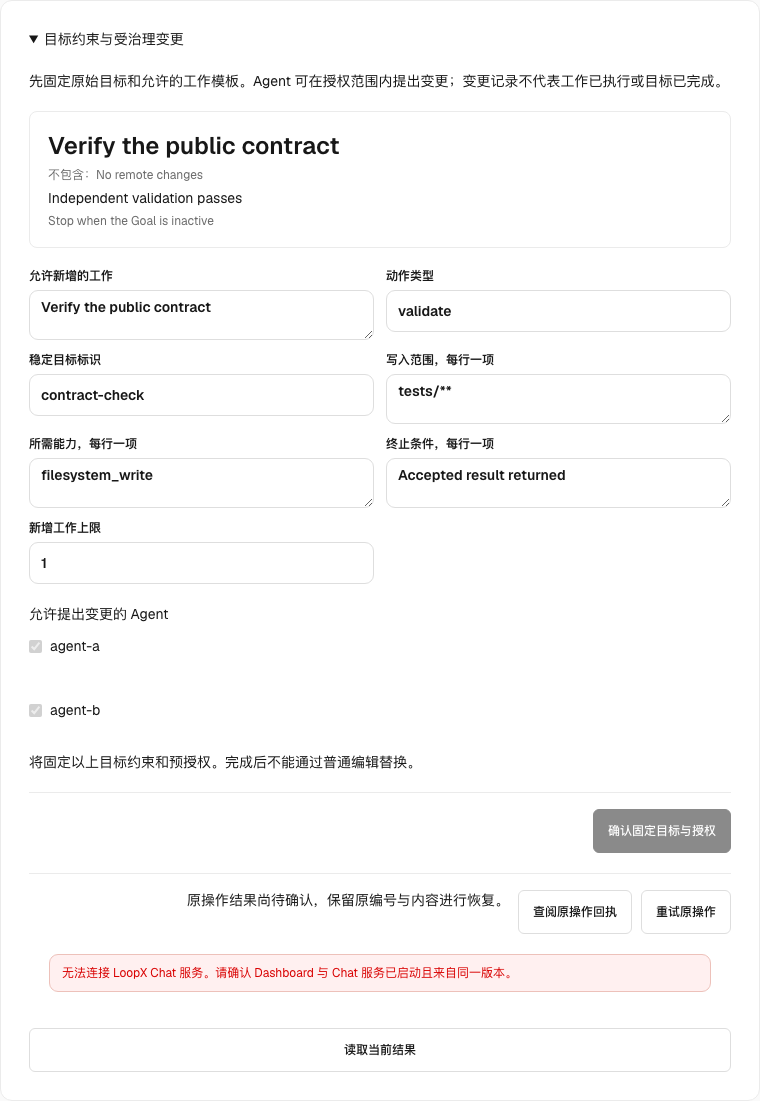
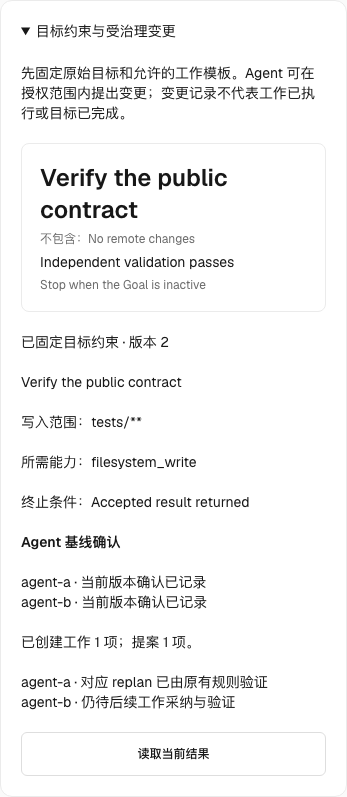
In the packaged workspace, select the Goal, open Goal settings → Task ownership → Goal commitments and governed changes, inspect the original objective/non-goals/acceptance/stop condition, fill the permitted work and permission/terminal envelope, review it and explicitly freeze it. The same operator HTTP route cannot impersonate a peer. Current readback lists actual peer basis acknowledgements and pending/settled replan observations. Saving a root or committing a Todo is not work execution or whole-Goal acceptance. Source metadata discovery works while generic status, chat execution and unqualified companion settings retain their existing refusal.
Synthetic examples from the packaged interface (not live Goal or model evidence):
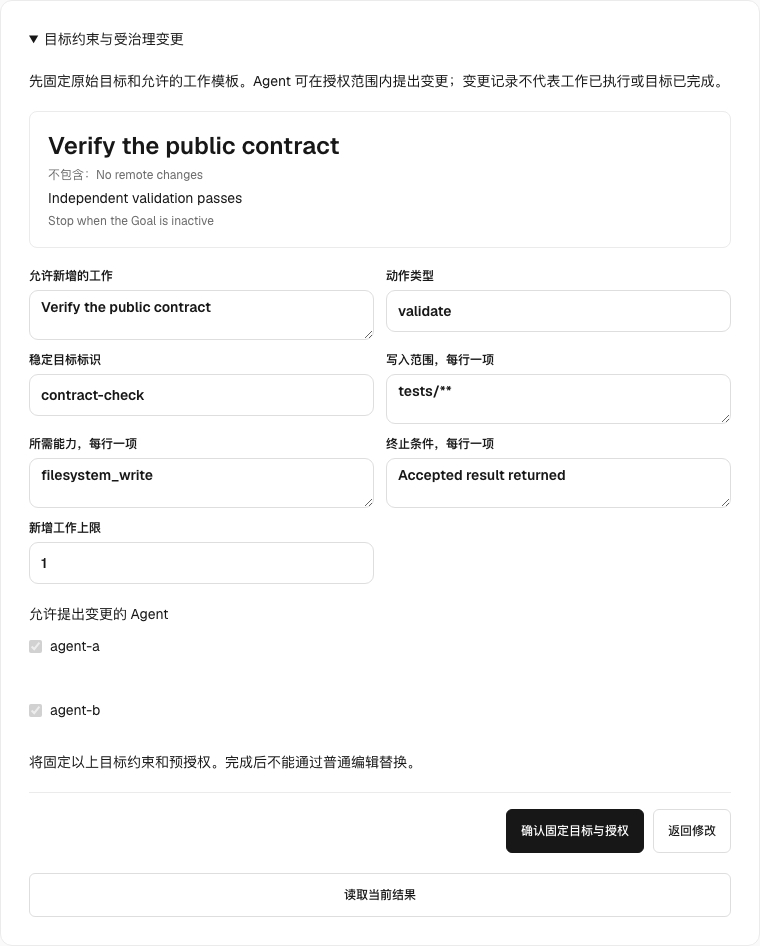
Unknown response and original-operation recovery · Current revision, peer adoption and replan readback on a narrow screen
The CLI uses the same owner; writes preview unless --execute is supplied:
loopx --registry REGISTRY --format json goal-amendment-proposal \
  --governed inspect --goal-id GOAL --goal-instance-id INSTANCE
loopx --registry REGISTRY --format json goal-amendment-proposal \
  --governed adopt --goal-id GOAL --goal-instance-id INSTANCE \
  --agent-id AGENT --operation-id ADOPTION --request-json basis.json --execute
basis.json contains base_goal_revision, base_intent_digest and
base_work_digest from the current inspect result. propose additionally
requires a fresh proposal_id, an authorized template_id, the exact current
replan_obligation_id and bounded evidence_refs (evidence:ID or
sha256:HEX; raw evidence remains in its owning store). It accepts no replacement
Todo text, permission, acceptance or request-derived source context. commit
takes only the retained proposal_id and proposal_digest. Each mutation uses
its own stable --operation-id; changed input under that id conflicts.
A successful commit creates unclaimed work and advances the Goal revision in
one CAS, preserving all prior Todos and leases. Peers must inspect and adopt the
new basis. claim takes that basis, todo_id, expected_provider_revision and
lease_request (the existing idempotency_key, expected_version, ttl_seconds
contract). The existing claim owner enforces hard leases. Once its causal binding
is recorded, reconfirming the claim or reacquiring an expired lease uses that
owner without reopening the settled replan obligation. Only the original
proposer's exact causal binding can satisfy its source-derived replan obligation;
another peer's claim cannot settle it. This is replan consumption, not terminal
acceptance of the created work. The original amendment receipt keeps its
historical pending adoption/settlement fields; current observations are separate.
For root/proposal/adoption/commit history, use --governed receipt with a JSON
request containing receipt_operation_id. Claim recovery stays with its
original claim operation/receipt. Retry the exact original mutation after a
lost reply, never a fresh operation. The UI retains the reviewed request across
reload and can read the original receipt or retry that same request. A missing
receipt is not proof of no commit; stale basis requires a new inspected preview.
The typed Goal owner supplies the operation outcome to both transports:
no_change is a successful no-op, while missing current authority cannot make
inspection or a mutation successful. Restore the original storage before retrying.
Validation covers native registration/CLI/HTTP with real File/SQLite, an existing peer lease, stale or retired lifetimes, source commitment preservation, semantic corruption, response loss, same-operation recovery and claim/replan isolation. The shared claim changes also require the isolated real PostgreSQL suite. Packaged browser evidence must distinguish this named settings journey from unavailable generic runtime reads. Lark, automatic Turn/Vision adoption, request-derived reservation/abort, protected or acceptance amendments and live model collaboration remain separately unqualified. Disabling the entrypoint stops new operations; retain historical readers and fences and use the existing lifecycle owner for forward retirement. Never remove committed intent to resume an old writer.
9.4 Local request-derived changes and cancellation recovery¶
The local candidate now connects §5.1 to the existing request and Goal owners.
It requires an exact source_session_v1 Goal, the configured local runtime,
existing canonical File/SQLite authority, frozen Goal intent/policy, and a
local private request addressed to a registered receiver. An independently
bound host execution or external source is not qualified by this profile.
No command below activates a Goal, launches a model, or grants more work scope.
The existing request entry retains its original message, brief and identity.
Its collaboration_request_control_v0 field owns ordered corrections, per-revision
read/assessment facts, one unresolved effect reservation and operation receipts.
request_control_contract.ts owns the bounded wire values shared by the Goal
owner and frontend. These are request-domain contracts, not additional entries
or proof claims in the original 26-vocabulary acceptance.
A goal_request_work_graph_amendment_v0 proposal carries an exact
source_request reference: request_id, request_revision, request_digest.
Before commit the request owner reserves the original operation with that
reference, receiver, proposal, Goal/work/intent basis and actual authority-source
identity. The Goal owner's existing work planner still decides the allowed delta.
Commit and source-authorized conditional abort compete for the same durable
operation receipt. A lost response remains unresolved until that receipt is read
and linked back to the request; an absent receipt or a fresh operation id does
not release the reservation. A definitive stale Goal basis records rejected
without changing Goal work. Current request state and the historical Goal outcome
are separate observations.
A correction may advance the request while the old reserved effect is unknown. The source entry attempts conditional abort after recording that correction. The old binding remains immutable; another effect cannot begin until its exact terminal receipt is linked. Cancellation before reservation closes admission. Cancellation after reservation remains pending; if commit already won, the result reports that committed Goal change and retains its created work. It does not claim rollback, cancel independent Goal work, or settle its execution or acceptance. Source/provider identity changes retain a recovery hold rather than writing an abort into another authority store.
Owner journey. Open the original private conversation's delegation details. Edit the brief or cancel the request there; Goal/receiver/source identities are already bound to the original message. Saving validates and writes in one user gesture. A failed current read clears current controls. Before dispatch, read back the complete retained request, including its route, operation, basis and content. If retention fails, keep the editable page draft and send no mutation; an in-memory value alone does not establish reload recovery. Unknown write responses retain that original request across reload; retry that exact operation. A typed stale-basis refusal reloads the latest revision for editing. Pending cancellation and committed/aborted/rejected outcomes remain distinct. Historical Goal instances remain read-only here; this is not restored-runtime authorization.
Receiver journey. manager-inbox read supplies the current brief, revision,
digest and source_request reference. Acknowledge with --request-revision N
--request-digest DIGEST, and report with --request-revision N. MCP
assess_request and return_result accept the same explicit revision fields.
An omitted revision continues to name original revision 1; late original results
remain appendable without satisfying a newer request. A new revision's first
conclusion uses the existing immutable result-update chain automatically.
For a conversation return, --phase decision retains one immutable interim
update per revision. An older conclusion cannot suppress a newer revision's
interim update; an available conclusion for that same revision supersedes its
unsent interim update. Original decision/result records remain unchanged.
Returned peer and conversation results identify their source revision.
Use the existing governed proposal fields plus source_request when proposing
this request's fixed-template work. Commit with the retained proposal_id,
proposal_digest, source_request and stable --operation-id; the adapter
reserves and links through the real owners. Removing source context from a
request-derived proposal does not make its commit independent.
The original requester can inspect, revise, cancel or recover through:
loopx --registry REGISTRY --runtime-root RUNTIME --format json manager-inbox control \
  --goal-id GOAL --goal-instance-id INSTANCE --agent-id REQUESTER \
  --peer-agent-id RECEIVER --request-id REQUEST --control-operation inspect
For revise/cancel, supply --operation-id and --control-file containing
expected_revision, expected_digest, reason, and (for revise) the complete
brief; use --execute to write. Omit --agent-id only for the authenticated
original local conversation owner. recover --execute reads the original
terminal receipt and may conditionally abort an already cancelled or superseded reservation;
it never reassigns an unknown effect. The bound peer MCP control_peer_request
uses the same source owner. Browser writes cannot impersonate a receiver/peer.
Limits: eight request revisions, sixteen effect reservations, sixty-four request operation receipts and the existing 128,000-byte entry read boundary. Admission reserves space for a maximum legal cancellation and terminal linkage, including JSON escaping; oversized new work is refused before persistence. Replays do not consume additional capacity. Source text and artifacts keep their existing owners and limits; there is no new automatic private-locator service.
Validation combines actual source registration, request IO, canonical File/SQLite transactions, independent CLI/MCP consumers, original-conversation HTTP and packaged UI; shared Goal transactions also require isolated real PostgreSQL. Synthetic source progress observations are not model behavior. General request reassignment, arbitrary host effects, live Lark/model qualification, restored writer activation and whole M2/G1 acceptance remain unqualified. Existing Lark tracking consumes the same revision/control facts with its audience filtering; no live transport send is inferred from readback tests.
Before use, the code can be reverted. After control/proposal records exist, stop new admission and retain readers, original request/Goal receipts and fences. Do not erase the control field or roll back only one side to make work eligible. Restoration and a wider runtime/profile rollout retain their existing ownership and qualification gates.
10. Staged delivery¶
- Stage 0 — characterization and RFC. Record own-lane, unclaimed, peer-claimed, replan, concurrent proposal, and in-flight lease scenarios.
- Stage 1 — read-only alignment. Add
shared_goal_alignment_v0with canonical revision binding, per-Agent frontier basis, unclaimed work, and drift/conflict facts. An optional Decision Context extension may pair an exact host-session scope with bounded advisory recall. No writer changes. - Stage 2 — proposal only. Validate and retain
goal_amendment_proposal_v0; proposals have no canonical effect. - Stage 3 — one bounded commit class. Implement governed commit for a shared work-graph amendment that preserves root intent, including automated policy commit, CAS, receipt, replan settlement, and lease impact handling.
- Stage 4 — provider-neutral shadow/parity. Map the reviewed transaction to the file reference provider and optional NoKV/PostgreSQL candidates; compare projections and recovery without changing default authority.
- Stage 5 — TEST ONLY shared canary. Exercise two peers, concurrent proposals, unclaimed claim, response-loss recovery, stale bases, and protected changes before any authority-source promotion.
Acceptance and operational-objective commits are not the first runtime slice. They require demonstrated need and a separately reviewed automated policy and verifier contract. Permission expansion or escape from root intent cannot be auto-committed unless Goal creation explicitly delegated that exact class.
The proposed current operating objective
slice addresses stale source declarations through explicit owner apply and
independent peer adoption. It does not enable automated root-intent, acceptance
or permission amendments. The existing immutable work-template intent and
its revision keep their meaning; the operating-objective history has its own
versioned contract, and old intent_basis receipts are not upgraded in place.
11. Validation matrix¶
At minimum, tests must prove:
- a work switch, compaction, restart or handoff preserves declared requirement identities and coverage;
- a late acceptance clause remains available through exact detail, without substituting another Todo or a stale display;
- dropped or rewritten criteria require an authorized amendment; a missing, irrelevant or stale evidence reference cannot satisfy acceptance;
- local completion with another Agent's outstanding requirement cannot settle the whole Goal;
- own-lane replan cannot change canonical intent;
- unclaimed work is visible but cannot execute before claim/lease;
- a pending proposal does not affect unrelated peers;
- policy and verifier decisions are bound to the exact proposal digest;
- two conflicting proposals from one base yield at most one canonical commit;
- stale revision/digest commits fail closed;
- response-loss recovery returns the original receipt;
- protected changes cannot be committed by proposer, scheduler, lease holder, verifier, or provider operator identity alone;
- routine in-envelope amendments complete without human approval, while an out-of-policy proposal never silently expands authority;
- in-flight leased work receives an explicit disposition; and
- all Agent projections rotate or gate after a canonical revision changes;
- a host-task locator resolves only through the current project binding and grants no claim, lease, lifecycle, verifier, or amendment authority;
- disabling or removing the advisory provider does not block authority-source collection, while amendment submission still independently requires the current Goal revision and intent digest.
Existing Goal-amendment and authority-store conformance tests remain the owners of durable proposal, receipt recovery, and cross-Goal commit isolation. The optional locator/provider tests must not duplicate those state-machine suites.
12. Non-goals¶
This version does not define automatic voting or consensus, CRDT/offline multi-writer merge, an omniscient planner, a permanent leader, direct Agent writes to storage providers, broad migration of LoopX state, or autonomous escape from the immutable root user intent. Human approval is not a required step in the normal amendment lifecycle. Host-session locators, deep links, and transcripts are also not part of the Goal aggregate or a durable evidence store.
The smallest useful outcome is a legible, read-only alignment projection and a proposal that is visibly non-authoritative. Runtime commit follows only after that boundary proves useful in real multi-Agent work.
Appendix A: Execution ledger¶
Dated checkpoints for this RFC live in the per-entry ledger, one file per measured slice. Sections 1–12 above stay the normative contract; a ledger entry records what shipped and what it did not establish without changing that contract.