Managed steward monitoring and periodic reports
Status: source-bound identity preparation, opt-in status monitoring, the original steward's periodic full-body reports and explicitly configured local Agent Session calendar reports are implemented. Installation, an enabled subscription and a natural scheduled delivery require their own readback evidence. Preparing an identity enables neither monitoring nor reports.
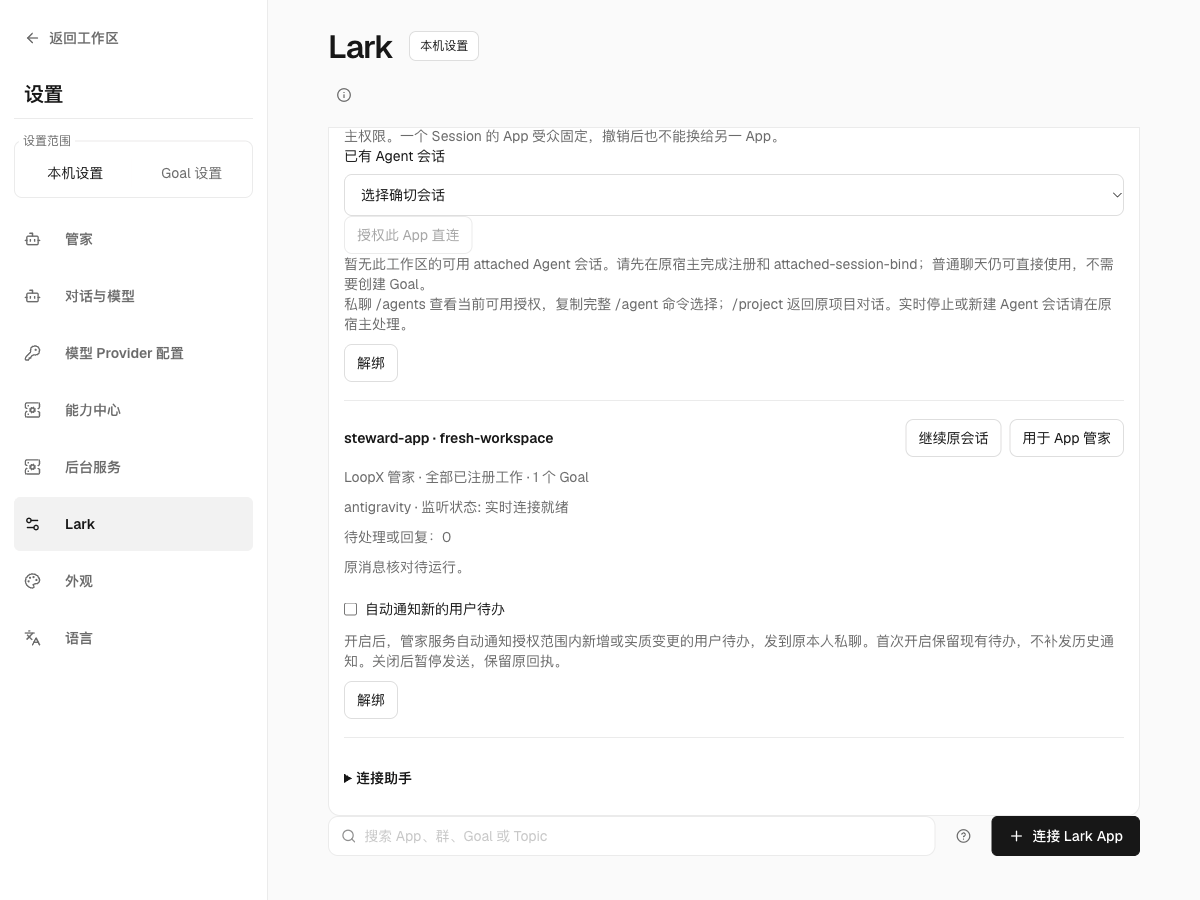
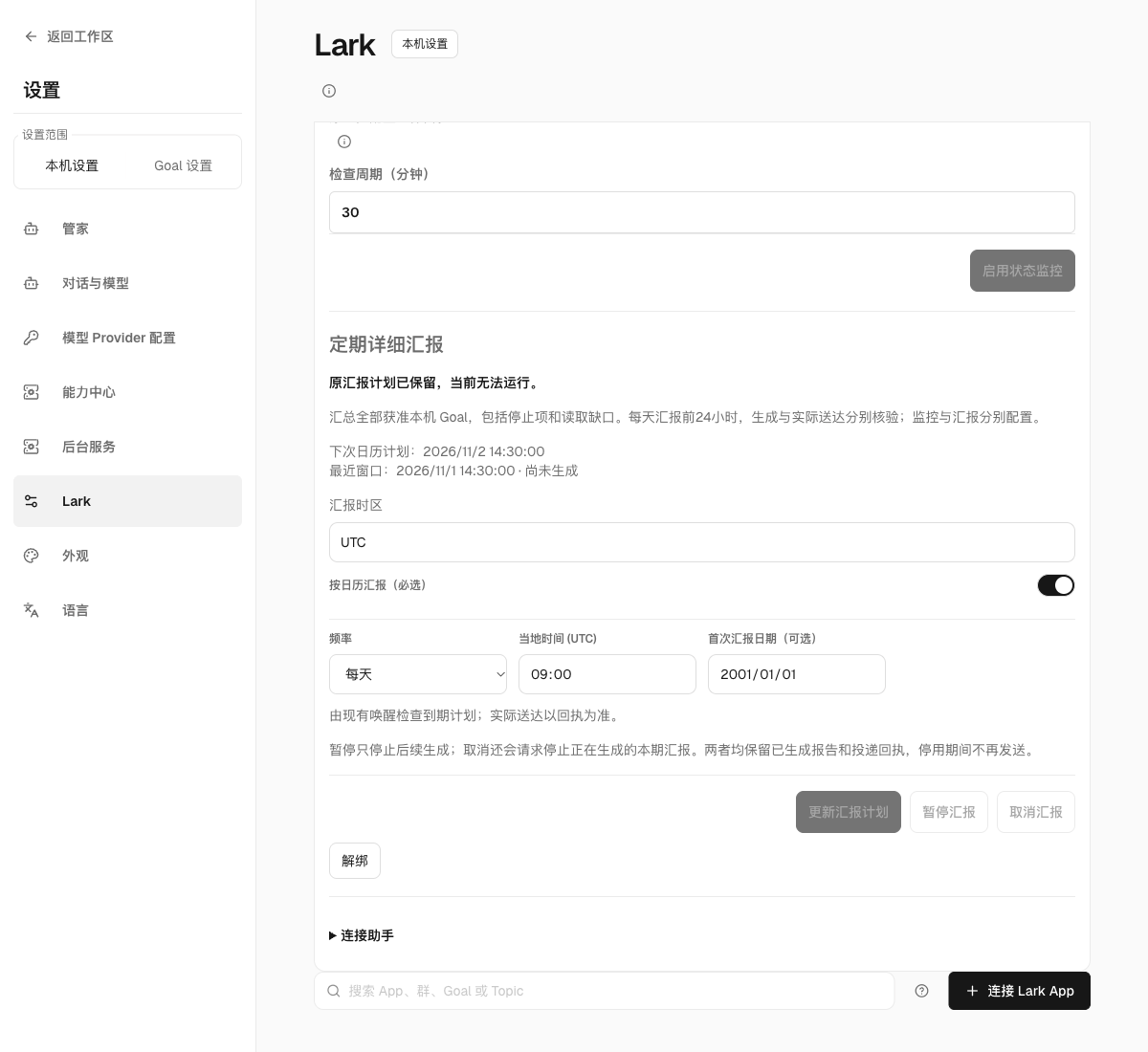
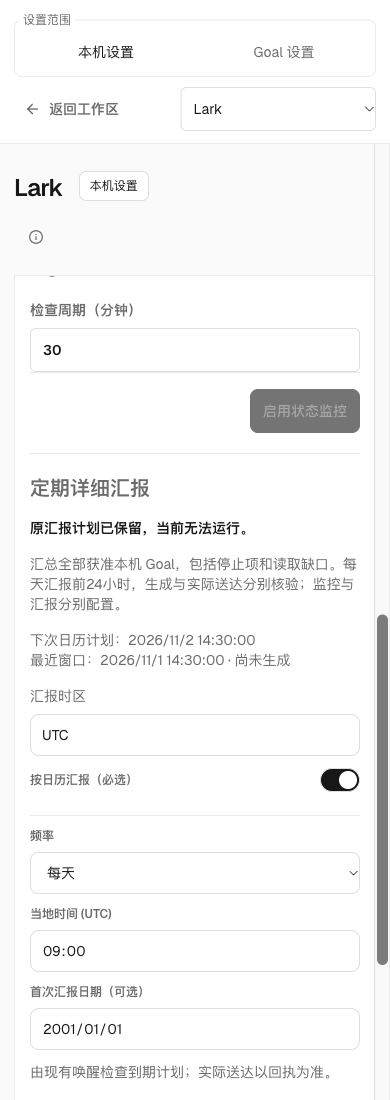
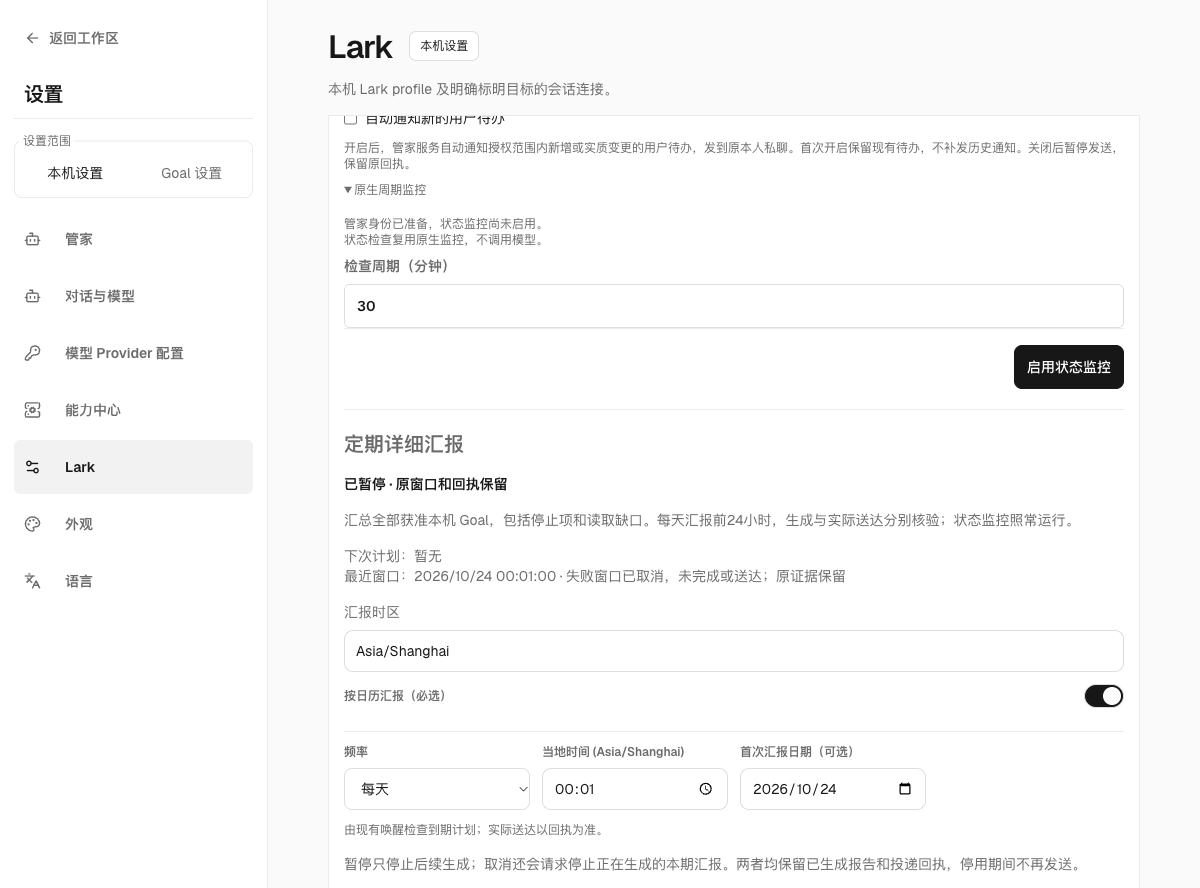
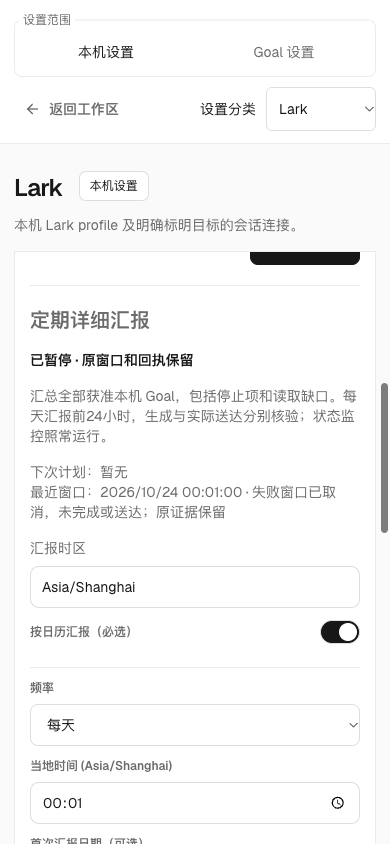
Changing a previously prepared private steward to an executor without native scheduled-work support keeps its original configuration readable in connection settings. The monitor deadline, report schedule, retained window and delivery state remain visible with an explicit execution-unavailable notice. Configuration controls are disabled; inspecting retained state neither re-enables the old host nor retries a failed window. Native admission still owns every execution and configuration change. Restoring a supported executor restores the existing configuration view rather than creating a replacement identity or subscription.
The disposable steward_report_fixture.py --retained-executor journey prepares
one original synthetic steward and calendar window. With baseline assets the
section is absent; current packaged assets expose the retained state at 1200
and 390 pixels. Its restore-supported-executor control restores the same
configuration. No wake owner is started, no model Turn is requested and no
provider write is added during inspection or restoration. This qualifies UI
readback and executor compatibility, not scheduled generation or live delivery.
| Baseline: retained section hidden | Current: original schedule remains readable |
|---|---|
 |
 |
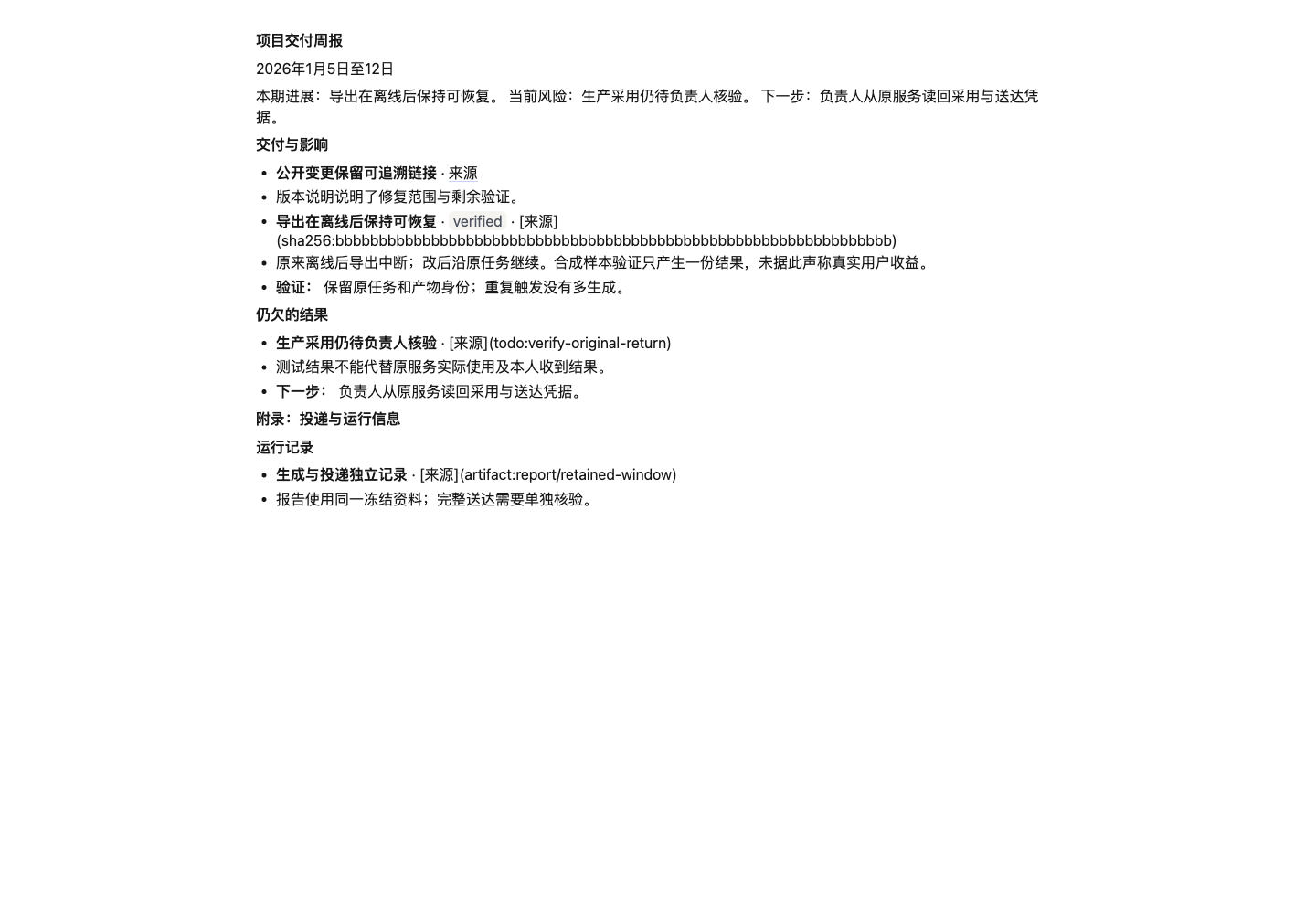
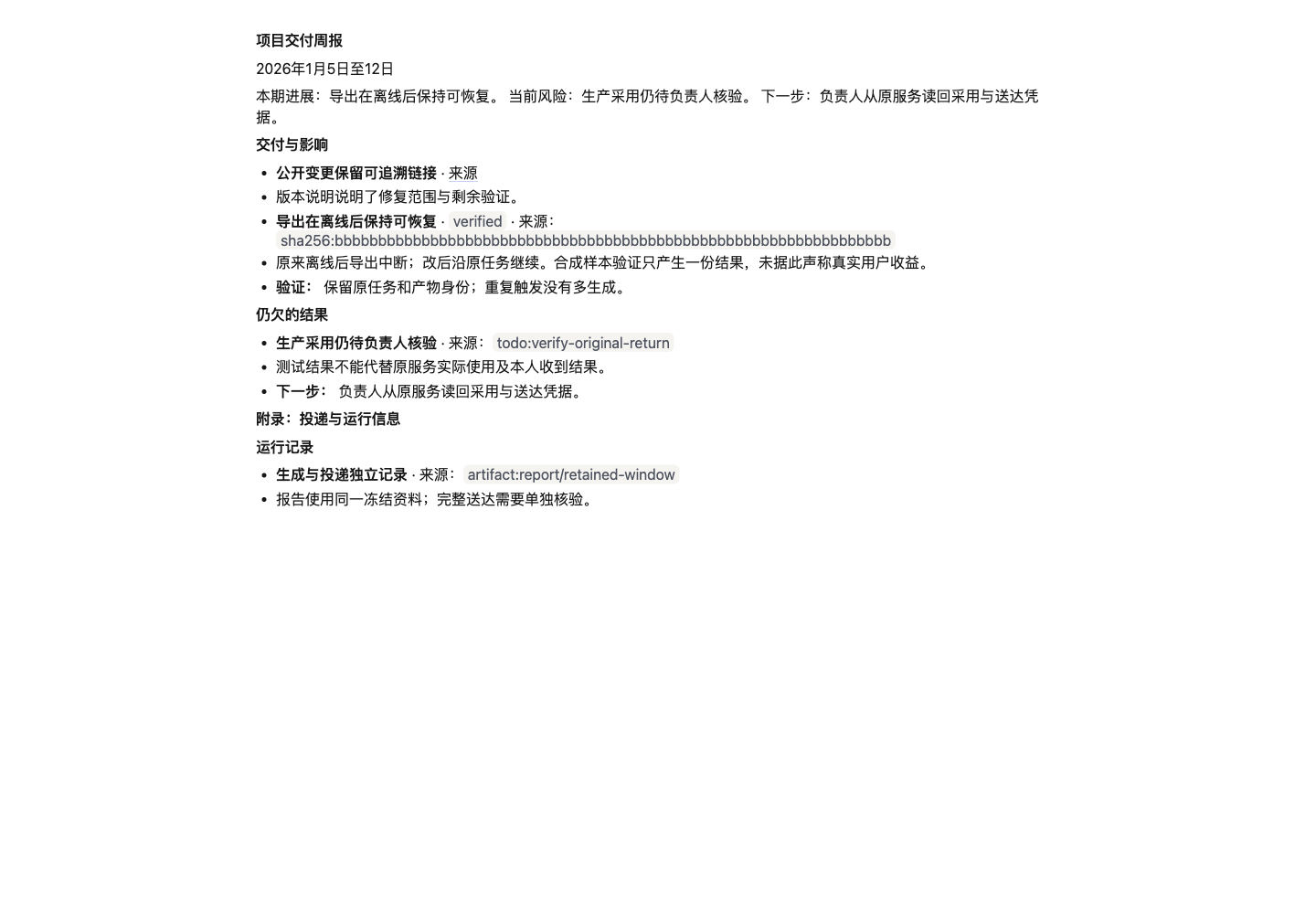
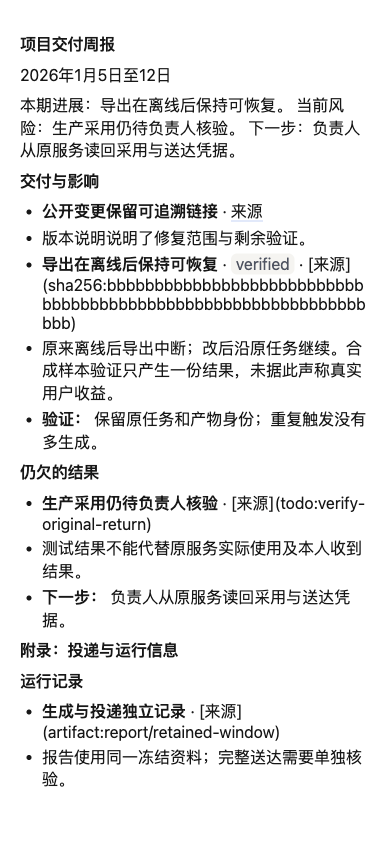
Markdown, the HTML report and its copied full text use the same source-link rule. An unchanged, well-formed HTTP(S) address is a link. Opaque evidence digests, native Task/artifact references and private relative paths stay source references; they are never presented as working web links. Malformed addresses, credentials in an address, control characters and non-web schemes remain inert. Markdown escapes destination punctuation without inventing a different source. This is presentation validation, not a claim that a URL is reachable, public or authorized for another audience. Source collection, frozen evidence, redaction and delivery authorization retain those responsibilities.
Exact authorized portfolio delivery reads retain eligible references recorded in the original Turn's path evidence, alongside their digest identities. New private portfolio inputs bind those references to the same frozen source and make them available to the report author as recorded, unverified citations. Local paths, credential-bearing and malformed reference values remain withheld; the source reader never fetches a URL. A recorded address proves neither public access nor permission to publish to a different audience. The original scope, source gaps and unread-artifact status remain authoritative; an opaque digest does not supply a missing URL. Existing v1 frozen inputs retain their original fact set and bytes. New ordinary managed Session inputs use the same frozen citation format for a native Task whose evidence field is one eligible HTTP(S) reference. The original Task reference and complete source remain available; the address is explicitly unread and unverified. Prose, notes and compound evidence strings are not searched for links. This adds no source read, fetch, publication route or audience, and existing local v1 windows remain unchanged.
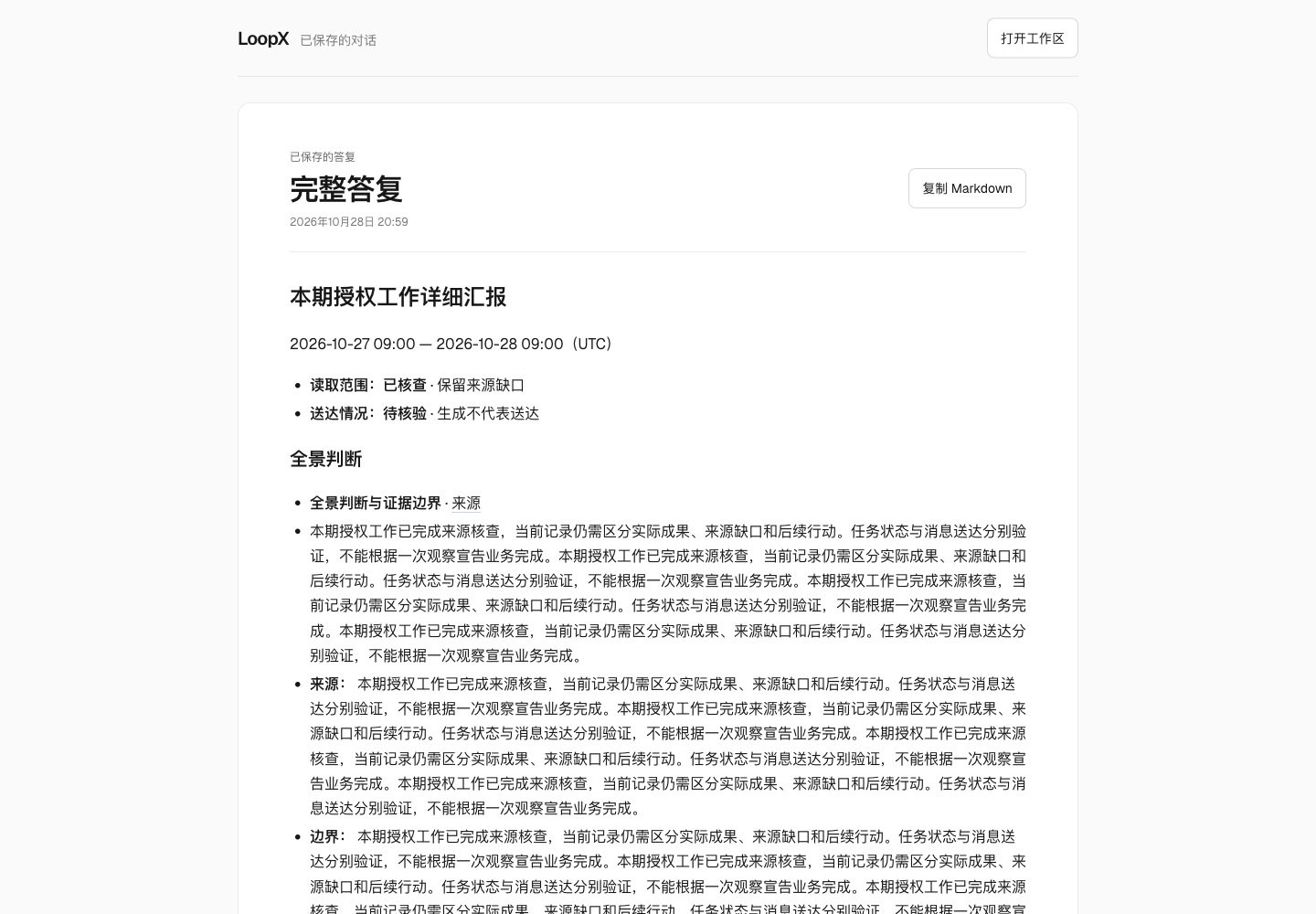
The packaged local-Session journey below uses a disposable SQLite backend and synthetic model response: normal configuration preview/apply, one native report Turn, its complete original conversation return, then the existing answer reader. The six source links retain the recorded Task address in both formats. The fixed synthetic prose qualifies transport and reading mechanics, not live editorial quality or the address's availability. No layout or editor changed.
New portfolio and local-Session editorial requests share the same time and
content requirements. A Task completed after the period end remains a later
state observation; only timestamped evidence inside [start, end) supports
period progress. Older history, later changes, unknown times and unavailable
views remain distinct. The author is asked to retain concrete outcomes,
quantified comparisons, counterevidence and the responsible owner's next
action, while stating shared limitations once. These are authoring requirements,
not a semantic validator or proof of model compliance. Existing frozen requests
and reports retain their original requirements and bytes.
The public browser fixture also keeps the original private outbound owner running through its periodic source-history check. Its shared synthetic provider returns the stored messages with source-bound pagination and time windows; it does not replace history with an empty successful response. The observation includes worker liveness, history-page count and ingress coverage so a background exception cannot be mistaken for a completed journey. File and SQLite regressions retain all 55 synthetic uncaptured sources without admitting or replying to them. These qualify test mechanics; live delivery, account switching and an unknown-effect failed production window remain separate.
| Packaged answer reader | Narrow answer reader |
|---|---|
 |
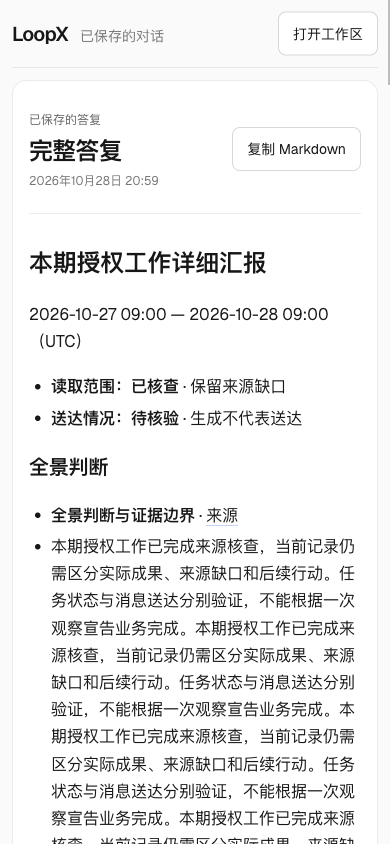 |
Text reports include the same authored overview values, labels and details as the HTML artifact. When that overview is present, it replaces the generated title-only opening; reports without highlights retain their compiled summary. This exposes existing editorial content, not an independent verification of it.
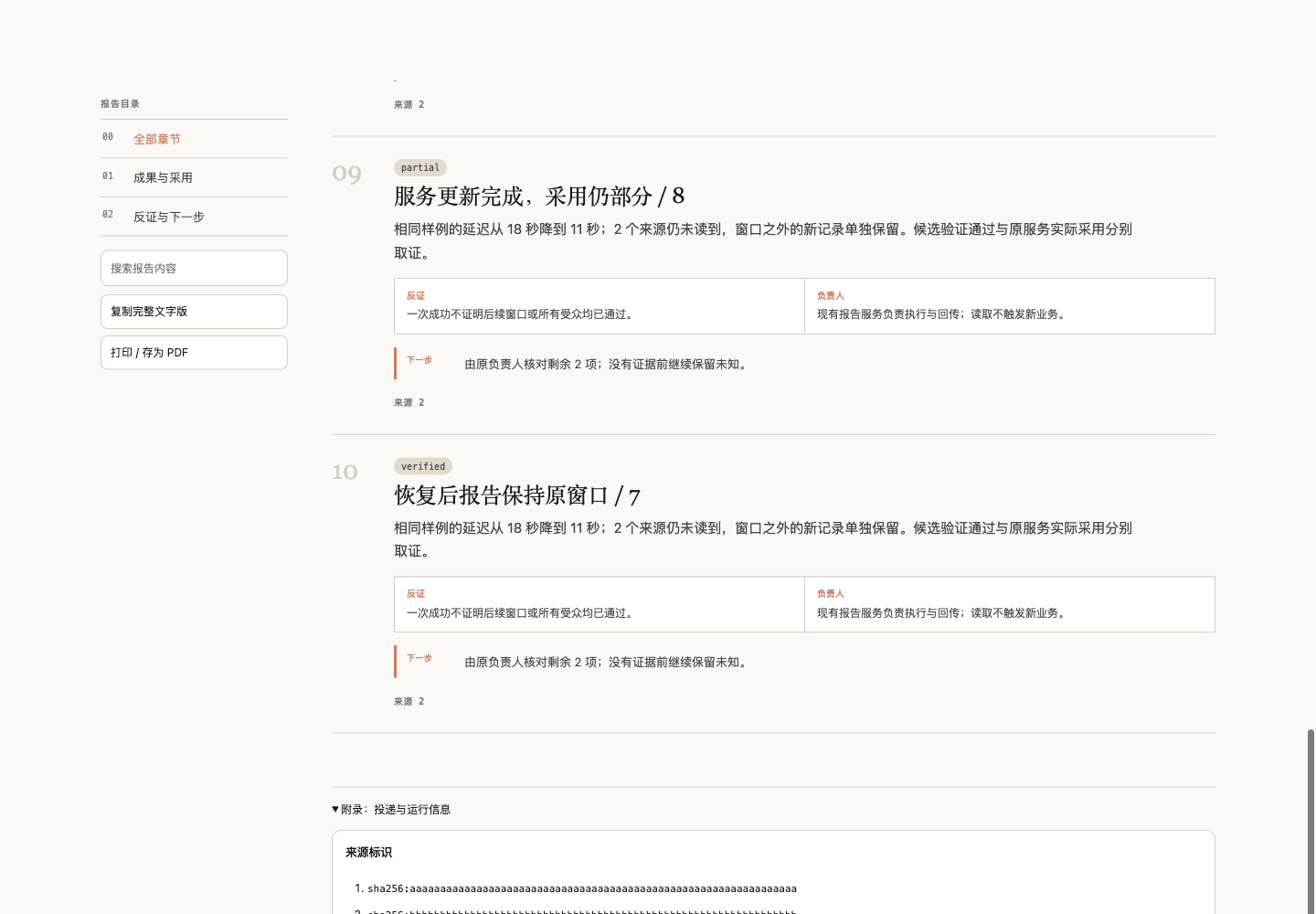
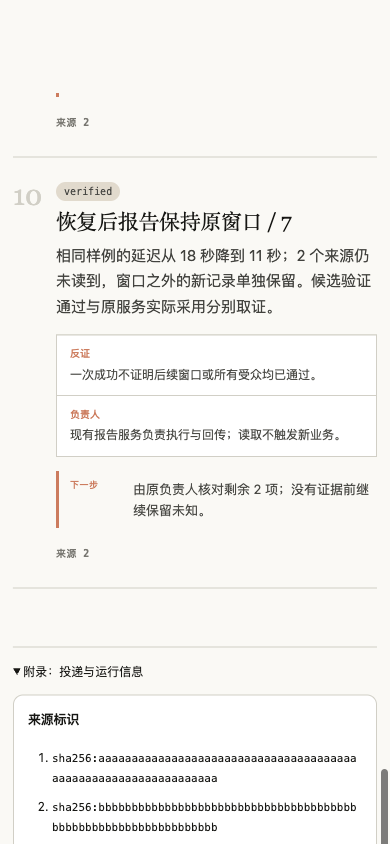
Opaque source references receive stable numbers in document order. Repeated references share one exact, redacted entry in Source references, including sources used only by supporting items. Web addresses keep their existing links. Markdown retains the index in its full linear body. HTML opens its existing appendix when a source number is followed and moves keyboard focus to the reference; reopening the fragment restores it. Printing includes the full index and restores the prior disclosure state afterward. No lookup, upload or new source authority is introduced.
An already frozen report retains its original bytes and generation identity. Validation can reconstruct the exact previous inline-reference and source-link presentations without rewriting its artifacts, invoking generation or acknowledging publication. The full frozen source, authored response, bundle, candidate and body must still match; an unsupported or altered presentation remains unavailable. New reports always use the shared source-link rule above.
A report refused because its model allowance was exhausted can receive one new, correlated Turn when the original host independently reads a stable native failure containing only its original user input and observes usable allowance for the current authentication. A reset time or successful authentication RPC alone does not qualify. The shared typed conversation owner also checks the original failed kernel receipt, unchanged actor, subscription, window and Task, and the absence of any authored response, generation or delivery attempt. The original Chat Turn and failed kernel journal remain unchanged. The new Turn uses ordinary admission, lease, quota, validation and original-route publication; user work retains priority. A second failure is retained, never chained into another automatic attempt. Unknown effects, unavailable native metadata, revocation, cancellation and an unavailable allowance retain the existing hold. The admitted continuation refreshes only its own native adapter to reload current authentication while retaining its native thread. This applies to original steward reports and ordinary managed Session reports; authentication selection and unrelated clients retain their existing owners.
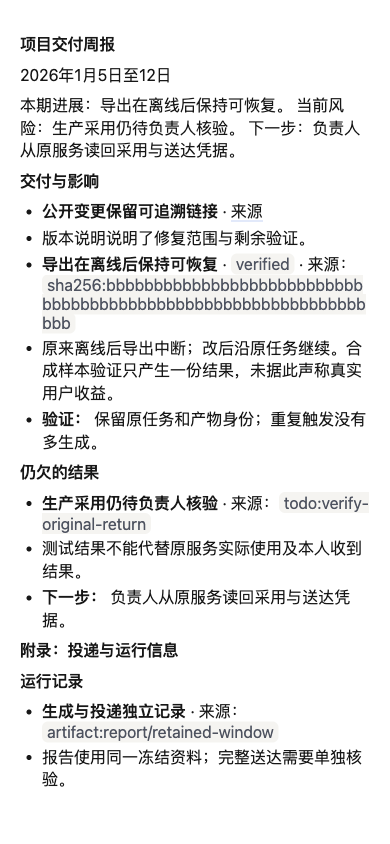
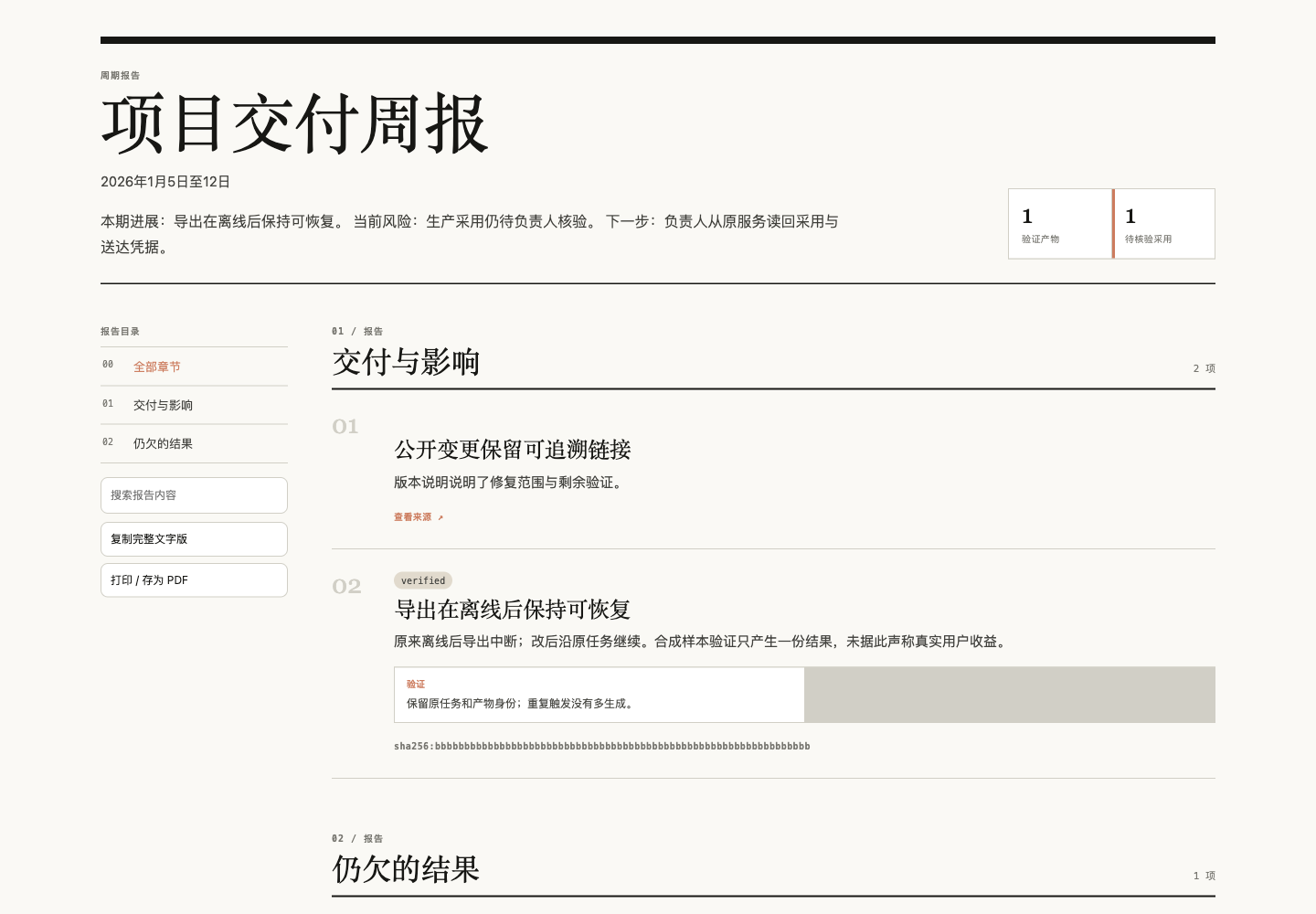
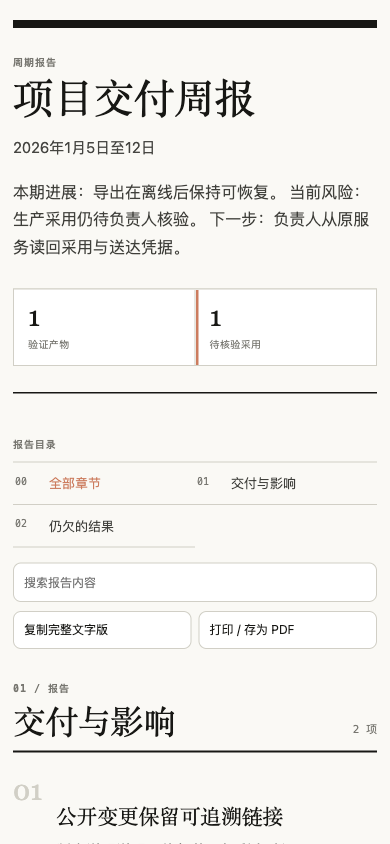
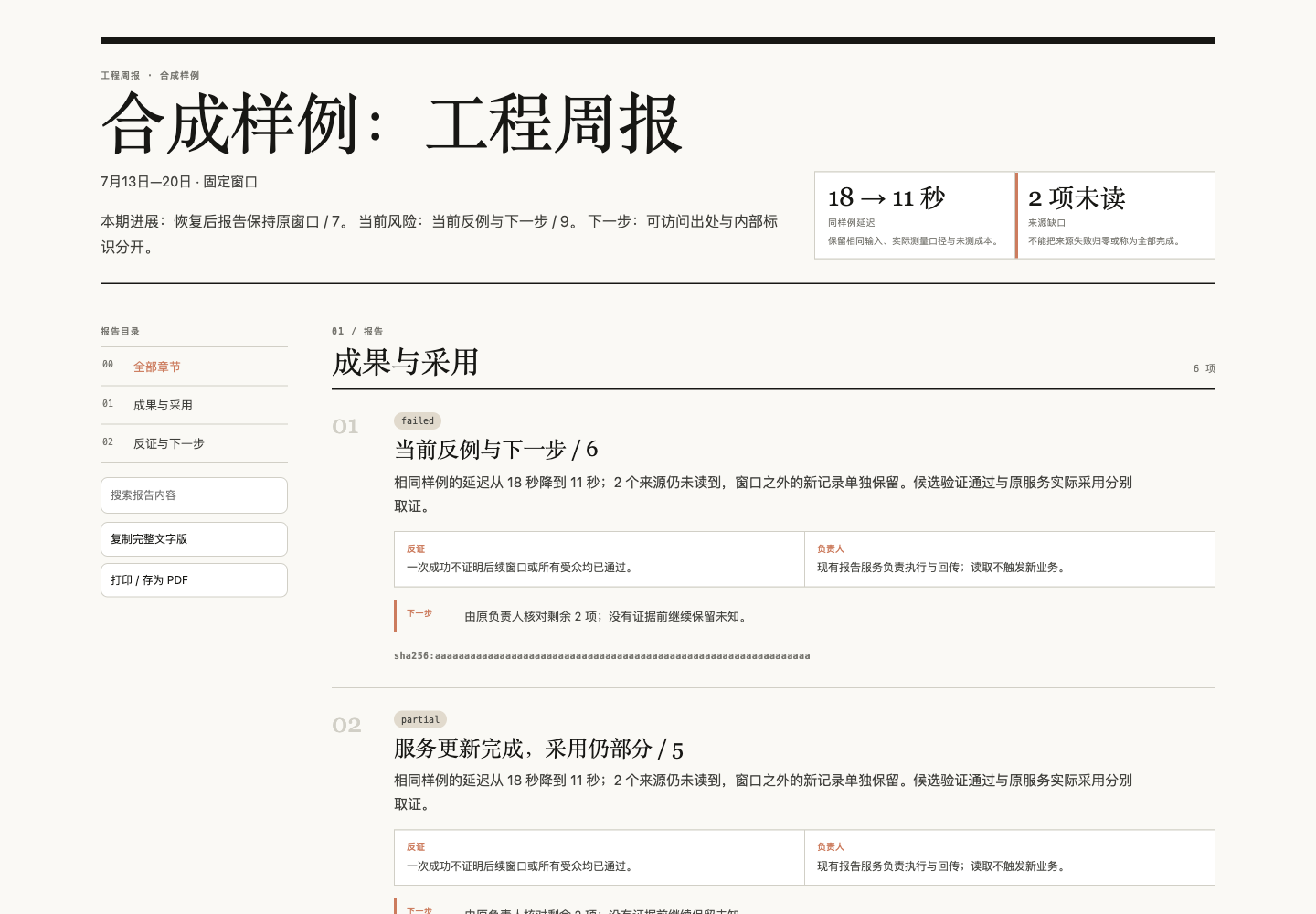
The following synthetic reports use the production formatters. Text views use the compiled App Markdown component and its stylesheet; HTML views use the standalone report artifact. The same normalized records retain their outcomes, counterevidence, next actions and source identities. These captures qualify format rendering, separately from the full packaged App, installed scheduling, live-model content and provider delivery. Desktop is 1440×1000; narrow views are 390×844 viewport emulations.
| Text report before | Text report after |
|---|---|
 |
 |
| Narrow text before | Narrow text after |
|---|---|
 |
 |
| HTML report | Narrow HTML report |
|---|---|
 |
 |
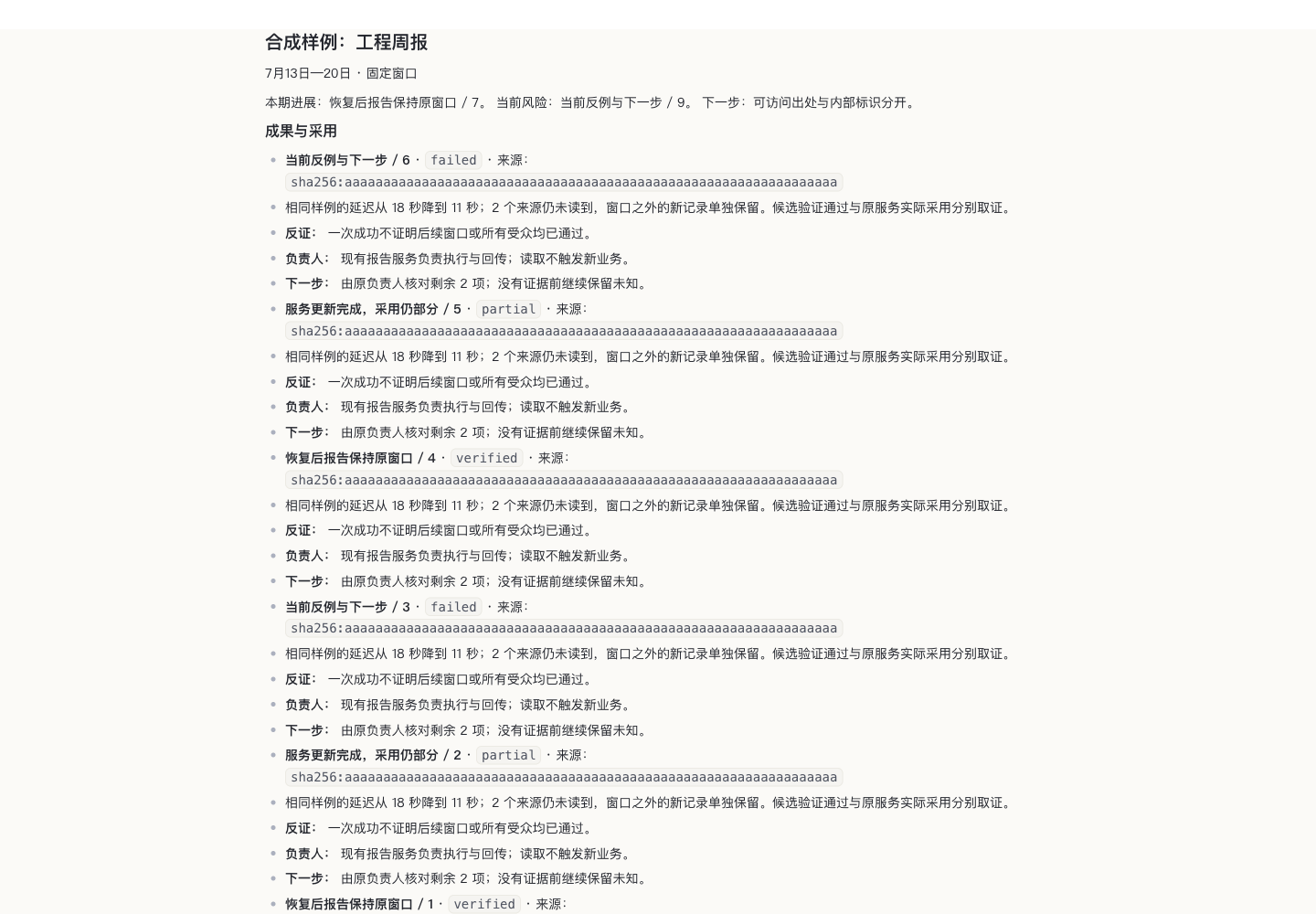
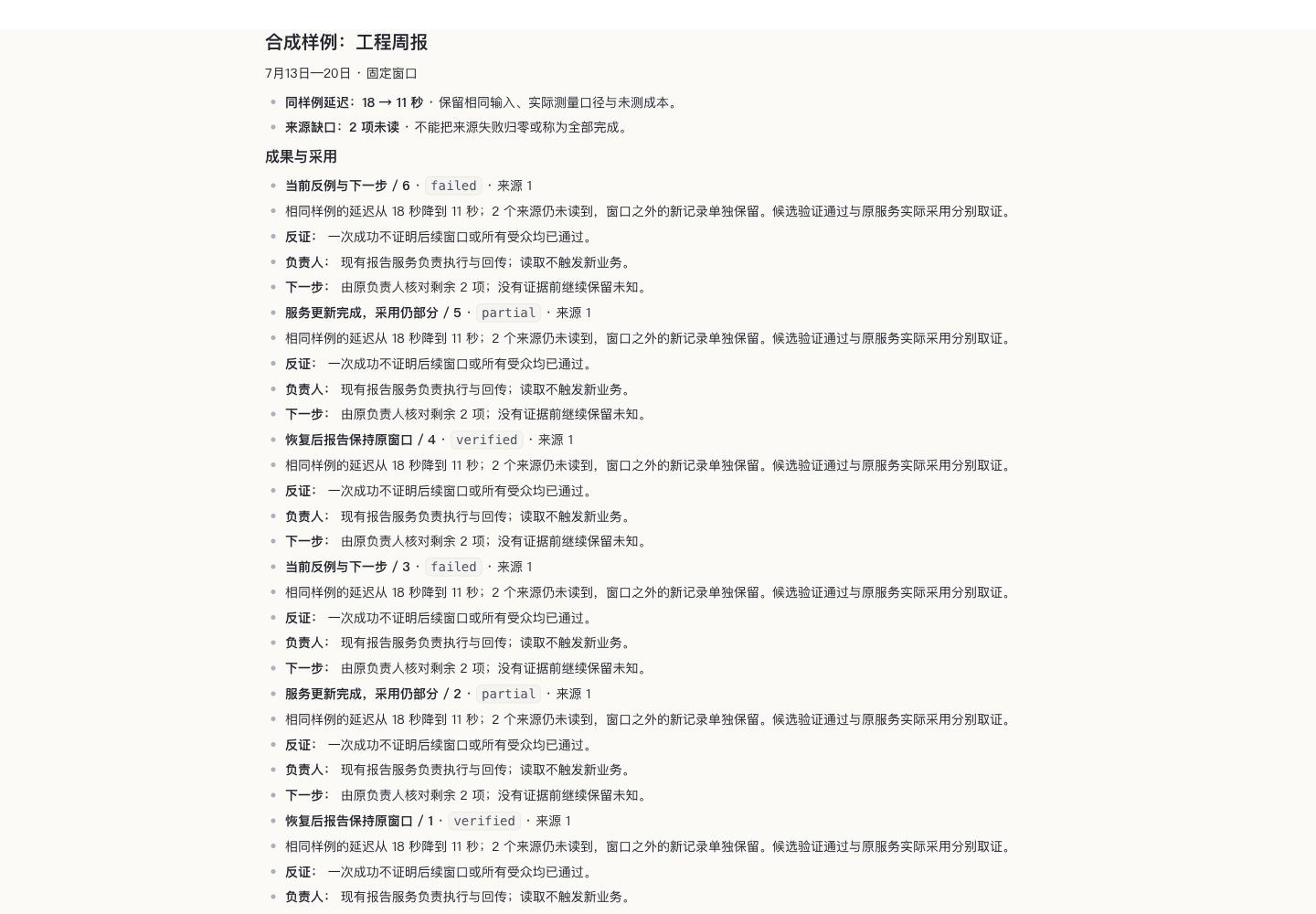
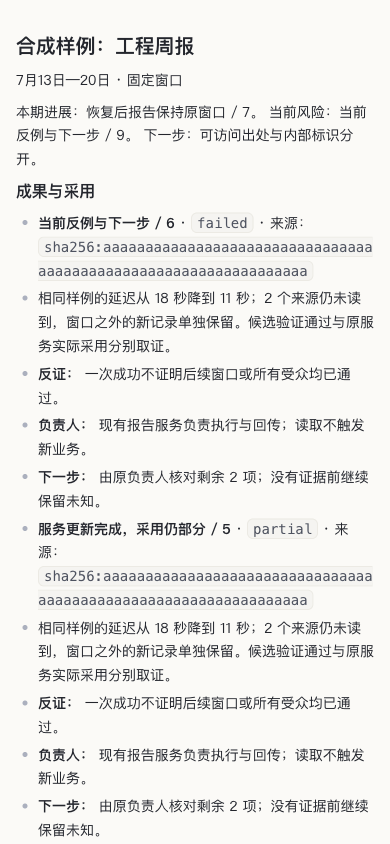
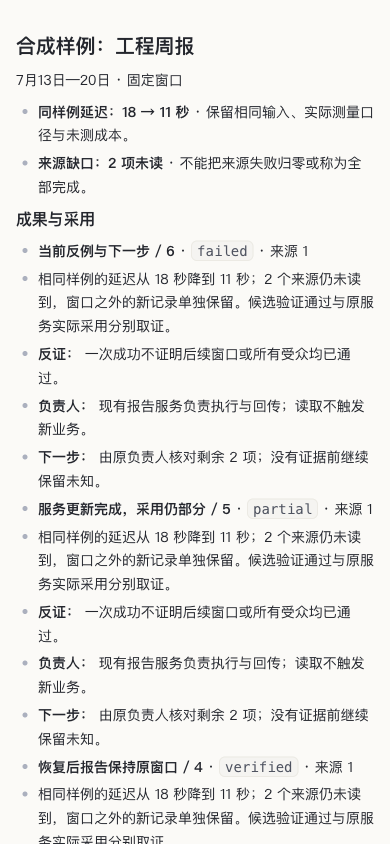
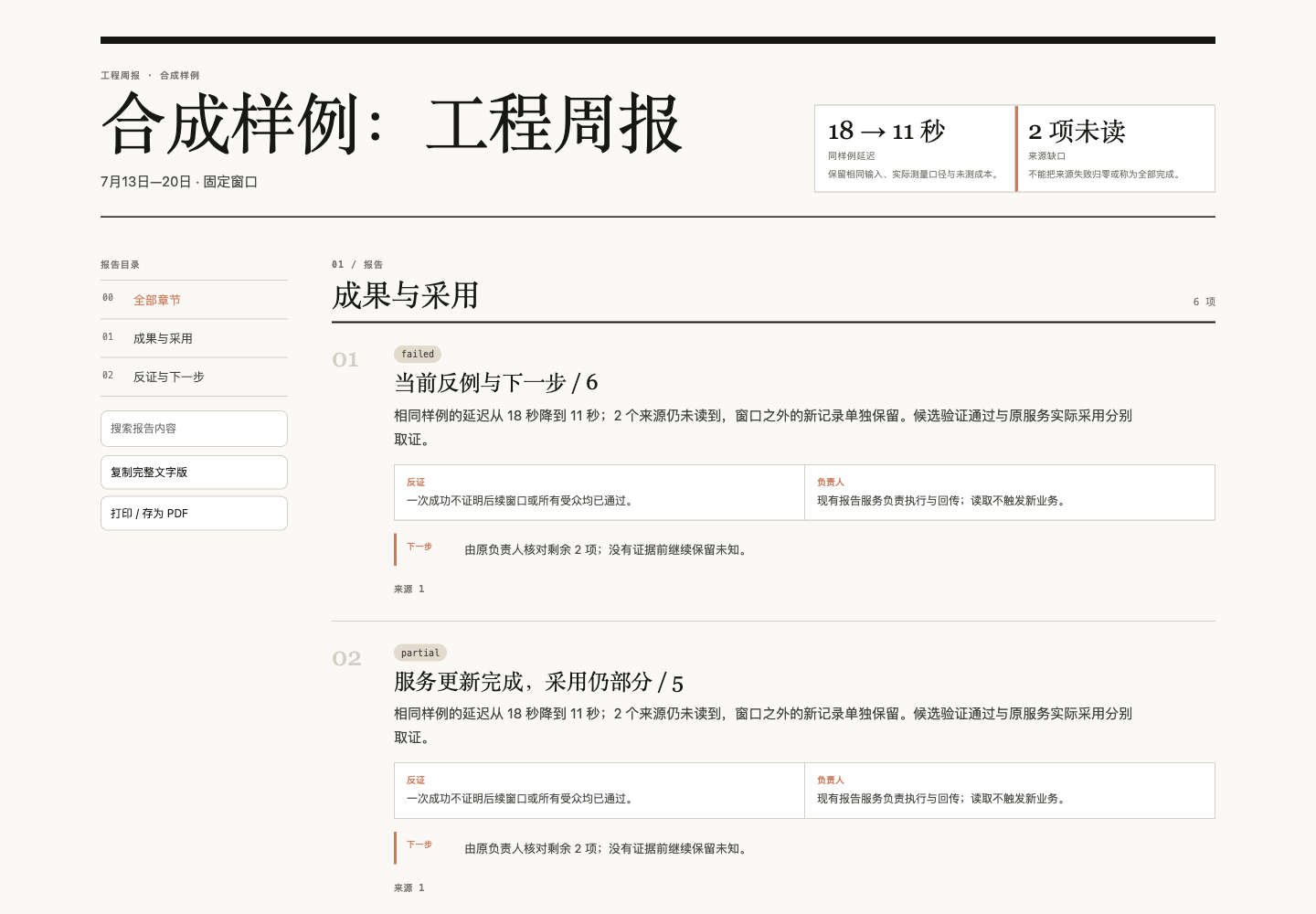
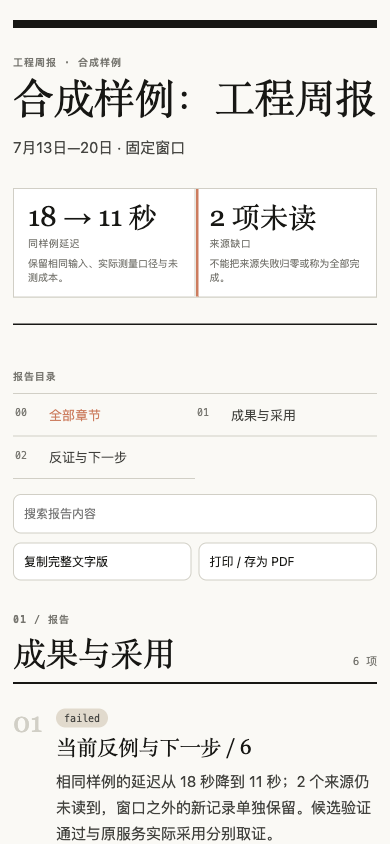
The following same-input synthetic report contains ten substantive items and two repeated internal source identities. The text overview now retains its authored numbers and source gaps; nine inline digests become two indexed references. The text changes from 2,875 to 2,420 characters while preserving every item title, summary, detail and next action. This is a fixture result, not a token-cost or live-report quality measurement. The expanded HTML index also stays within a 390-pixel viewport; its exact references were read back from the browser's printed PDF. The same frozen pre-change Markdown/HTML artifacts remain byte-identical under read-only reconstruction.
| Text before | Text after |
|---|---|
 |
 |
| Narrow text before | Narrow text after |
|---|---|
 |
 |
| HTML before | HTML after |
|---|---|
 |
 |
| Narrow HTML | Expanded source index | Narrow expanded source index |
|---|---|---|
 |
 |
 |
The same local calendar can explicitly repeat an already completed native Task in its original managed Session. This backend/configuration slice is described below; arbitrary new tasks from natural language and the unified Agent UI remain separate, unfinished acceptance.
Calendar changes use the existing Goal configuration transaction. If a pause, schedule change or clear was written but its readback is unavailable or differs, the response retains the partial-write receipt instead of claiming that the old configuration was preserved. Reload the source configuration before deciding on another change. This does not rerun the task, confirm an unfinished result or retire a failed window; those remain with their original lifecycle owners.
The steward becomes a persistent LoopX-managed Agent. Its original private conversation remains the user's entry point. Native monitor Todos, Turn admission, scheduling and periodic-report publication own recurring work.
Lifecycle owners
The current components already provide most of the lifecycle:
control_plane/scheduler/monitor_todo.pyand the typed scheduler project due monitor work and the next deadline.control_plane/turn_driver/provides registered Goal/Agent admission, single executor ownership, recovery, settlement and quota lineage.capabilities/periodic_report/cadence.py,cadence_journal.pyandcadence_runtime.pyevaluate calendar windows, retain a pending reporter and expose due report intents at Turn start.- Native external-conversation admission and the existing Lark reply journal retain original requests, audience identity and delivery evidence.
The private steward retains the special loopx-manager conversation identity;
preparation adds the separate registered execution Goal/Agent described below.
The original project-Goal Chat endpoint still rejects this private steward.
Its source-bound native host bridge supplies monitoring admission. A report
Turn-start hook alone does not independently wake a sleeping actor, so calendar
calculation does not enable a report.
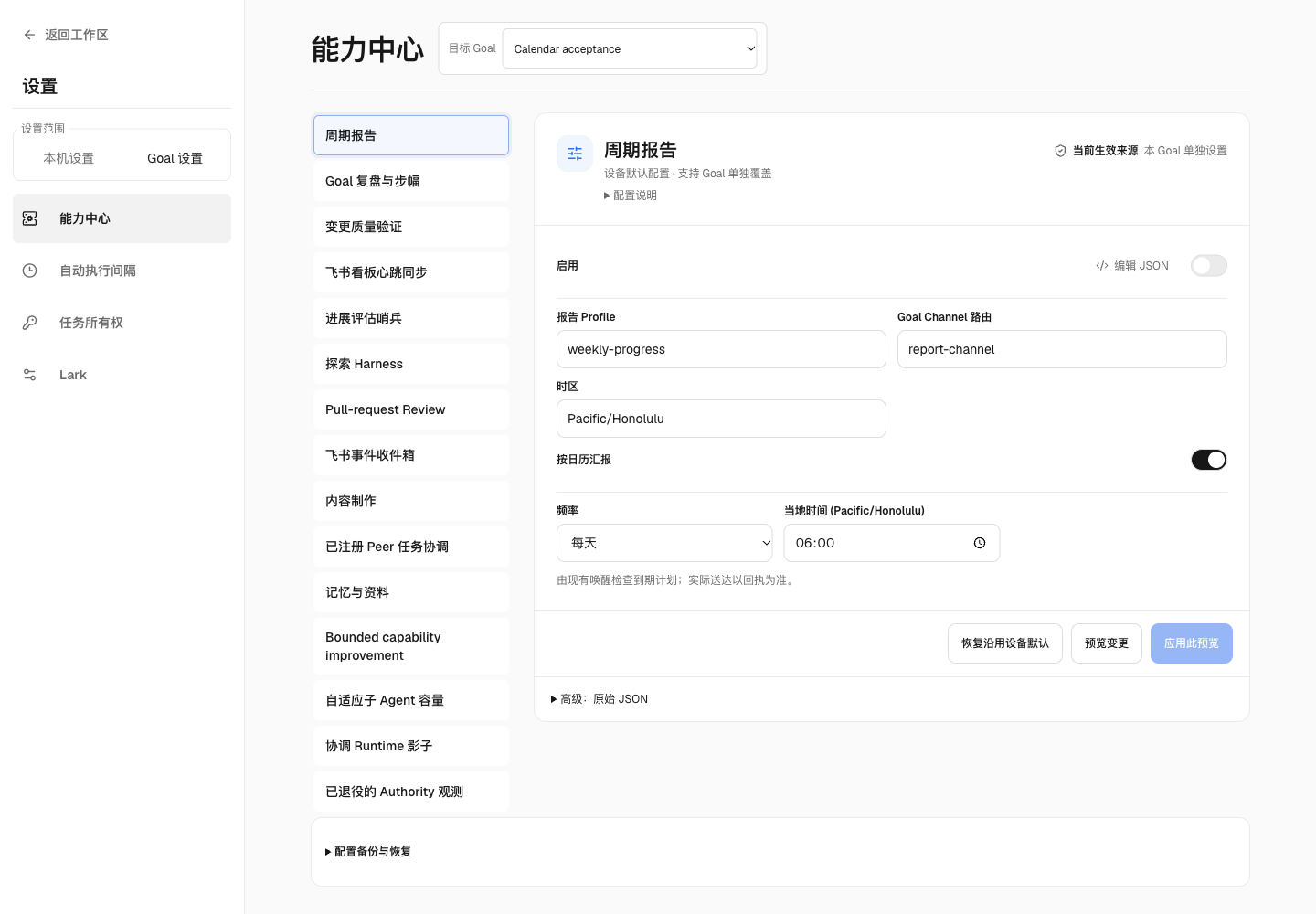
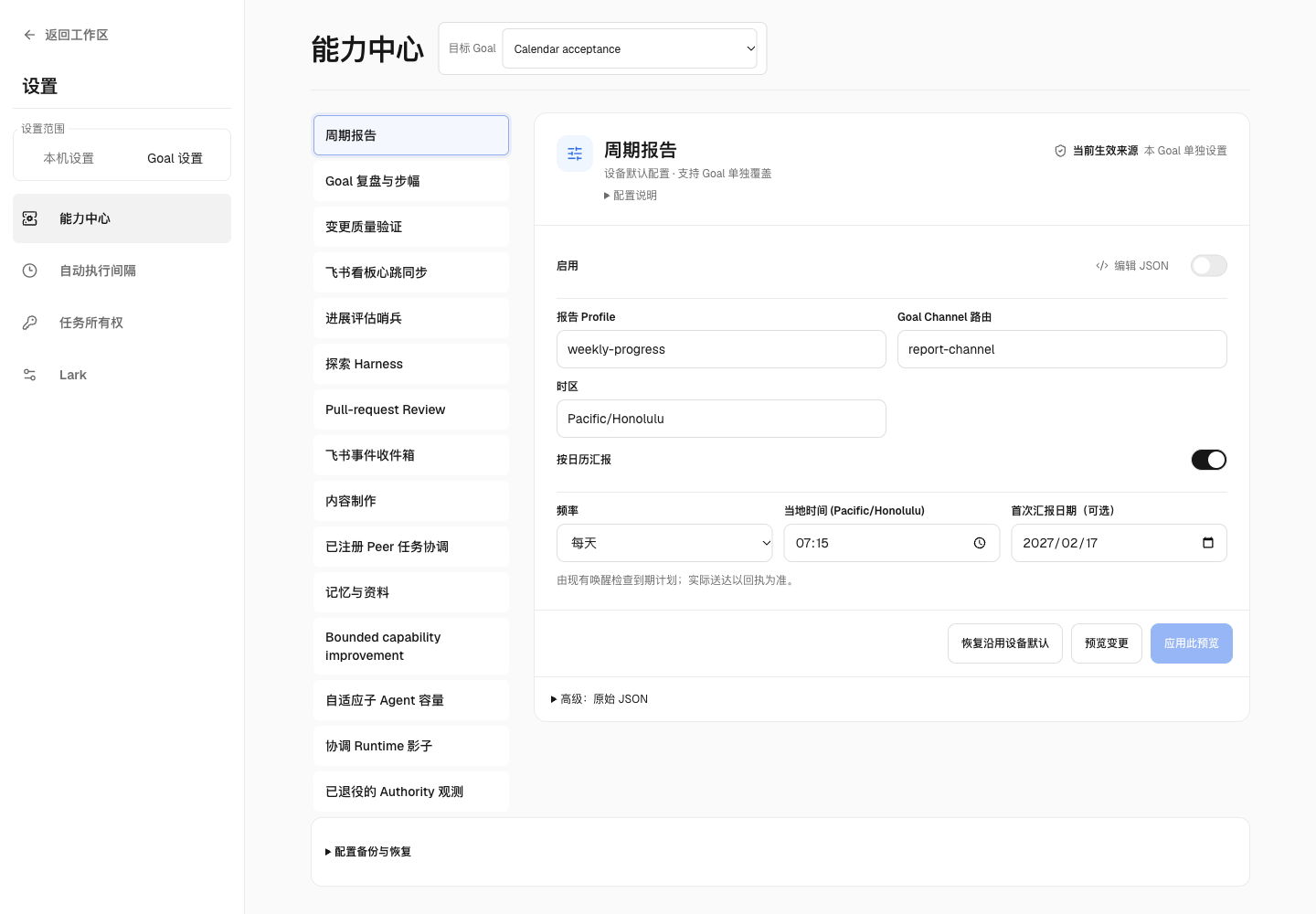
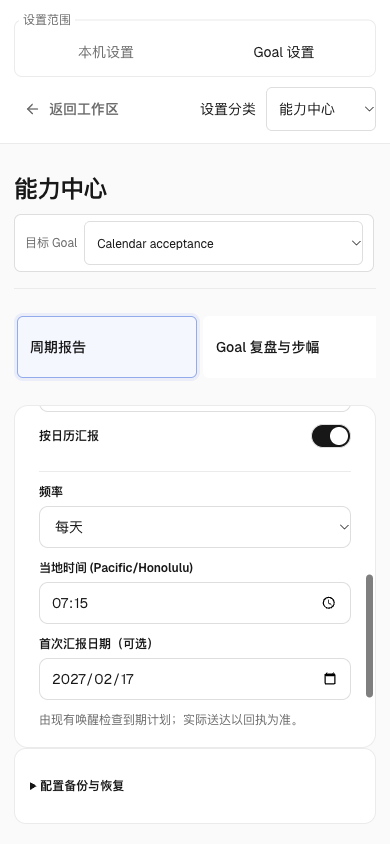
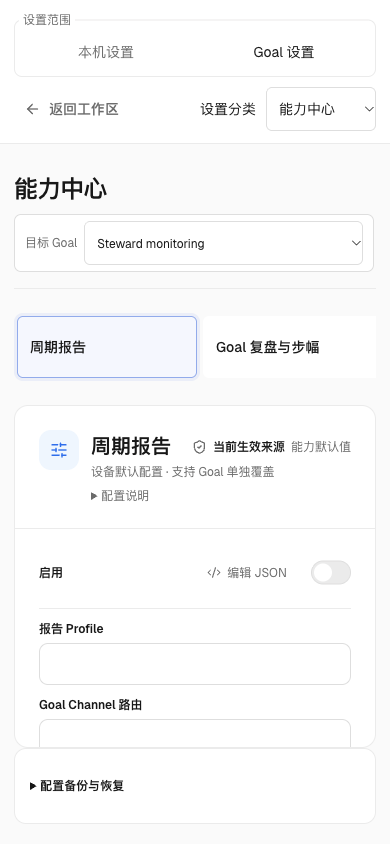
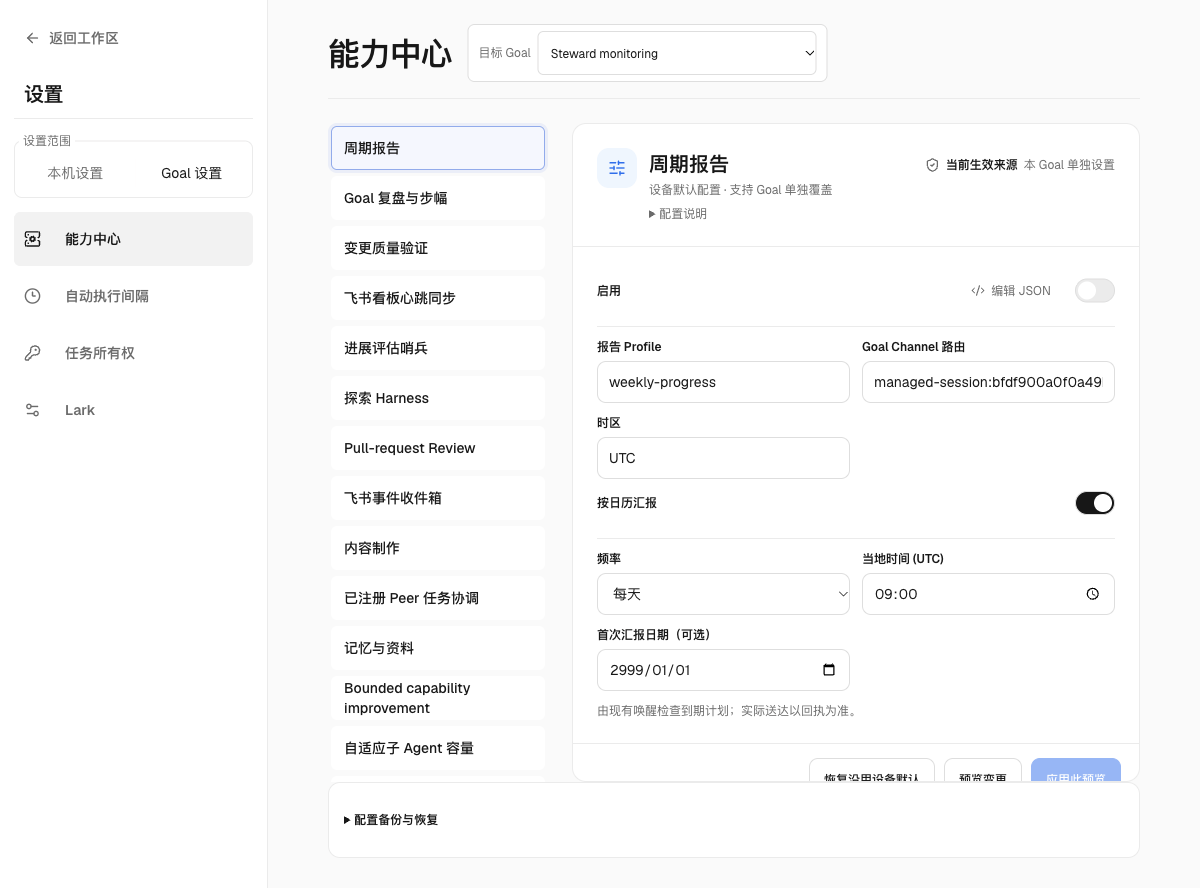
The existing calendar settings support an optional First report date, in the schedule's timezone. Before its first matching daily or weekly deadline, the calendar admits no report intent or generation work. The first report still covers the preceding full interval. Leaving the date empty retains the existing calendar behavior. This setting does not enable the steward's daily portfolio report integration by itself.
New scheduled reports appear as independent full-body messages in the original owner's private conversation. The retained source message verifies the original App, chat and read grant; an unrelated historical question does not become the new report's reply parent. Rich parts use the same frozen placement and delivery journal, and readback verifies the private chat and main-conversation position. An existing delivery record without explicit placement retains its original source-context behavior, including pending or unknown sends. Upgrading neither retargets those attempts nor republishes a report already verified as delivered. Ordinary replies keep their existing source-context/thread behavior; this does not enable chat-root delivery for group conversations.
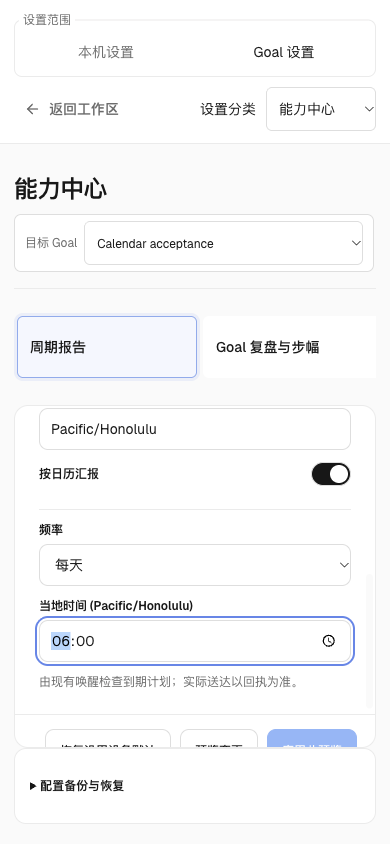
The synthetic packaged settings journey below uses real preview/apply/readback over local HTTP. It preserves the date across frequency, time and timezone edits and reload. The narrow view is a 390×844 viewport emulation.
| Before: recurrence only | After: optional first report date |
|---|---|
 |
 |
| Before, narrow viewport | After, narrow viewport |
|---|---|
 |
 |
Chat /goal transport supervision and a LoopX-managed Turn are distinct. Merely
relaxing validate_goal_chat, changing a Session field, adding a prompt, or
starting a Codex native Goal does not establish the LoopX lifecycle below.
One persistent steward actor
Extend the existing source-bound upgrade/activation path. A typed preview must identify the original private binding, its conversation, the steward workspace, the persistent execution identity and the current host/profile. Apply is an idempotent native transaction using the owner's existing authorization.
Register one visible steward Goal/Agent, rather than creating a hidden Goal for each monitor or borrowing a project worker's identity. The Goal owns the steward's durable monitoring and reporting lifecycle. Its execution authority does not include performing other projects' business work.
The upgrade retains private chat identity, visible history, queued and accepted requests, unfinished delegations, original delivery routes and existing grants. In-flight work stays with its original accepted Turn; the upgrade waits for an eligible idle boundary. If host tools require a replacement upstream thread, preserve the visible conversation and history, and record that transport change. Do not claim to preserve a physical thread that was actually replaced.
The macOS CLI update path checks every configured Chat store before switching its LaunchAgent services. Accepted, queued, completing or unreadable work defers the whole service switch; an empty Session summary is insufficient. Updated consumers and the updater share an admission lock through process replacement, so a new request cannot pass the idle check and begin on the retiring process. The first adoption from an older consumer without that fence still requires an independently established idle boundary. Installation readback remains visible when service activation is pending, including partial restart failures. The same-source update retry performs a fresh check; this adds no second consumer, automatic business replay or separate activation scheduler. The combined App upgrade also stops before restarting the App when this service switch is pending.
Keep the steward's existing portfolio-read authority separate from its execution actor. Resolve both through their native owners on every admission. Registering the actor does not grant new project writes or broaden the original audience. Keep ordinary project assistants unchanged.
Identity preparation available now
In the private steward's connection settings, expand Native periodic monitoring and choose Prepare steward identity. The same gesture obtains a current preview and applies it. A stale preview, unverified provider, changed grant, active Turn or queued user request refuses preparation. Resolve that condition and retry in the original conversation.
The existing local-owner endpoint is
POST /api/chat/lark/private-conversations/managed-steward. A preview accepts
binding_id and optional session_id. Apply additionally requires
execute: true and the preview's plan_id. Callers cannot select a Goal, Agent,
workspace, provider account or new grant. Existing loopback/origin checks apply.
The typed conversation owner names one Goal and registered steward Agent from
the original binding. Existing native Goal creation and configuration owners
initialize File or SQLite storage according to machine settings. The existing
conversation binding stores only the resulting identity reference, including
the original Session and native creation operation. Source-session registries
retain their lifetime token; ordinary registries retain the existing nullable
lifetime contract. Preparation does not strengthen that legacy contract.
A lost registration or binding response can resume the same verified creation; it cannot adopt an unrelated Goal or recreate a missing bound Goal. Repeating an applied request verifies the same registration and returns the same actor. The original Session, history, upstream thread, accepted requests and portfolio grant are retained. Preparation invokes no model and enables no native monitor. The UI shows the prepared identity with monitoring not yet enabled.
Preparation remains separate from enabling recurring work. Disconnecting the conversation uses its existing owner and leaves the registered, unscheduled Goal visible; it does not delete history or accepted work. Removing that Goal remains an explicit native Goal lifecycle operation. Monitoring requires the separate explicit setting below.
Native status monitoring
If the host restarts before a native watch observes anything, the original
idle pump can create one separately correlated Chat continuation. It preserves
the failed request and uses the same native observation identity and deadline.
For a bound steward, this also covers a portfolio read explicitly refused
because its authorization snapshot changed. The exact original failure and a
single empty external_authorization_changed context must both be present.
An App identity read that fails before context publication can also qualify,
but only with its exact original error, one recorded manager_context phase,
no published context and the independent no-effect checks below. The current
provider must verify successfully before acceptance; a matching error alone,
other runtime errors or missing, conflicting or unreadable evidence do not qualify.
The shared typed admission requires an untouched observation-only request, an
available original worker lock, complete event/history reads and no pending or
committed native poll receipt. It rechecks current authority, lease generation
and user work; it never starts a model, repeats business or spends execution
quota. Unknown effects, unreadable history, an active old worker, revoked or
paused watches and another failed continuation remain held for reconciliation.
This bounded recovery applies to both local managed Sessions and the prepared
steward through the existing host, without another scheduler or consumer.
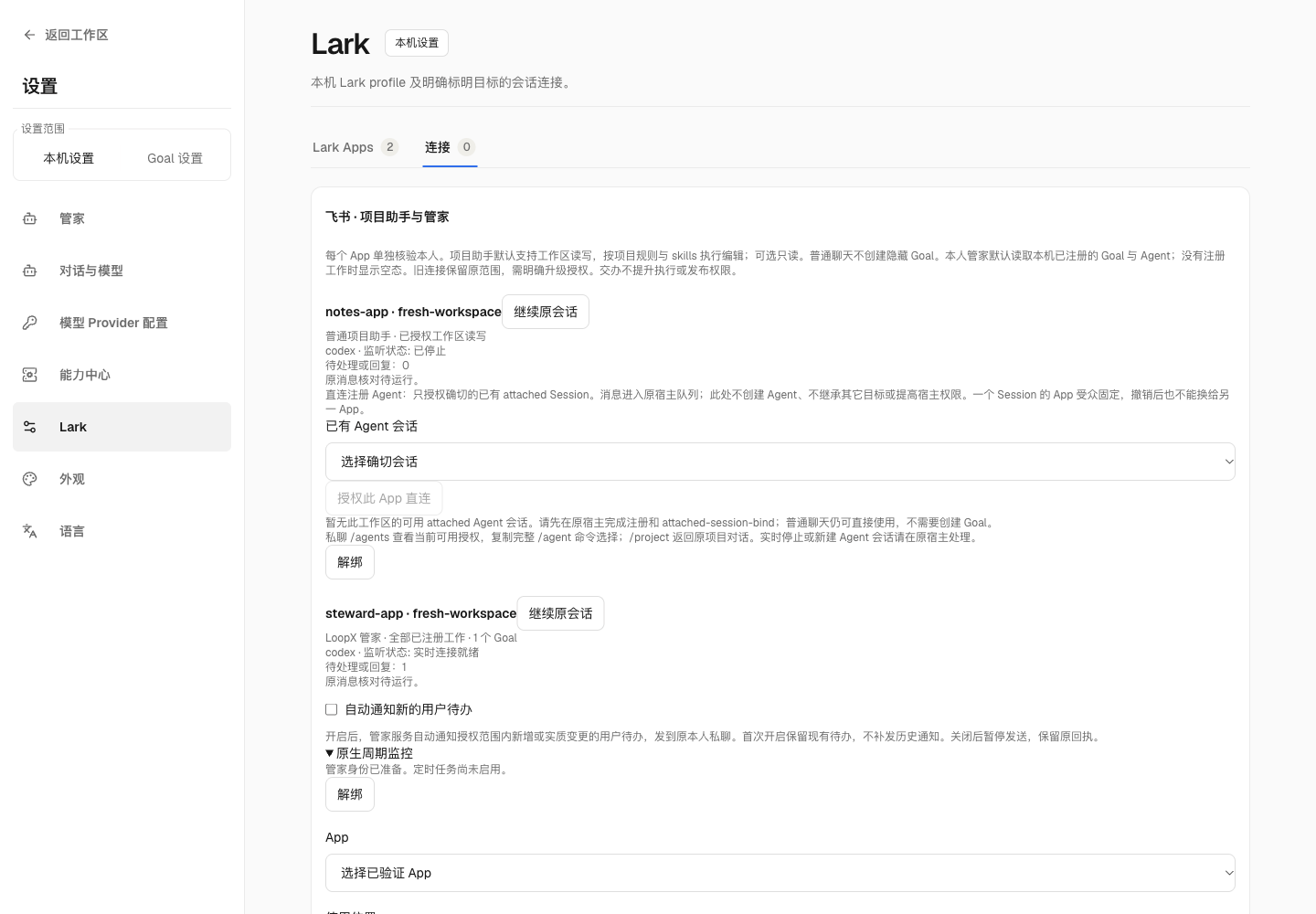
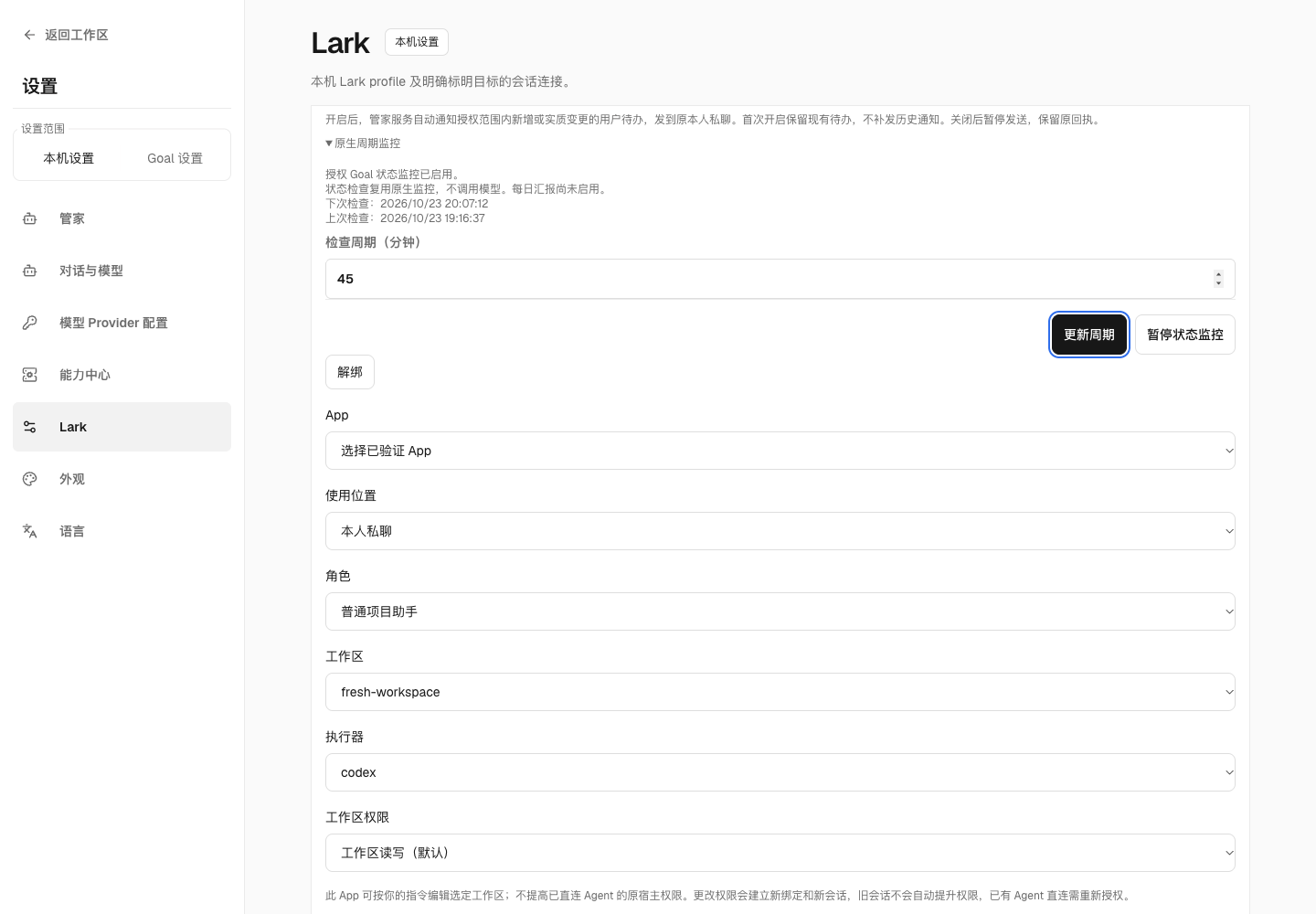
After preparation, choose Enable monitoring in the same connection panel.
The native continuous-monitor Todo owns enable/pause, the 30–1440 minute cadence,
last observation, result hash and next deadline. The panel's single gesture
obtains a fresh source-bound preview and applies it through
POST /api/chat/lark/private-conversations/managed-steward/monitor; it accepts
only the original binding, enable/pause operation, cadence and preview id.
It cannot select a different actor, workspace, account or grant.
The existing Chat host wake service checks this native frontier. A due watch
enters the original Session's Core worker and settles through native
quota monitor-poll, with an exact task-lease generation. It reads the current
authorized local portfolio, including stopped Goals and coverage gaps, without
a model call or execution-quota spend. Its own monitor bookkeeping is excluded
from the material-change hash. This watch neither delivers business replies
nor enables a daily report.
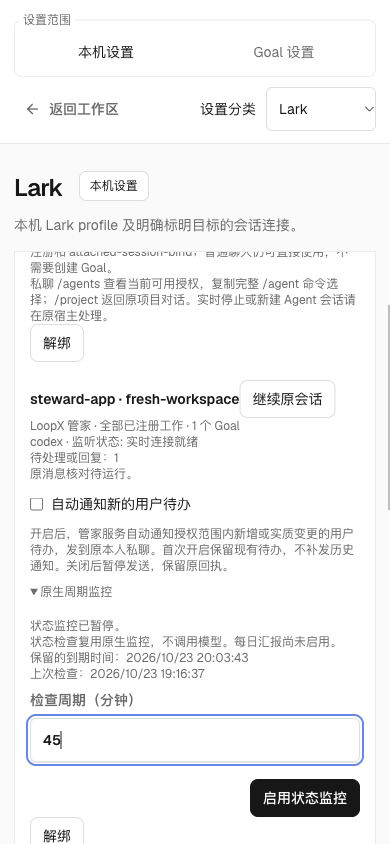
Active or queued user work retains priority. Pause uses the existing native blocked lifecycle to retire the current lease atomically; enable reopens that same Todo and obtains a fresh generation for cadence edits. First enable checks immediately; resume or a changed cadence starts a fresh future window. An unchanged setting leaves the existing deadline alone. Each accepted watch fixes its native deadline and observed lease version before collecting data, so a pause/re-enable cannot let old data borrow a new lease generation. Final native writeback rechecks the collected scope under the binding's configuration and revocation fence. Native Goal stop also blocks observation. The user can still pause the retained monitor while that Goal is stopped. Restart reads the native Todo/deadline and original Core request. A failed or unknown accepted attempt is retained, never replayed. An in-memory wake hint expires within a minute and holds no scheduling authority; configuration invalidates it immediately. No extra scheduler, message consumer or binding-side scheduling toggle is created.
An unreadable Session or queued Turn file affects only its own binding. Other stewards continue their due checks. The unreadable data and original monitor deadline remain intact; once the file is repaired, queued user work still takes priority over monitoring.
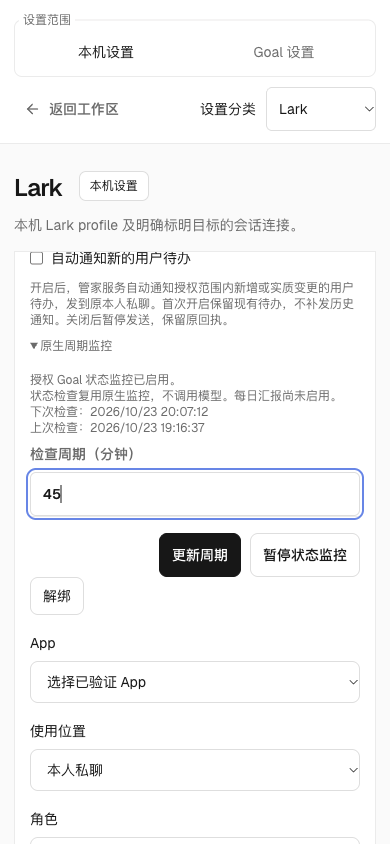
The packaged browser journey below uses synthetic private connections over real HTTP, Core and native File storage. Desktop views are 1440×1000; narrow views are 390×844 viewport emulations, not physical-phone acceptance. The journey covers enable, one automatic poll, cadence edit, failed authorization, pause, resume and reload. An ordinary web-manager Session may also be prepared by the workspace; the original private Session remains unchanged and the watch adds no model request. File/SQLite regression tests independently check that monitor polls leave execution-quota slots and original business replies alone.
| Before: prepared identity | After: enabled native monitor |
|---|---|
 |
 |
| Enabled, narrow viewport | Paused, retained deadline |
|---|---|
 |
 |
Native scheduling and execution
Owner Todo notifications during a source outage
The existing Automatically notify new owner tasks setting uses the original private steward's background outbound worker. It does not enable a native monitor, report, model Turn or second message consumer.
Discovery enumerates the complete current authorized Goal scope. Each Goal must provide a complete native Todo read and exact current decision terms. If one Goal is unreadable or unmigrated, its previous subjects, pending notices and unknown sends remain retained; an unavailable source is never treated as an empty or withdrawn Todo list. Notices from other readable Goals continue. An unsent notice becomes eligible only after its own source is read again, with the original generation and provider intent preserved. Real withdrawals or scope removal still cancel unsent notices. A known provider locator continues independent readback of the frozen original effect, even if the Todo changes or its source is unavailable; current App, owner and original-route verification remain required. This read cannot create another notification.
First enable baselines readable history and remembers unreadable initial Goals. Their first successful read also baselines history, avoiding a delayed recovery burst. Later changes and newly registered Goals retain ordinary discovery. Failure to enumerate scope or verify the original owner, App, grant or route still pauses delivery. The panel distinguishes a fresh partial-source check from a stale worker or a delivery error; unknown receipts remain visible.
Expand View unavailable Goals in that setting to identify each missing
source. A native canonical_authority_required result asks the project's
maintainer to back up and migrate its Todo authority; other read failures stay
generic and are checked again. Only the Goal identity and an allowlisted error
code enter this health view. Private exception text and paths are not displayed.
This diagnosis never migrates a Goal, changes its grant, or resends a notice.
在同一设置中展开“查看不可读的 Goal”,可逐项定位缺失来源。原生待办尚未迁移时, 需由该项目维护者先备份并迁移;其他读取失败只提示暂不可读,服务会继续检查。 页面不显示原始异常或私有路径,也不会据此迁移项目、扩权或重发通知。
The packaged fixture
apps/presentation/dashboard/smoke/owner-attention-source-fixture.py uses real
HTTP, native File authority and the existing outbound worker, with synthetic
provider/model transport and no paid call. Its unmigrated Goal reproduces the
outage; initializing that disposable source verifies recovery. File/SQLite
regressions separately cover source errors, incomplete reads, changing exact
reads, retained queue identities and independent provider readback. The baseline
image shows the prior UI bundle over the same partial-source backend state;
the baseline adapter also fails the healthy-source regression independently.
These captures establish packaged browser behavior, not phone-device or live
account acceptance.
| Before: generic incomplete notice | After: explicit partial coverage |
|---|---|
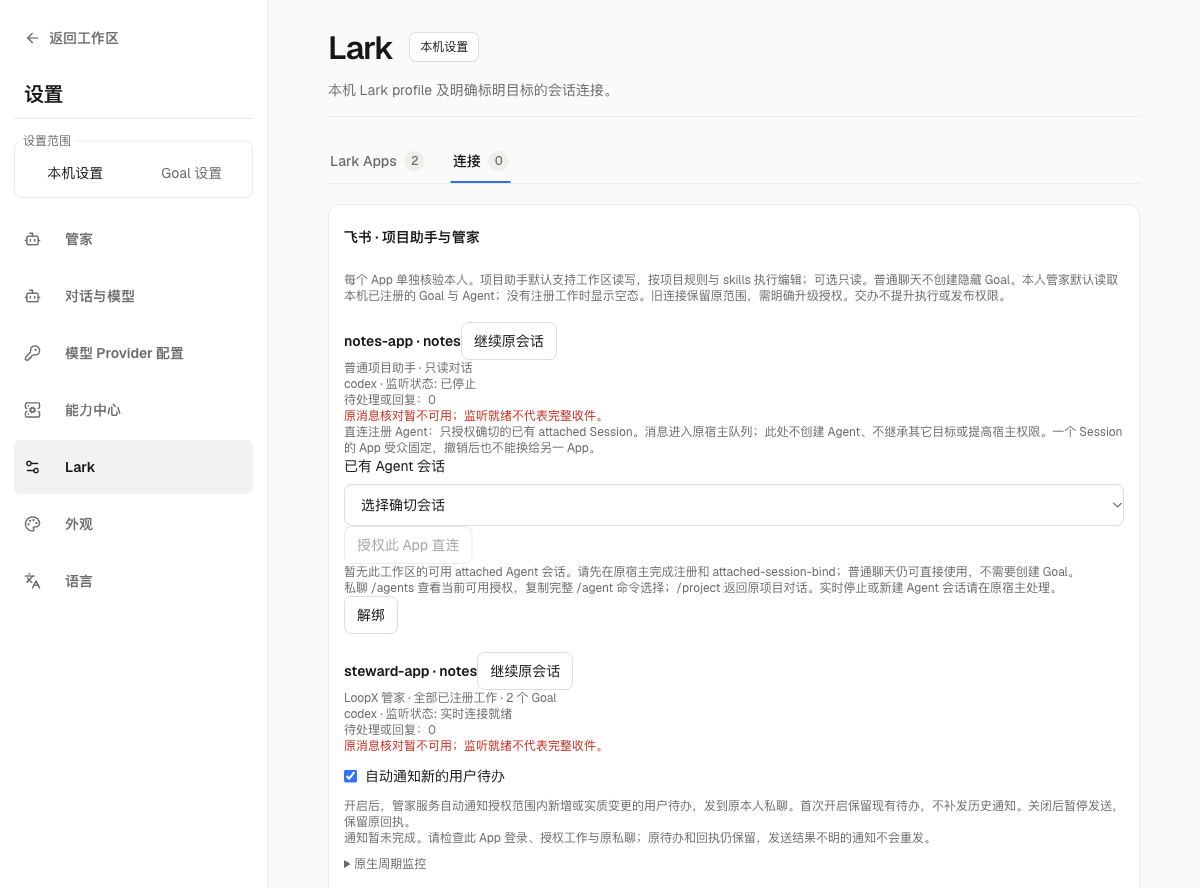 |
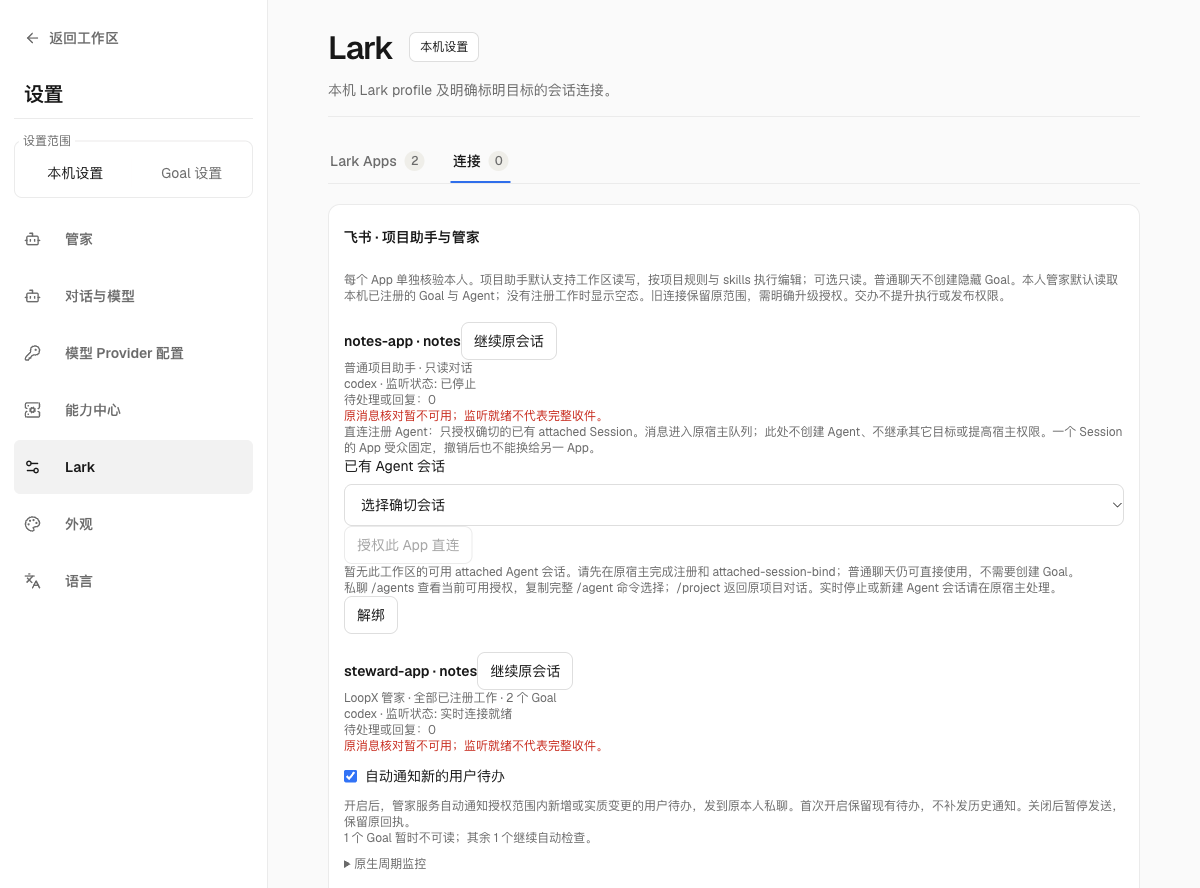 |
| Partial coverage, narrow viewport | Recovered worker, narrow viewport |
|---|---|
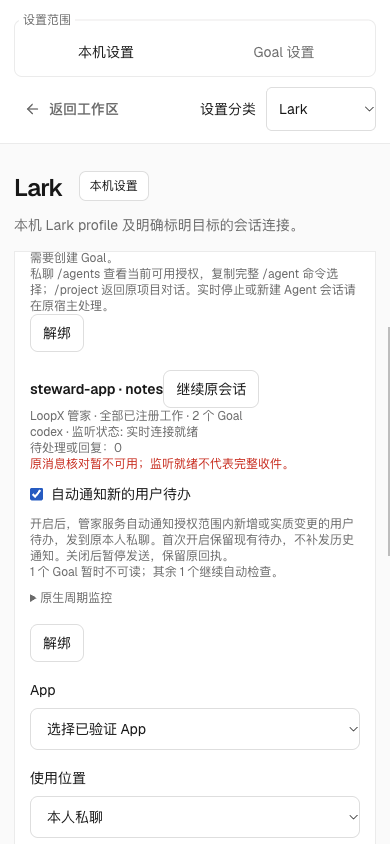 |
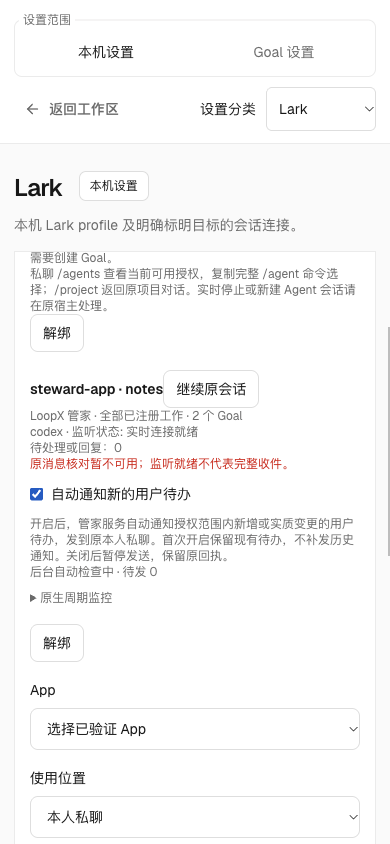 |
Terminal-failure notices
A blocked Todo that is neither done nor superseded and has a reject or cancel
in its typed decision_scope_outcomes becomes a separate owner-attention subject,
<goal>/<todo>/terminal, independent of its ordinary owner-action subject.
The notice uses the latest terminal outcome by recorded time when all terminal
outcomes have timestamps; otherwise it uses the last terminal outcome in the list.
Its digest includes the terminal outcome count, so a second outcome starts a new
notice generation even when the latest terms are unchanged. Clearing the terminal
outcomes, leaving blocked status, completing or superseding the Todo withdraws
unsent notices; delivered receipts remain unchanged. A missing decision_scope
does not suppress a terminal notice. These notices reuse Automatically notify
new owner tasks, its first-enable baseline and the existing outbound worker;
they add no setting, scheduler or message consumer.
未完成、未被替代的阻塞待办若有 reject 或 cancel 结果,会成为独立的所有者关注项;缺少 decision_scope 也不会漏报。
终止结果均有时间戳时取最新一项,否则取列表最后一项;计数变化会产生新一代通知。结果清除或待办离开阻塞、完成、被替代时撤回未发送通知,已送达回执不变。
此通知复用“自动通知新增所有者任务”、首次启用时的历史基线和现有出站工作器,不新增设置、调度器或消息消费者。
The intended flow is:
original private ingress -> original steward conversation
                                      |
                              steward Goal / Agent
                                      |
           native monitor/report deadline -> scheduler admission
                                      |
                              one managed LoopX Turn
                                      |
                    periodic-report generation/publication
                                      |
                     original private reply + provider readback
Represent monitors as native continuous_monitor Todos under this actor. Reuse
their due times, observations and lifecycle; do not create another task store,
cron, model loop or message consumer. Expose the report calendar's next boundary
to that same scheduler frontier. The periodic-report calendar/journal remains
the owner of report windows; a monitor deadline is its scheduling projection,
not a second publication cursor.
The existing runtime host checks the frontier without invoking a model. When nothing is due, it sleeps until the next eligible native deadline. Only an admitted Turn can invoke the model. A fixed daily report remains due even if project state has not changed. Preserve the owner's minimum scheduling cadence; align eligible calendar wakes to the requested wall time and disclose lateness when the machine, host or actor cannot run then.
User messages, due monitors, outstanding original replies and reports use the same actor's queue and admission. A busy actor retains due work and rechecks it at the normal terminal boundary. It does not create another executor. Existing priority, replan, budget, stop and settlement policies remain effective. Pausing the steward prevents new scheduled model Turns without discarding accepted work or historical results.
If the native guard refuses the exact report Task before execution because a semantic replan is due, the original idle worker can admit one correlated continuation of that window. It rechecks native admission without choosing another business Task. When governance is still due, the canonical writeback preview must independently accept the original Agent's semantic delta before writeback and quota settlement. When the fresh guard no longer owes governance, the host-only admission stop can request a new exact admission of the original report Task without a governance model call. A different advisory Task in that probe is never executed and grants no authority over the report. A retained stop from the earlier host can receive one separately correlated continuation only when its canonical journal proves that exact host-only path and no model work; missing output alone is insufficient. Both paths retain the original native report identity, task validator, report window and publication owner. Ordinary delivery remains withheld during governance. The original return reader then verifies the full report through its existing publication owner. The refused Chat request remains in history. Unknown execution, partial effects, a frozen generation, changed authorization or an unsuccessful continuation do not authorize another model replay, window or message consumer.
A native status watch calls the existing monitor-poll owner under its original Chat Turn and task lease. It does not select a continuous monitor as a heartbeat advancement task, so open executable work does not prevent a due observation. Fresh source, user-gate, capability, deadline and lease checks still apply; the poll keeps its stable Turn identity and does not invoke a model or spend a slot. The earlier adapter's exact pre-poll selection rejection can receive one separately correlated attempt only when its failed Turn has no native start, answer, delta or poll event. The original failure remains; unknown failures, interruptions and a failed recovery do not trigger a retry loop.
Daily portfolio report
Configure the original steward's daily report for 09:00 Asia/Shanghai. At
scheduled boundary T, freeze the reporting interval as [T-24h,T). Keep scheduled
boundary, actual generation time and actual delivery time separate.
Read all locally authorized registered Goals, including stopped Goals, through their current native read surfaces. Do not reactivate them. Collect window progress, relevant active/completed Todos, actual artifacts and validation, unresolved requests/returns and concrete blockers. Distinguish reported claims from independent verification, and report incomplete coverage explicitly. Reconcile current approvals and dependencies before proposing a new owner ask.
The steward produces the full Chinese body and returns it to the original private chat. A summary, queued outbox row, attachment alone or assistant-side completion flag is insufficient evidence that the user received the report.
Use a stable identity for each scheduled window. Retain generation and delivery progress separately. A restart resumes that window; confirmed delivery is not sent again, and uncertain sends are read back before retry. After extended offline time, produce the most recent complete window and disclose missing windows, rather than starting an unbounded series of model calls.
Original private report settings and execution
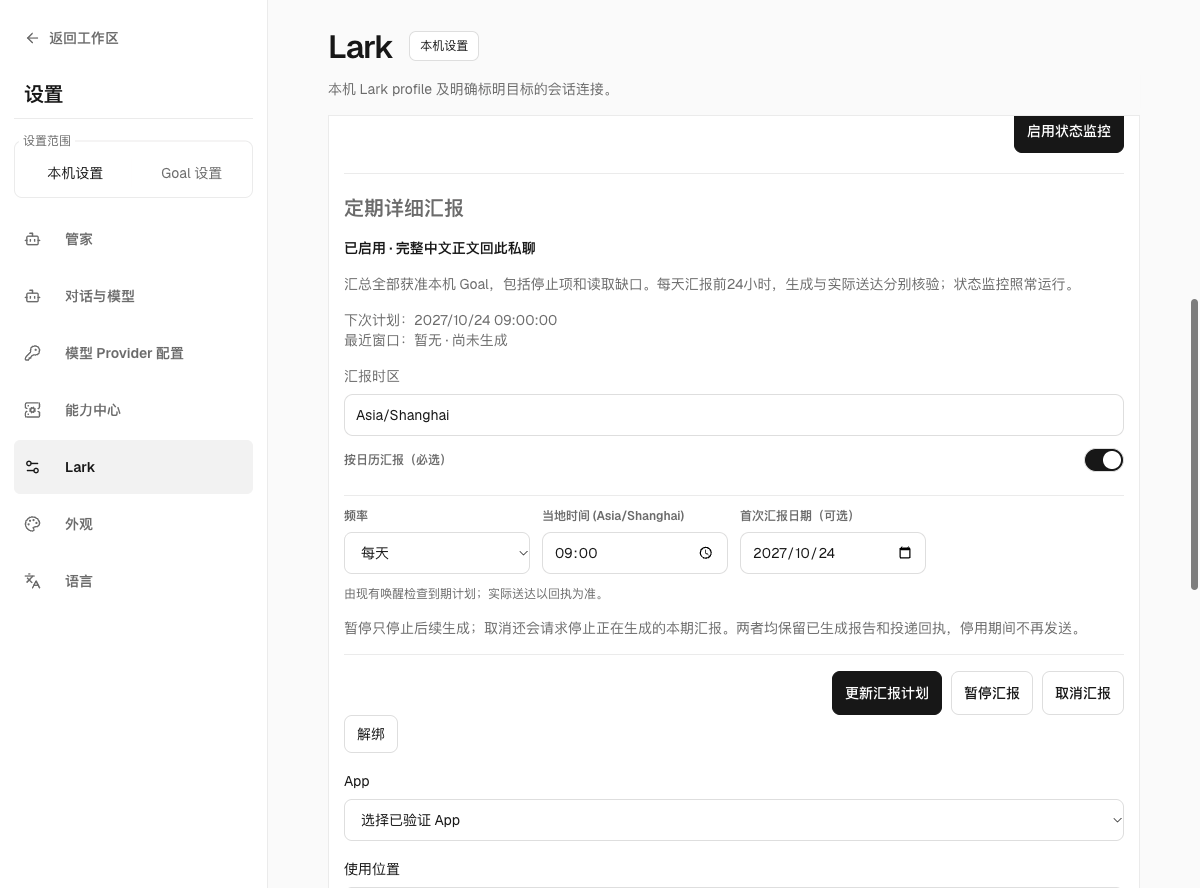
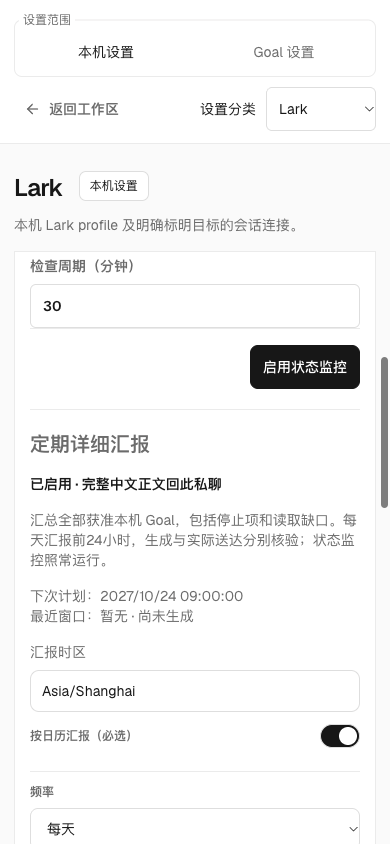
In Settings → Lark → the original steward → Native periodic monitoring,
the owner can enable or update detailed reports, select daily/weekly frequency,
local time, timezone and first report date, or pause/cancel. The existing calendar
field is reused. A source-bound preview and exact-plan apply configure the
existing periodic_report Goal setting with the portfolio-progress preset;
the destination is derived from the original private binding. Neither the
browser nor the model can supply another Goal, App or recipient. The generic
single-Goal report consumer cannot consume this private portfolio preset.
This preset requires a calendar; its switch cannot select the generic
stage-boundary reporting mode. Pause or cancel through the report actions.
After /new and first preparation in the new Session, route discovery selects
a verified source belonging to that exact managed actor's Session and private
source. An older Session in the same chat cannot mask an eligible route, and
a retained report route cannot fall back to another Session or audience.
Provider, owner and original-message verification still apply. Owner Todo
notifications retain their existing private-chat route selection.
Worker conclusions from an already recovered original conversation use the recorded Core continuation when resolving their private return route. A client suffix alone is insufficient: the transport and Core journals must agree on the current Session, Turn, source and recovery record. Quota, routing and unfinished-work continuations retain the same audience and existing saved-send verification; this lookup neither retries model work nor resends an unknown provider effect. Missing records, changed identity or revoked grants still block delivery.
Portfolio evidence collection finishes before the governed driver captures its launch authority. A long read can then observe legitimate registry rewrites without immediately invalidating an earlier launch witness. The original source and execution lease are checked after collection and again at dispatch; authority changes after plan capture still reject the launch. This ordering does not authorize replay of a historical attempt with unknown host effects.
The original pump can resume one retained report after the first-party launch
owner's exact stale_goal_authority refusal. That owner rejects before publishing
turn/start; a missing answer or missing events alone is insufficient. The
host adapter records this guard-entry refusal through the native executor's
existing contract_rejected host-failure contract. The durable attempt remains
recorded; an exception after publication is not converted into that proof.
Older in-progress journals with unknown host effects remain blocked. The
typed admission checks the original Chat request, canonical native transaction,
one recorded attempt, no generation or settlement, and the current original
subscription and grant. A separately correlated Chat attempt resumes the same
native journal, window, Todo and settlement identity through run-once recovery.
The historical outer response is retained. A failed recovery, unknown transport
outcome, real model start, changed identity or revoked permission cannot trigger
another automatic model attempt. Existing no-model settlement recovery and
independent full-body delivery readback still apply.
Frozen generation is checked independently inside the original host using the same installed report provider. An embedded Python host's bootstrap does not imply that its bare child interpreter can import LoopX; no second installation or ambient import path is required. Ordinary CLI command validators are unchanged.
If the original model has returned and the frozen generation validates, the original pump can resume a failed native validation phase without invoking the model again. The typed owner requires the same live subscription, actor, window and open generation Todo, the canonical cached host/result phases, and an explicit no-host recovery decision. The native driver revalidates the frozen artifacts and current authorization, reacquires the original task lease and performs ordinary completion and settlement. A paused subscription, changed identity or grant, invalid generation or unknown model effect stays blocked. The historical Chat response is retained; only the native committed receipt allows the existing original-audience sender to proceed.
Once generation is frozen, delivery checks the original source Goal identities against the current authorized scope. Adding an authorized Goal does not revoke the frozen report or rewrite its source/body; later windows include the new Goal. Removing a frozen Goal, replacing its identity, revoking the original grant or changing frozen artifacts still blocks delivery, including after a partial or uncertain send. Existing provider readback decides which original parts remain unsent; scope growth never authorizes another model run or resend.
Read coverage and authorization are separate. A partial source may omit an unreadable or oversized Goal without revoking the original report grant. New private editorial requests freeze the complete authorized Goal identities alongside their existing authorization digest. Delivery checks this immutable witness, including unread Goals; it never upgrades partial coverage to complete. Later authorized additions belong to a future report, while removal or identity replacement of an original authorized Goal still blocks publication.
Older frozen requests remain immutable. When their readable Goal list does not reconstruct the original authorization digest, recovery requires the complete current authorized scope to match that original digest exactly. An absent identity witness never permits guessing which Goals were originally authorized; an ambiguous later scope change remains retained, without another model run.
The existing idle Chat wake producer admits one calendar window and creates
one native finite generation Todo for it. The original Chat worker and native
thread author the report, using complete frozen source records and the owner's
REPORTING.md criteria. Public-safe Turn fields remain separate from private
editorial content. A report-specific opt-in allows the kernel's existing
validated_completion; its original task lease and independent artifact
validator must pass before the generation Todo closes. Ordinary host prompts
and result vocabulary retain their defaults.
The finite postcondition is the validated generation itself: a complete valid
editorial response closes this generation Todo even if the model labels it
progress. This does not close the ongoing Goal or claim delivery.
If generation has completed but native writeback or debit has not committed, the normal idle producer resumes the remaining effects of that same original Turn. It reads the canonical completion under the original Turn fence, without reopening the Todo or invoking the model again. Existing effect readbacks also reconcile a committed effect whose response was lost; a missing outer Chat result event can be recovered from the committed native journal. Historical failures and generated content remain intact. Delivery still requires the native committed result and current original authorization; unknown or contradictory journal identity remains blocked.
The existing Lark outbound pool reads the committed native result, validates the frozen source/editorial/artifact lineage and returns the full Chinese body through the original reply owner, splitting long text into verified parts. Known part IDs are read back after restart; a send with unknown outcome and no locator is retained without another create. Only complete provider verification advances the existing publication cursor. No additional scheduler, consumer, model worker, business store or provider scope is created.
Pause disables subsequent generation and delivery. Cancel also requests a stop only for an active report Turn; an unconfirmed stop is shown separately from the committed configuration. Original reports and delivery receipts remain. Revocation, subscription changes, source/provider changes or damaged artifacts block late publication. Monitoring and ordinary conversation retain their own lifecycles. The settings show the next due time, retained window, generation and verified/unconfirmed delivery as separate facts. Changing a frozen, unverified report's schedule is rejected with a specific pending-window explanation. Pause and restoration of the same plan remain available; schedule edits can proceed after verified publication. This keeps an unfinished original window from being stranded by a different subscription.
A terminal native attempt with a retained invalid editorial response, no generation and no delivery attempt is shown as generation failed. The owner's existing cancel action can explicitly retire that failed window: its Todo is paused as blocked, the native failure, cost and artifacts remain, and the cadence journal records retirement separately from publication. Restoring the same plan does not replay the failed attempt; a later due window can progress. A changed future plan is also allowed after retirement. Unknown model outcomes and partial or unknown sends cannot take this exit; they keep the original recovery boundary.
Execution failure is visible even when it happens before an editorial response:
the original steward and managed Session health expose execution_failed for
the exact current actor, window and subscription revision. The steward settings
show the retained failed execution instead of “Not generated”; the next calendar
deadline is not a promise that the held window can run. This observation grants
no cancellation, retirement or retry. A correlated quota continuation that
succeeds clears the current failure projection while retaining its failed predecessor.
| Cancelled failure on the original settings page | Narrow retained-failure state |
|---|---|
 |
 |
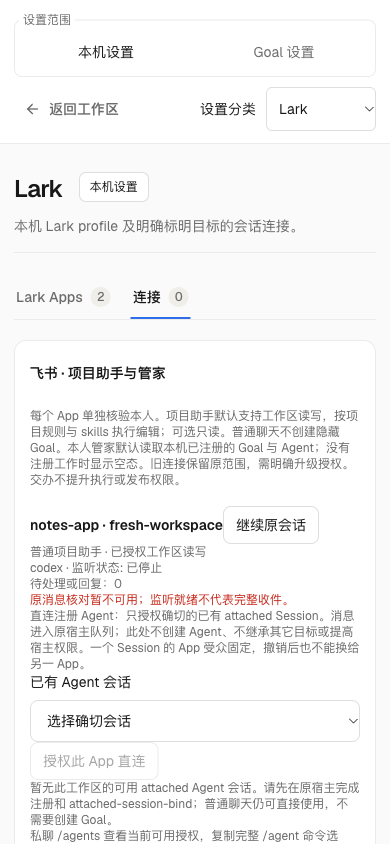
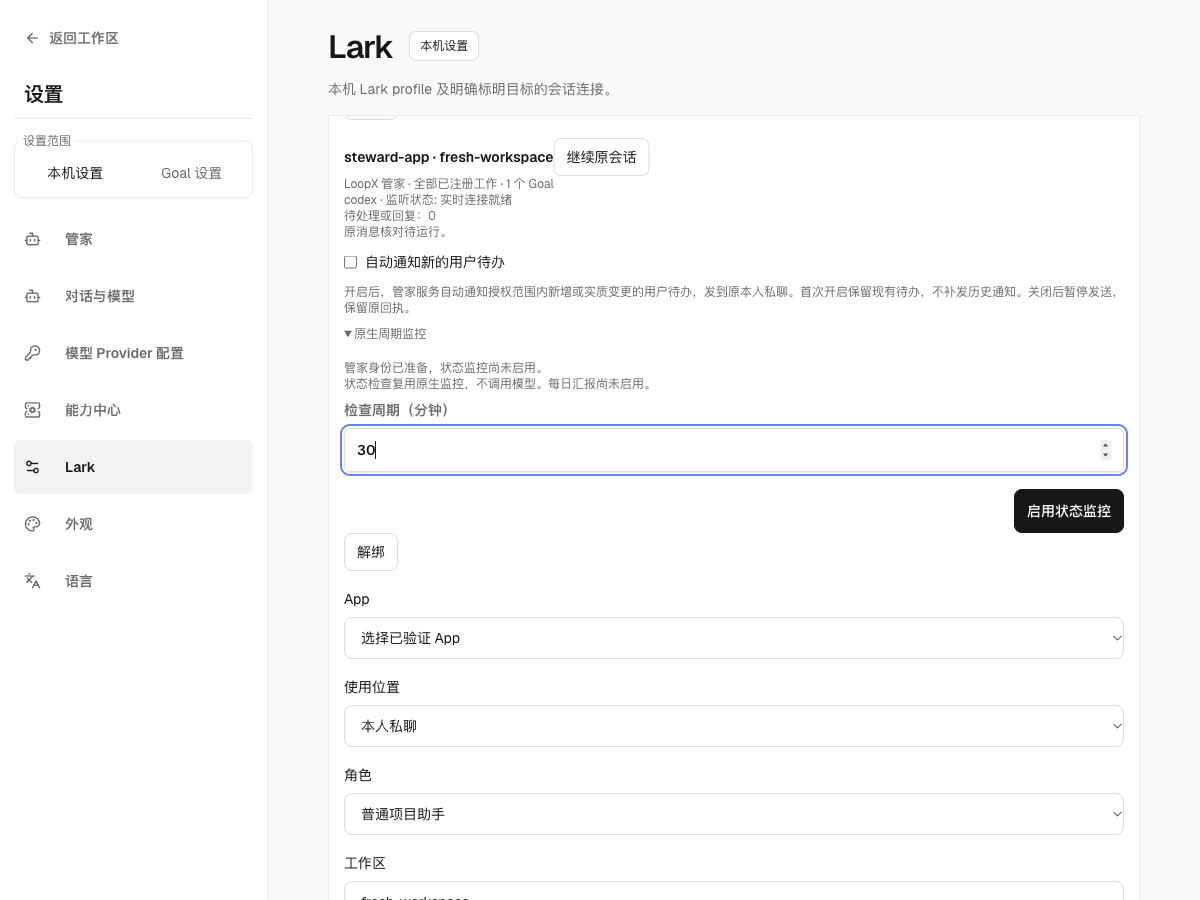
The packaged browser fixture uses actual HTTP/Core/calendar storage with a synthetic original provider/model. Screenshots below are that isolated journey, not production-message or real-phone proof.
| Before integration: monitoring only | Enabled future first date |
|---|---|
 |
 |
Acceptance boundaries
Managed Agent execution boundary
A managed conversation must belong to the selected registered Agent, with its own original Session, execution state and return path. In the Goal's Agent view, managed and attached conversations are parallel sources; a Goal-wide Codex chat with an extra Agent selector does not establish that binding. The experimental Advance LoopX tasks control has therefore been withdrawn from ordinary Goal Chat. The existing general conversation, native Goal mode and original attached conversation entry retain their current owners.
The native host groundwork remains separately qualified: an explicitly invoked local managed request can use the original Core worker and native Task/Turn owners for a finite source-validation task. It retains the same thread and sandbox, resolves the selected Task's immutable argv validation declaration before model execution, and checks its canonical digest/revision and lease before accepting completion. Missing validation starts no model; a failed postcondition cannot complete the Task or spend a delivery slot. The low-level request accepts no runtime profile or caller validation command. Stable Core operation identity retains failed or unknown requests without replay.
The existing session creation API now accepts managed_agent_id for a local
Goal. It binds the registered work identity separately from the executor
(agent_id) and model. Core persists that immutable identity, Goal lifetime
and original thread, with a distinct Agent channel. Resume selects only that
Goal/Agent/executor channel; another Agent cannot execute its native work.
Old Goal-wide conversations remain readable and unassigned, and cannot gain a
native work identity through a request-time selector. Existing project,
steward and attached entrypoints retain their original identities and workers.
Registration removal, Goal stop, a changed lifetime or a mismatched workspace
refuses continued execution rather than transferring the conversation.
This is an API/host lifecycle slice, not the finished Agent workspace entry or arbitrary periodic-task journey. The Agent view still needs to expose this binding alongside attached sources, including all original history and honest unavailable states. Reuse existing Session, native Turn, monitor/calendar and periodic-report owners; do not add a second scheduler, task store or model worker. General writable execution, natural-language configuration and arbitrary recurring task composition remain unfinished.
An explicitly bound local managed Session can also observe its Goal's native
work through an existing continuous_monitor Todo. Use the existing Todo
authoring path with action_kind=local_runtime_observe, watch_only=true,
the registered Agent as claimed_by, and
target_key=managed-session-watch.<original-session-id>. Its existing cadence,
deadline and open/blocked lifecycle are authoritative. For example, after
selecting an authorized existing Goal, Agent and bound Session:
loopx todo add --goal-id PROJECT --role agent \
  --claimed-by WRITER --text 'Observe this Goal native work' \
  --task-class continuous_monitor --action-kind local_runtime_observe \
  --target-key managed-session-watch.ORIGINAL_SESSION_ID --watch-only \
  --cadence 30m --next-due-at 2030-01-01T09:00:00+08:00 \
  --required-capability filesystem --execute
Replace the illustrative identities and future deadline with the actual
authorized task. Registration, opening a Session or installing the feature
does not author or enable a watch. The existing idle wake producer admits a
due watch into that Session's original Core worker; the shared observation
adapter and native monitor-poll settle it without starting/resuming a model
thread or spending a delivery slot. Other runnable work remains available.
The original private steward retains its own portfolio source and provider
checks; a local watch requires neither a private binding nor portfolio access.
The local observation hashes canonical work fields from the complete native Agent Todo read in that Goal. Monitor bookkeeping and ordering do not create work transitions. This is current work-state observation, not a claim that the business or Goal has completed. Busy/queued user work wins; a paused watch, revoked Agent, stopped/replaced Goal or mismatched Session cannot poll. A host restart reads the original native deadline and Core operation, including a failed or unknown attempt, rather than replaying it. External Todo edits are observed within the existing one-minute wake hint; the hint is not authority. This watch does not generate a report, execute a business task, send an external reply or complete the natural-language/periodic-task user journey.
Earlier packaged browser evidence demonstrated only the finite host/API path with disposable real Core/File data and a synthetic model/provider. It did not establish the correct Agent hierarchy, real-model adoption or natural-deadline acceptance. The UI withdrawal does not alter the original private steward's subscription, published reports, pending requests or publication route.
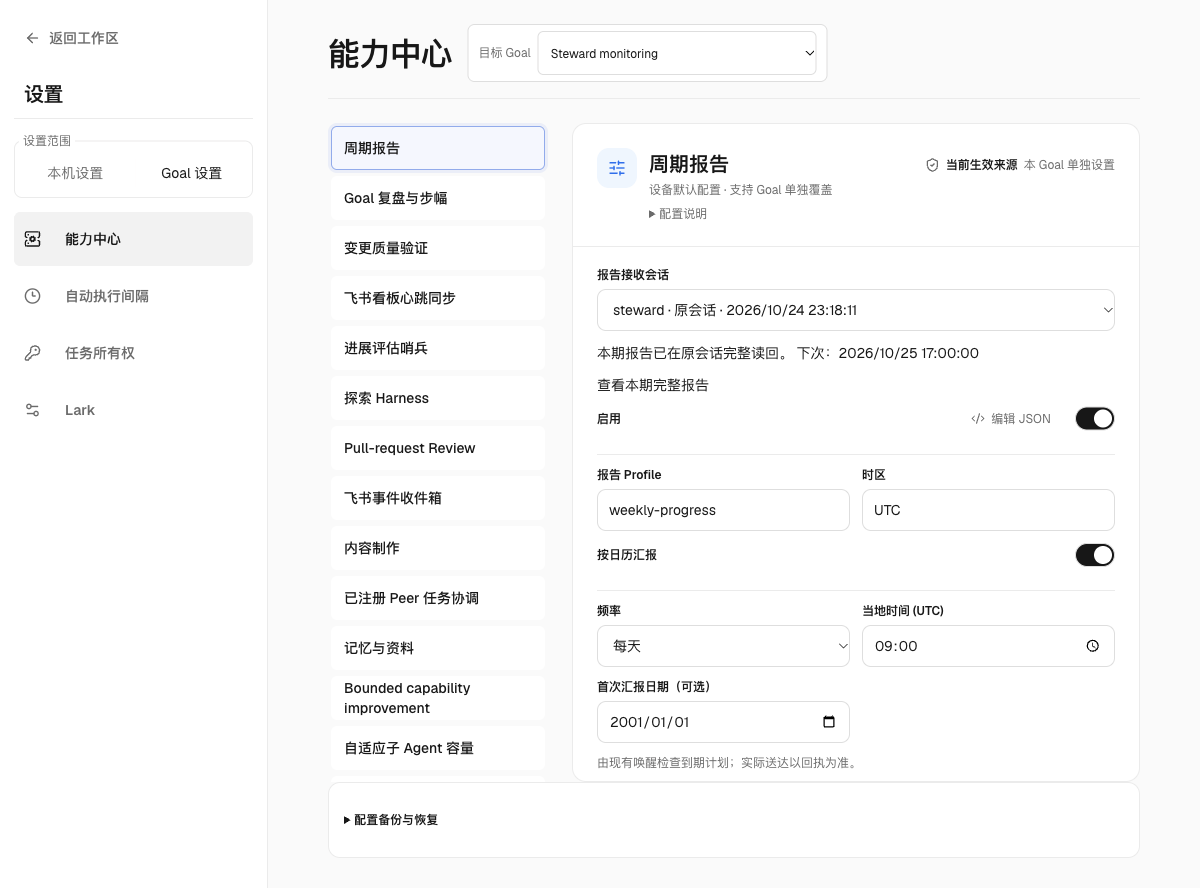
Calendar reports in an existing Agent Session
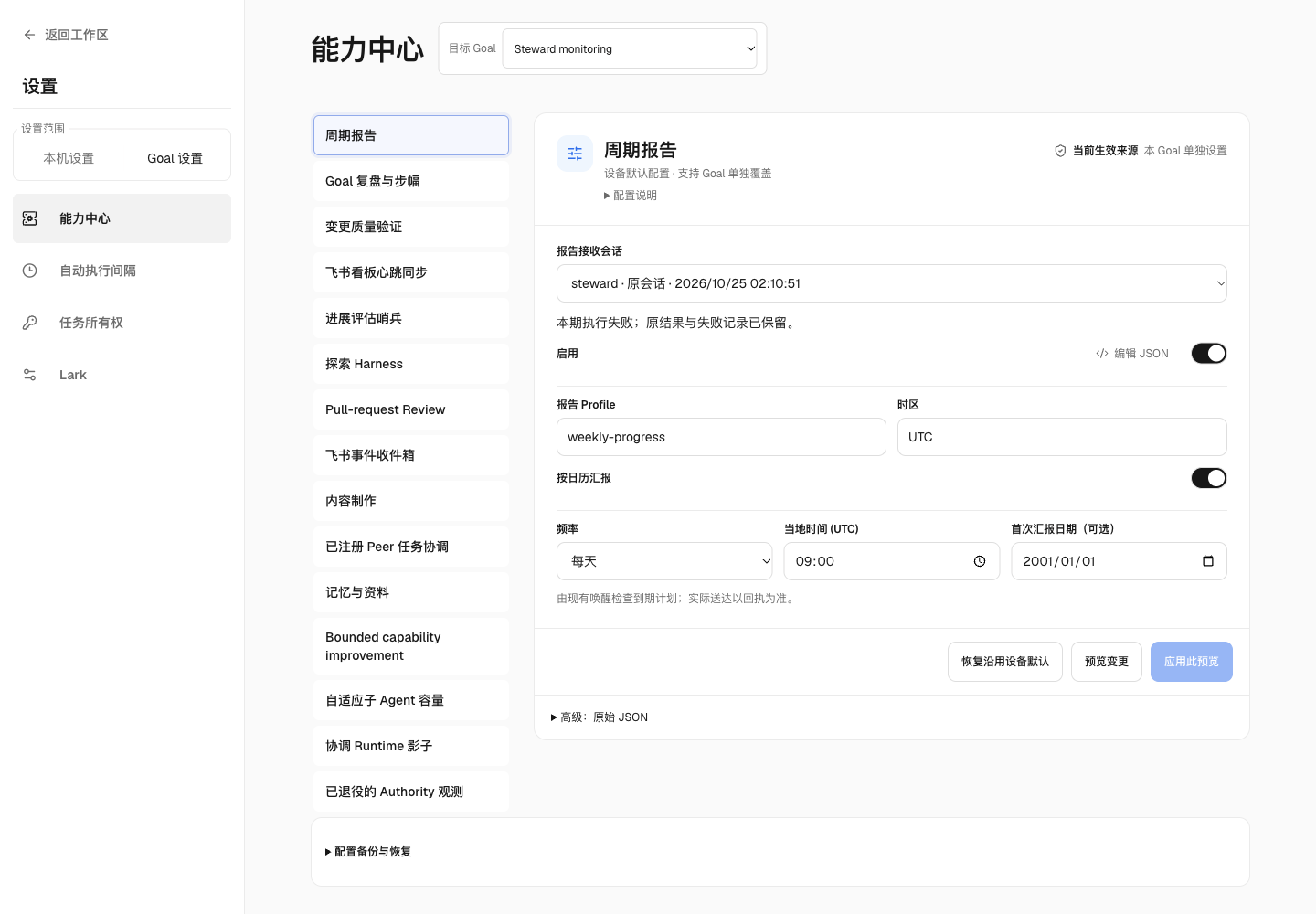
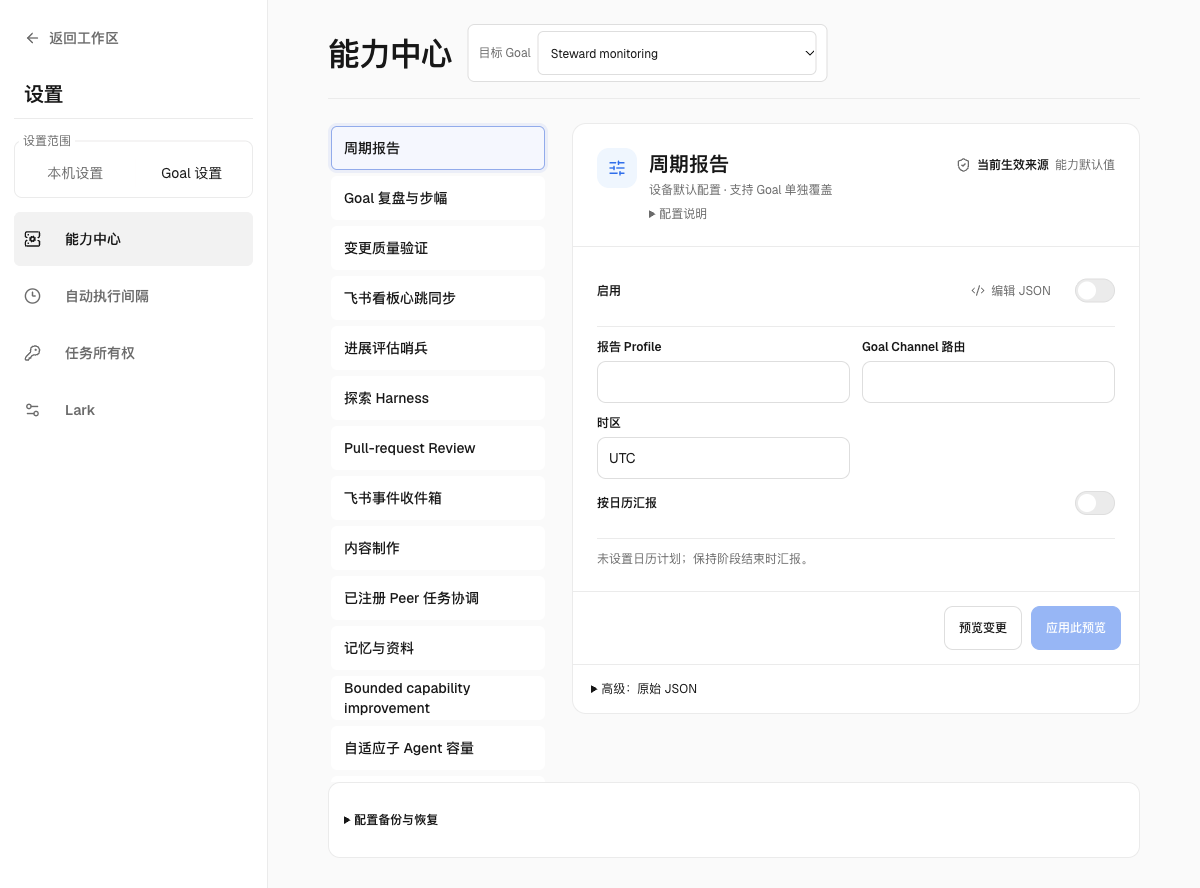
In Goal settings → Capability center → Periodic reports, use the
weekly-progress profile and choose an existing Report conversation.
The selector lists only this Goal's already bound managed Agent Sessions. It
does not create an Agent or assign a legacy Goal-wide conversation. Enable
reports, set a daily or weekly calendar and optional first date, then use the
existing preview/apply controls. Reload reads back the saved destination,
calendar and original conversation's execution/delivery status. No calendar
means no automatic local Session report; the status asks for a report time.
After verified delivery, Read this period's full report opens the existing
original-message report viewer, including its full body and Copy Markdown.
The link is available only while that exact returned body is readable.
This is an explicit Goal override. Machine defaults, registration, opening a
Session and installation do not enroll a conversation. The reserved route
managed-session:<original-session-id> is persisted in the existing
periodic-report configuration; it is a destination reference, not an execution
or permission grant. Other profiles and configured Goal Channel routes retain
their existing path. Local Session reports do not enter the generic CLI
report-consumption hook or gain a second Goal Channel delivery.
The existing idle host wake admits the calendar window into the selected Session's original Core worker. Native periodic-report owns the finite generation Todo, fixed window, frozen source/editorial artifacts, validator, publication candidate and cursor. Native Turn owns the original executor, lease, validation, completion and quota. Busy or queued user work has priority; another registered Agent cannot claim this route. Paused/stopped Goals, removed registration and replaced Session/Goal identities refuse execution.
The local source reads the complete original Goal's current native tasks and completed Agent history without a display limit, retaining full rows and observed times in the frozen source. The report distinguishes this fixed window's recorded completions from older history and current work. It does not reconstruct task state as of a past deadline, independently certify linked artifacts or read another Goal's portfolio. Source overflow or an unavailable complete read fails visibly rather than silently dropping trailing tasks.
After native generation commits, the adapter writes one complete report to that original Core conversation and independently reads back its exact body, message and Turn identity. Only then does the existing publication cursor advance. The normal Core finalizer uses the same message identity. A lost append/cursor response reconciles that original body after restart without a second model call or duplicate publication. Cached validated generation can resume only the native journal's permitted remaining effects; an earlier partial/failed answer remains historical evidence.
Use Enable to pause the same configuration; the original task, frozen window, failure and message history remain. Re-enable that exact plan to continue eligible native recovery. An unpublished frozen window prevents a schedule/destination change from stranding it. Failed/unknown generation is retained for repair by its original execution owner; toggling the setting does not replay it. After a known terminal generation failure, with no generated report or delivery attempt, Restore device defaults can clear this Goal's subscription through the existing preview/apply transaction. Verified apply blocks the original failed Task and retires its window without changing its artifacts, costs, Turn or publication cursor. Preview alone does not cancel. If cancellation is interrupted after the configuration clears, retry the same clear request: the original frozen Session identity and failure recover the remaining retirement, without a model call or replay. Re-enabling the same calendar does not retry that failed period; the next independent period can run. Existing reports and unknown or partial delivery retain the original protection. Natural-language schedule authoring and arbitrary task profiles remain part of the existing general recurring-task work.
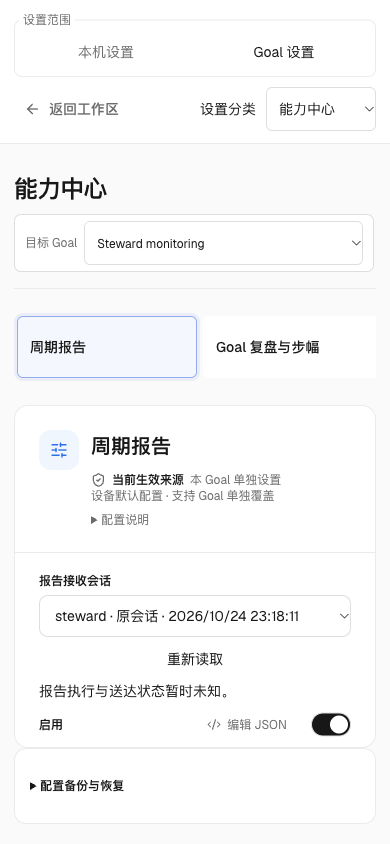
The packaged journey uses disposable Core/SQLite state and synthetic model and provider transports. It checks future-date inactivity, preview/apply/reload, one automatic full-body return, retained failure and pause. The 390×844 view is viewport emulation; this evidence does not establish real-model report quality, production backlog completion or a natural production deadline.
The cancellation check also uses that packaged UI and real disposable SQLite state: a synthetic invalid editorial result remains failed, clear preview leaves it intact, and applied clear retires it without another model call, message or provider send. File/SQLite regressions separately cover interrupted cancellation, unchanged artifacts and history, unknown effects and the next independent period.
| Retained failed period | Cleared Goal override, failure retained |
|---|---|
 |
 |
| Before: raw route | After: original Agent conversation and verified return |
|---|---|
 |
 |
| Temporarily unknown delivery state, narrow | Paused configuration |
|---|---|
 |
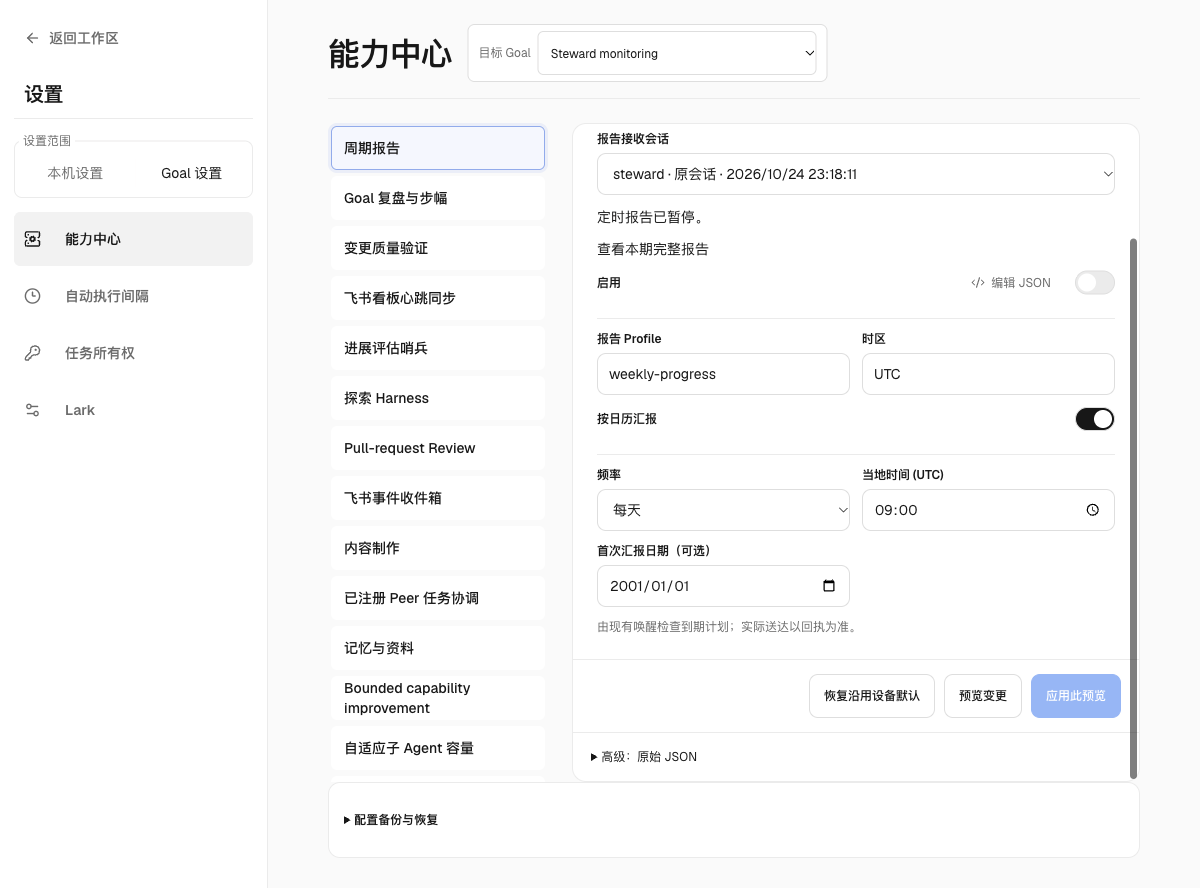 |
Original private steward
The original-Session host bridge now runs a bounded native Turn through the
existing Chat worker and Codex app-server connection. It uses the explicit
codex_app_server outer-controller profile, not Codex CLI execution or a
desktop App heartbeat. Fresh native work selection, independent validation,
writeback, quota and scheduler handoff remain with the existing Turn command.
It retains the original visible conversation, provider and portfolio grant.
With unchanged authorization it reuses the upstream model thread. For an
all-registered report whose authorized inventory or Goal lifetime changed before
execution, the existing context owner discards old model history and prepares a
fresh upstream context, records it through the existing context owner, then re-enters strict native
execution admission. No new user message is required to repair this context.
Selected-scope changes, revocation and changes during a model call still fail
closed. Busy/queued user work wins admission, and revoked or stopped sources cannot
commit a late model result. Same-request readback does not restart failed or
unknown work.
The native status-monitor producer now uses this original-Session bridge, with the separate no-model observation path described above. Identity preparation still leaves monitoring disabled. Calendar configuration, native generation and original private publication use the owners described above. A passing synthetic File/SQLite host journey does not establish an enabled production subscription, real model/report quality or natural deadline delivery.
- Qualify the native steward upgrade and rollback at an idle boundary. Verify one registered actor, preserved original history/requests/grants, and no change to ordinary assistants or other project Agents.
- Connect a real monitor deadline to that actor's native host and Turn driver. Verify not-due checks invoke no model; due, busy, pause and restart cases preserve one executor and native settlement.
- Add the authorized portfolio report source to periodic-report, project its next calendar deadline and configure the original private delivery route. Reuse the existing report settings and monitor views for edit/pause/cancel, next due time, last result, coverage and actual delivery status.
- Run semantic File/SQLite and host tests for fixed windows, unchanged-but-due reports, offline recovery, original audience, revoked grants, duplicate or unknown sends, partial delivery and late callbacks after cancellation.
- Qualify the exact final diff, publish and merge under the existing repository policy, install it, then independently verify original-service adoption, actual configuration and an end-to-end report. The first natural scheduled report remains a separate acceptance event.
Reading a fixed local evidence window
The existing private steward's evidence tool can read an exact report interval.
For example, a report ending at 09:00 uses view=deliveries, the authorized
goal_id, window_start=2026-01-01T09:00:00+08:00 and
window_end=2026-01-02T09:00:00+08:00. Both timestamps need offsets. The read
includes the start and excludes the end; it does not move the interval to local
midnight or to the time the report happens to run. The existing days lookback
keeps its calendar-day behavior and cannot be combined with these bounds.
Follow next_offset and pass the first page's source.source_revision as
expected_source_revision on subsequent pages. If the index changes, the reader
returns a conflict with no rows: restart that Goal's read rather than combining
pages from different revisions. Complete the authorized portfolio pagination,
including stopped Goals when requested; one Goal's page is not global coverage.
This exact-window interface currently supports local sources. It rejects these
arguments for SSH sources instead of silently substituting a remote lookback.
Use an observed row's source_ref as delivery_ref to recover its complete
permitted recorded_details and evidence references, with the same interval and
revision. A related task outside the overview is joined through its exact
canonical Todo read. Oversized, unavailable or changed records remain explicit
coverage gaps. Recorded delivery time is not necessarily actual work time;
reading a receipt does not read its referenced artifacts or independently verify
the Agent's claims.
This extends evidence reading in the existing conversation. It does not enable a report subscription, start a model, change a Goal, or send a report. Calendar admission, report generation and verified delivery retain their existing owners.
Authorized portfolio source
The same original conversation reader now accepts view=report_source with a
closed window_start/window_end. This composes the existing local portfolio,
Todo, fixed-window delivery and handoff readers. It enumerates every permitted
Goal, including stopped Goals; expands task excerpts and delivery details;
and reads each delivery's associated task, including completed records. It does
not read unregistered projects, SSH sources or referenced artifact contents.
Its delivery reads include typed outcome_gap records as counterevidence;
ordinary view=deliveries retains progress-only selection unless the caller
explicitly sets include_outcome_gaps=true. Neutral observations and untyped
host failures are outside that delivery source, so even complete pagination is
not a claim to have independently audited every failure or artifact.
The first call freezes one bounded snapshot in that Turn's reader. Source
observations and individual coverage gaps are rows too. Page through
next_offset, carrying source.source_revision. Later pages reuse the frozen
data, while the original live authorization check still wins over the cache.
Another Turn or a lost snapshot cannot resume at an old offset. An inventory
change, source revision conflict, outage, invalid/oversized row or read budget
limit remains an explicit coverage gap. Other readable Goals continue. Current
task and handoff state is observed at collection time; it is not an as-of-window
reconstruction or proof of a newly completed business outcome.
The provider's manager_portfolio_report_source_adapter composes with the
existing PeriodicReportAdapterRegistry using that authorized reader. Its
supporting items contain lossless JSON-string parts of the permitted evidence
rows, grouped by source_ref; decode each part's summary and concatenate in
item order. These are editorial input data, not audience-facing report prose.
The Agent still reads relevant referenced artifacts and authors the report.
There is no new state store or background loop. A capture allows at most 512
reader calls, 4,000 evidence rows and 4 MiB of evidence data, plus bounded source
coverage metadata; exhaustion is partial coverage,
not success or zero progress. These are IO bounds, not a model budget.
New private and managed-Session editorial requests carry the local artifact
format marker source_fact_binding=frozen_source_v1, also retained in the
frozen source so stripping it from the request cannot select legacy behavior.
Cache reuse, generation
and independent generation validation derive the complete ordered fact list
again from the unchanged frozen source, including its revision. A recomputed
request digest cannot substitute an unsupported URL, summary or incomplete fact
set. The generation receipt retains the same marker. Historical windows without
it keep their original validation contract and bytes; they are not retroactively
qualified or regenerated. This is source-to-fact consistency, not proof of a
claim, public disclosure permission or URL reachability. Opaque references stay
opaque when no permitted accessible source has been supplied.
This source can also be read through the original Chat dynamic tool. Reading alone does not activate a subscription or deliver a report. The opt-in original steward report path binds it to the admitted calendar window, native generation and private full-body delivery; installed adoption, current configuration and the original production route still need independent verification.
Repeat an existing native Task in a managed Session
Use this optional mode for “repeat this completed task on a calendar.” It uses an existing Goal, registered Agent and exact local managed Session. It creates no Goal, executor, recurring cron or separate task database. The source Task must already be completed, belong to that Agent and retain an independent argv validation declaration. Open, deferred, blocked, foreign and unvalidated tasks are rejected; configuring a calendar does not resume them or install commands. Report-generation and calendar-generated Tasks are already window-bound and cannot be sources themselves. Use the existing report calendar for reports. This uses the Goal's existing single calendar subscription. Selecting this mode replaces that Goal's previous subscription after the pending-window guard; it does not add another schedule beside an enabled report calendar. The original validator must check the repeated task's current expected outcome; a check pinned to an old output does not establish fresh business work. Scheduling preserves that declaration rather than improving its proof.
The existing Goal capability configuration transaction accepts:
{
  "goal_id": "example-project",
  "capability_id": "periodic_report",
  "configuration": {
    "enabled": true,
    "profile_preset": "session-task",
    "route_ref": "managed-session:11111111111111111111111111111111",
    "timezone": "UTC",
    "schedule": {
      "schema_version": "periodic_report_schedule_v0",
      "schedule_id": "repeat-completed-task",
      "timezone": "UTC",
      "rrule": "FREQ=DAILY;BYHOUR=9;BYMINUTE=0",
      "start_date": "2030-01-01"
    },
    "task": {"source_todo_id": "todo_completed_example"}
  }
}
Replace the example with the actual existing identities and requested time.
Prepare through /api/chat/goal-configuration/preview, then apply the same
body and its expected_plan_revision through
/api/chat/goal-configuration/apply. Read back the saved configuration and the
managed Session's scheduled_task inspection. A stale preview or changed identity is
rejected. This is an explicit Goal override: a machine default cannot enroll
another conversation. session-task is a calendar execution mode, not a report
renderer preset; it does not invoke the progress-report source or editorial
format. Task descriptions, scripts and validation argv cannot be supplied in
this configuration.
The current generic Goal editor does not register the task field. Its
form drops that source from the draft, and its JSON editor rejects unregistered
fields. It therefore cannot yet configure or edit this Task mode end to end;
the HTTP contract above and the read-only source catalog are partial product
delivery. Do not mistake a preconfigured fixture for a completed Task picker or
natural-language journey. Missing, empty, non-object or command-bearing Task
input is rejected as HTTP 400 before Session source inspection, without changing
the subscription, creating a window or invoking work. It does not infer a source
from an older configuration.
当前通用 Goal 编辑器尚未登记 task 字段:表单会在草稿中丢失原来源,JSON 编辑器也
拒绝未登记字段,因此完整任务配置界面仍未交付。上述 HTTP 合同和只读来源目录只是
阶段能力,预配置的合成场景不代表已完成 Task 选择器或自然语言旅程。缺失、空值、
非对象或夹带命令的 Task 输入在读取 Session 来源前即以 HTTP 400 拒绝,不改订阅、
不创建窗口、不执行业务,也不从旧配置推断来源。
For reproducible packaged checks, run the existing disposable browser fixture:
uv run --extra test python examples/personal-workspace-browser/steward_report_fixture.py \
  --managed-calendar-task sqlite --output-dir /tmp/loopx-calendar-task-qa
Use file instead of sqlite for the other native backend. ready.json names
the isolated HTTP URL, original Session, completed source and future disabled
configuration. The model computes an independently validated synthetic sum;
no real identity or private provider is attached. The start-existing-owners
control starts the real idle wake owner. stop-existing-wake stops only that
owner; removing it resumes the same stored state through a new wake-service
instance. observed.json records artifact, completion, retained history and
actual post-setup model calls. This qualifies neither live-model understanding,
complete Chat-process restart nor production delivery.
For a controller-restart check, stop that wake owner, await accepted work, then
write a unique operation token to restart-runtime in the same output directory.
The fixture closes the old controller and reconstructs the normal controller,
Chat store and transport over the original physical state, keeping its HTTP URL.
restart-readback.json verifies the original Session, actor and message history
and that restarting itself added no model or delivery effect. The wake owner
remains stopped until stop-existing-wake is removed. Reusing a token within
that fixture lifetime does not restart again. Missing stop or pending original
work writes restart-rejected.json and leaves the controller running; that
token cannot apply later after the condition changes. This is an isolated controller
restart inside the fixture process, not an OS-process or installed-service test.
test_same_calendar_task_lifecycle_retains_results_and_rejects_late_dispatch
joins settings changes, pause/cancel, restart, original result readback,
withdrawn Agent registration, late dispatch and three distinct calendar windows
in one File/SQLite journey. Paused and withdrawn stages must add no model call
or reply; each admitted window must have exactly one original Core result.
Callers can discover eligible references on demand with
GET /api/chat/sessions/<original-session-id>/native-turn?calendar_task_sources=true.
The calendar_task_sources view reads the original Goal's canonical completed
history, including archived Tasks, and applies the same original Agent and
independent argv-declaration checks used when configuring execution. It returns
Task references, display titles, validation digests and archive state, without
installing commands or copying validators into the configuration. Open work,
other Agents' work, report generation and generated calendar periods are not
offered as repeating sources. A missing, changed or unreadable declaration
fails this read visibly; it is not represented as an empty valid list.
Ordinary inspection omits this optional catalog. Repeated discovery does not
configure a subscription, wake an Agent, create a Task, invoke a model, spend
quota or send a message. Configuration and every due execution still recheck
the original source; a displayed reference grants no launch authority.
调用方可在原会话的 native-turn 读取中显式加入
calendar_task_sources=true,发现同一 Agent 可重复执行的已完成 Task,包含已归档项。
此只读视图复用原生已完成历史和执行入口的验收声明检查;返回原引用、显示标题、
验收摘要和归档状态,不传入新命令。未完成任务、其它 Agent 的任务、报告生成和
已生成的日历窗口不会成为候选。声明缺失、变化或不可读时明确失败,不伪装为空列表。
普通状态读取不加载此目录;重复发现不会启用计划、唤醒 Agent、创建 Task、调用模型、
扣额或发消息。保存配置和每次到期执行仍重新核验原来源。
At the first due boundary, the original idle Chat pump freezes the source Task's declaration into the existing cadence attempt. It creates one finite native Task for that window, inheriting the source Task's scope, repository, capability requirements, decision requirements and independent validation. TypeScript admission rechecks those declarations, the exact Session, Goal lifetime and current configuration. The same native Turn worker executes and settles it. Successful Task validation, native commit and the complete original Core answer must all read back before that period is acknowledged. This Task completion receipt is distinct from report/provider publication; it never claims an external message was sent. Source and previous-period Tasks may be read from canonical completed history after archival.
Completion reconciliation requires one native result matching the complete stored Turn result and a strictly readable original message journal. Duplicate or conflicting result events, malformed JSON and non-object message records leave completion unconfirmed. The calendar retains its window and configuration; settings cannot clear that uncertainty as a successful or known failed task. Once the original records are readable and unambiguous again, a restarted host can acknowledge that same result without another model execution or answer, then admit a later independent period. This path does not repair journal bytes.
Before the first deadline, while the Session has accepted user work, or while the schedule is disabled, this path starts no task model. Ordinary calendar and source reads still have local IO costs. Each actual execution uses native admission, a Task lease, independent validation and quota settlement. Token usage and fees depend on the configured host; the calendar makes no savings claim. Duplicate observations and a lost completion acknowledgement reconcile the existing Task and Core message without another model execution or answer. If the native transaction has committed and the Chat result-event append loses its acknowledgment, that same invocation may finish returning the original answer after reading exactly one event with the complete matching result. Missing, conflicting, duplicate or unreadable result events, and uncommitted transactions, retain their failure. This readback neither repeats native execution or settlement nor reopens historical failed Chat Turns.
Set enabled=false to pause new work and delivery; retain the rest of the
configuration to resume that plan. Clearing the override after a known failed
independent task-postcondition validation retains that Task and retires only
that window, after verified
configuration apply. Re-enabling cannot replay the failed period; the next
independent due boundary can execute. Unknown, partial or interrupted work is
retained for the existing native recovery owner; there is no automatic model
replay. A template/source change during an unfinished period cannot silently
replace the frozen task. Clearing or disabling this mode preserves ordinary
Chat, attached Sessions, existing reports and their histories.
This slice does not interpret conversation text as a subscription, configure an arbitrary future task that has no completed native source, send to an external destination, or finish the unified managed/attached Agent journey. Those remain part of the existing recurring-task work. Tests use real HTTP, File/SQLite, native Tasks/Turns and an independently checked synthetic model artifact; they do not establish live-model comprehension, installed adoption, a natural production deadline or a full frontend acceptance.
For rollback, pause or cancel through a runtime that understands this mode. Older runtimes do not understand its Task completion receipt; downgrading that Goal's calendar owner with retained Task windows is unqualified. Keep the compatible reader and original evidence, rather than deleting the journal to make an older reader accept it. Ordinary feature-off Goals create no new calendar Task or Task receipt and retain their existing rollback path.