goal_vision_replan_contract_v0
goal_vision_replan_contract_v0 defines the small per-agent contract that
connects bounded agent vision, autonomous replan, dreaming proposals, and
goal-routing projection. It is a kernel contract, not an auto-research preset.
The purpose is to keep both the user layer and the product preset thin:
- the user supplies intent and small overrides;
- the preset supplies domain defaults and handoff hints;
- the kernel owns bounded per-agent vision, replan state transitions, and the read/write protocol used by quota and status.
Every vision packet and checkpoint is scoped by agent_id. Goal-level
projection may aggregate the resulting gaps, but it must not let one role's
vision drift or missing closeout satisfy, block, or wake another role.
Ownership Boundary
| Layer | Owns | Must Not Own |
|---|---|---|
| User | Objective, optional role overrides, and optional data/eval entrypoint. | Vision state-machine transitions, replan recovery policy, quota routing, or raw agent scratchpads. |
| Preset | Domain roles, handoff hints, metric/evidence adapters, and compact default acceptance text. | Long-lived replan mechanics, pane-local tick policy, generic successor routing, or product-specific forks of the kernel state machine. |
| Kernel | CLI-enforced vision budgets, vision/replan state transitions, goal-route projection, todo/evidence/status protocol, and compact default prompts. | Domain-specific research logic, benchmark scoring, support triage semantics, or sales workflow semantics. |
loopx/quota.py should consume the final goal_route_projection or
goal_frontier_projection. It should not grow per-agent vision storage,
budgeting, dreaming, or product-specific replan logic.
CLI Budget
Per-agent vision is an executable control-plane field, so the CLI/write API must enforce a hard size budget before the state reaches quota, status, or a visible agent pane. Long reasoning belongs in evidence artifacts or design docs.
| Field | Max chars | Purpose |
|---|---|---|
vision_summary |
420 | Current role-specific direction and success shape. |
role_scope |
280 | What this agent owns and must not own. |
acceptance_summary |
420 | Compact completion contract for this agent. |
advancement_policy |
32 | as_needed or repeat_until_closed. |
replan_trigger_summary |
240 | Why the latest replan is required. |
dreaming_policy |
240 | Whether advisory dreaming can propose a patch. |
last_patch_summary |
240 | What changed in the latest bounded vision patch. |
total_agent_vision |
1800 | Aggregate budget for one agent's active vision packet, including path delta and fallback declarations. |
The aggregate allowance was raised from 1,200 to 1,800 characters to accommodate direction, acceptance and evidence-linked replanning together. This is additional authoring headroom, not a target length or a larger quota-response budget. Summary field limits, list cardinalities and the 240-character unchanged reason remain unchanged; concise evidence references still replace long reports. Older packets remain valid. Older runtimes may reject newly admitted larger packets, so use an updated runtime for writes and preserve the original intent when correcting input.
整包预算从 1,200 提升到 1,800 字符,让方向、验收与路径调整能够共同表达; 这不是要求填满的长度,也不扩大 quota 输出预算。摘要字段、列表数量及 240 字符的 unchanged reason 限制不变,旧数据继续可读,较大新包需使用新版运行时写入。
Required write-path behavior:
- Reject over-budget writes with
vision_budget_exceeded, including the current character count, field limit, and a compact suggested replacement when the offending field is known. - Do not silently truncate fields; truncation hides control-plane intent.
- Store verbose rationale as evidence and reference it by id.
- Keep the latest bounded packet visible in status/quota so agents can reason without reading private scratchpads or chat history.
The normal lightweight CLI write boundary is loopx refresh-state with inline
vision patch fields:
loopx refresh-state \
  --goal-id <goal-id> \
  --agent-id <agent-id> \
  --vision-summary "<bounded direction>" \
  --vision-acceptance "<bounded acceptance>" \
  --vision-advancement-policy repeat_until_closed \
  --vision-replan-trigger "<why the frontier is insufficient>"
advancement_policy is a small machine-readable frontier rule, not a domain
label. It defaults to as_needed, which preserves bounded external waits only
when the wait belongs to the current vision, current blocked Todo, or its
explicit successor lineage. An unrelated deferred Todo or historical ACK
cannot suppress an acceptance gap. Use repeat_until_closed for campaigns,
iterative research, sweepers, and other visions whose open acceptance requires
another advancement iteration whenever the runnable advancement frontier is
empty. In that mode, monitor observations remain useful evidence but cannot
satisfy advancement continuation by themselves. A fresh evidence-linked vision
path outcome, new concrete blocker, coverage-backed terminal result, or a
closed/superseding vision resolves the duty.
For machine-generated or multi-field patches, the same command also accepts
--agent-vision-json <packet.json>. The two forms are mutually exclusive and
both pass through the same budget validation. When a vision-derived replan duty
is open, a valid packet counts only when it carries a fresh evidence-linked path
outcome accepted by the shared semantic write gate. An invalid, over-budget, or
pathless packet fails instead of recording a partial closure. A matching typed
semantic ACK settles the vision-derived duty even while the original acceptance
gap remains visible in the source projection.
Quota's replan writeback projection and write-time outcome matching share
work_items/replan_semantics.ts. Every vision-derived trigger, including a
missing required baseline, projects evidence-linked JSON authoring through
replan_action_packet.writeback_contract; limits come from the existing vision
validator. This is guidance for a valid refresh path, not a new obligation or
the removal of typed successor/blocker/terminal alternatives. A new surface id
alone cannot satisfy a vision obligation. Execute the current settlement binding
exactly once; accepted semantic writeback, satisfied checkpoint, settled Turn
and Goal completion remain separate facts. Existing missing-checkpoint recovery
stays on the original Turn, and in-flight continuation remains unchanged.
投影与写入校验共用 TS 语义规则;required-vision 不再投影只有普通进度标识的模板。 JSON 写作契约复用 vision 校验器,不新增 ACK 仪式,也不改变既有 successor、blocker、 terminal 出口。语义接受、checkpoint 满足、Turn 结算与 Goal 完成仍须分别验证。
Inline vision writes require --agent-id. JSON packets must also resolve to
the same agent_id as the refresh run. This keeps research-executor,
evaluator-promoter, and other roles from overwriting or satisfying each
other's active vision.
Path Delta
A vision packet may include a top-level path_delta object; goal_path_delta_v0
is its schema_version, not its enclosing field. The shared TypeScript authoring
boundary rejects misplaced declared deltas before any write, including through
CLI and Turn. It does not infer a protocol from ordinary metadata field names.
Existing packets may omit the nested schema version; an explicitly supplied
version must match. The look-back rides the existing --agent-vision-json
boundary, so it stays explicit without adding more inline CLI flags or expanding
the heartbeat prompt. Historical read compaction remains unchanged.
{
  "vision_patch": {"vision_summary": "Deliver the verified successor."},
  "path_delta": {
    "schema_version": "goal_path_delta_v0",
    "outcome": "replan",
    "prior_assumption": "Polling would produce acceptance evidence.",
    "observed_reality": "Repeated polls produced no material transition.",
    "retained": ["Keep the verified monitor target."],
    "changed": ["Create one runnable advancement successor."],
    "stopped": ["Stop treating polling as completion evidence."],
    "evidence_refs": ["evidence:monitor-poll", "todo:successor"]
  }
}
outcome is one of continue, replan, wait, no_change, ask_human, or
stop. prior_assumption and observed_reality are required when the object
is present, together with at least one retained, changed, or stopped
item. The remaining optional lists preserve unresolved questions and
public-safe evidence ids. The enclosing
vision packet's agent_id records who made the comparison; evidence_refs
point to evidence instead of copying long rationale or raw artifacts.
The path delta shares the 1,800-character total_agent_vision budget.
prior_assumption and observed_reality each allow 320 characters (previously
220); reentry_condition remains limited to 180. Keep/change/stop lists accept
at most three 120-character items, unresolved questions at most two
140-character items, and evidence refs at most four 140-character items. The
write path rejects excess data instead of silently truncating it. This is a
compact audit/read model, not a second planner or a new state machine. An
honest no_change remains valid when the observed reality does not justify a
different path.
state is a lower snake_case lifecycle token. Domain-specific states remain
extensible and are treated as open. The write path canonicalizes closure aliases
such as closed, satisfied, and vision_satisfied to vision_closed, and
closed_no_followup to no_followup. Quota/status use the same centralized
closure predicate when reading older persisted packets, so a legacy alias cannot
silently reopen a satisfied vision. Prose or malformed state values fail at the
write boundary with an actionable error.
When a valid packet includes replan_trigger_summary, status/quota projects it
as goal_frontier_projection.acceptance_gaps[]. If no runnable advancement
frontier remains, that gap is evaluated before monitor quiet skip and can
produce autonomous_replan_required. This is the intended self-discovery path:
an agent records the bounded reason the current vision is still incomplete, and
LoopX turns that reason into the next replan obligation without relying on chat
memory or owner reminders.
Vision Checkpoint
refresh-state always emits a per-agent vision_checkpoint_v0, and defaults
to the semantic_closeout delivery boundary. A material delivery outcome or a
durable ## Next Action update at that boundary requires an explicit vision
decision:
{
  "schema_version": "vision_checkpoint_v0",
  "agent_id": "research-executor",
  "required": true,
  "satisfied": false,
  "decision": "missing_required",
  "delivery_boundary": "semantic_closeout",
  "triggers": [
    {"kind": "material_delivery_outcome", "delivery_outcome": "outcome_progress"}
  ],
  "required_resolution": ["write_vision_patch", "record_unchanged_reason"]
}
One explicit exception exists for in-flight delivery. When quota admits an
open advancement Todo for normal delivery, its settlement guidance may add the
boundary below. After a resulting delivery_outcome=outcome_progress, the next
heartbeat separately prefers that same Todo while its typed facts stay valid:
loopx refresh-state \
  --goal-id <goal-id> \
  --agent-id <agent-id> \
  --todo-id <selected-open-todo-id> \
  --delivery-outcome outcome_progress \
  --delivery-boundary in_flight_continuation \
  ...
This boundary is valid only for the selected agent-bound or unclaimed open
advancement Todo while it is still in flight. It rejects Todo completion, a
durable Next Action update, autonomous replan writeback, and any outcome other
than outcome_progress. Its checkpoint has decision=not_required,
required=false, and a typed
in_flight_continuation trigger carrying the Todo id. The next quota decision
can therefore preserve causal ownership without manufacturing another vision
decision merely because the scheduler woke up. Agents must start from
interaction_contract.cli_channel.next_cli_actions[0] and preserve its
projected boundary and identity flags; reconstructing a generic
semantic_closeout command discards that continuity contract.
Omitting --delivery-boundary remains strict semantic_closeout. Todo
completion, outcome_gap, primary_goal_outcome, durable route changes,
replan, and terminal/no-follow-up decisions must use that boundary. This is a
vision/Todo domain transition, not a lighter Effect Program or settlement:
validation, durable writeback, receipts, and quota accounting still run on
every heartbeat.
Valid checkpoint decisions are:
patched: the refresh wrote a boundedagent_visionpacket for the sameagent_id;unchanged_with_reason: an already persisted current per-agent vision still applies, with a compact public-safe reason. A reason cannot create the first vision baseline; without one, the checkpoint remainsmissing_requiredand requireswrite_vision_patch. TypeScript binds the decision to that vision's exactgenerated_atrevision throughcontinuity_basis;missing_required: the turn was material but did not make a per-agent vision decision; andnot_required: no material closeout trigger was present, including a valid typed in-flight continuation.
A material closeout should carry its own vision patch or evidence-backed unchanged
reason. If omitted, refresh-state still records the outcome and returns the
checkpoint repair action. Follow that action in the same turn with the original
settlement identity, removing already executed state mutations. The supplement
must satisfy the checkpoint before terminal closeout; it neither re-authors the
outcome nor spends a second time. Never invent an unchanged reason to clear a gap.
Typed in-flight continuations keep their existing exemption.
missing_required is not a chat reminder. Status keeps it in compact run
history, quota filters it by current agent_id, and goal-frontier projection
turns it into acceptance_gaps[]. If the current agent has no runnable
advancement frontier, that gap can trigger autonomous_replan_required.
For the same agent_id, a newer satisfied checkpoint with patched or
unchanged_with_reason supersedes older
missing_required checkpoints; not_required does not.
A satisfied checkpoint is protocol-complete, but a material closeout also has
to qualify its relationship to the final outcome. A patched checkpoint must
name the active acceptance_summary, attach public-safe
goal_path_delta_v0.evidence_refs, and record one of these decisions:
continueorno_changewhen the new evidence supports the final-outcome path and the delivery did not reportoutcome_gap; orreplanwhen the evidence contradicts or leaves the path open. The typed path outcome is itself the vision decision; it does not rely on a legacy autonomous-replan ACK flag.
An unchanged_with_reason checkpoint may reuse that evidence-linked path only
when its typed continuity_basis matches the exact current vision revision and
the persisted path already carries the acceptance claim, evidence refs, and a
legal path outcome. A missing or mismatched basis, an evidence-free prior path,
or a newly missing checkpoint opens a new outcome gap. This closes the accepted
revision without suppressing a later material vision/checkpoint change.
An older path delta, an unchanged-with-reason decision, or an unrelated
runnable todo does not qualify the material closeout. Quota projects
vision_outcome_checkpoint_required ahead of ordinary runnable work until a
fresh evidence-linked continuation or replan is recorded. The same rule
applies when a same-agent advancement todo was completed after the latest
qualifying checkpoint. Todo completion is therefore the checkpoint timing
signal, not proof that the final acceptance contract is done; the evidence
decides whether to continue, replan/supersede, or close.
Checkpoint packets, context-delivery receipts, manual evidence reads, and historical autonomous-replan ACKs are protocol records, not semantic completion proof. A future monitor schedule is also not completion proof; it only says when to poll. If evidence, successor state, blocker state, or a superseding vision packet still shows the vision is unmet, the acceptance gap remains authoritative and quota must continue to project replan work. The write-time gate derives that same obligation from the goal-frontier reducer, so a maintenance classification or an ACK for an earlier periodic duty cannot bypass a newly rotated vision duty.
Semantic History Continuity
run_history.goals[].latest_runs is a strictly bounded recency drill-down. It
must not grow beyond its requested display limit to preserve older control
records. Long-lived goal semantics instead use goal_semantic_history_v0, a
per-agent read model whose size grows with participating agents rather than
heartbeat count.
Each agent lane independently selects the latest active vision (or explicit retirement), latest checkpoint, latest outcome-relevant checkpoint, latest autonomous-replan ACK, and latest material milestone. The goal also retains the latest compact human reward as the owner-correction slot. Repeated quota spend, monitor polling, promotion readiness, and ordinary refresh rows do not consume these semantic slots.
The outcome-checkpoint slot retains its same-run qualification vision. A newer
plain refresh may become the latest general checkpoint, but it cannot hide the
older material checkpoint or borrow a later path delta. Likewise, another
agent's qualified checkpoint cannot satisfy the selected lane. Goal-frontier
readers prefer this semantic context and fall back to latest_runs only for
older status payloads that do not carry the new read model.
Agent-scoped status keeps only the selected agent's semantic lane plus the compact owner-correction slot on the hot path. Whole-goal, all-agent history remains available through unscoped status/history diagnostics. This keeps final-outcome continuity authoritative without turning a long heartbeat thread into an ever-growing CLI payload.
Vision Continuation Audit
Every selected todo is a bounded step toward the active per-agent vision, not a
replacement for that vision. Before an agent records todo complete, a
no-follow-up rationale, --vision-unchanged-reason, or an autonomous replan
ACK, it must audit the current evidence against the active
acceptance_summary:
- Derive the explicit requirements from the active vision, current todo, user correction, and protected scope.
- Name the authoritative evidence for each requirement: changed files, public-safe evidence records, public web research findings, evaluation outputs, successor state, blocker state, or a superseding vision packet.
- Treat weak, indirect, stale, or protocol-only evidence as incomplete.
- Before external research, inspect the selected goal's registry-declared
topic_authorityandproject_materials, preferring the host-projected replan coverage ledger,agent_material_frontier, and projected required reads. Use role, freshness, revision, boundary, gate status, and conflict rule to select permitted references. Registration guides discovery; it neither grants access nor proves acceptance. - If projected evidence and permitted registry references remain weak, and the acceptance question depends on public facts, run bounded public web research from primary or authoritative sources and write back the confirmed/refuted finding.
- If any requirement remains unproven, keep the vision active by creating a
successor todo or writing a compact
--vision-replan-trigger.
Quota/status expose this as vision_continuation_audit_v0 in the CLI payload
and interaction_contract. This mirrors the /goal continuation rule: goal
state persists across turns until evidence proves the requested end state. It
prevents a role from declaring success merely because it consumed the currently
selected todo, recorded a checkpoint, or observed that another lane is quiet.
A typed progress observation with result_class=no_followup is coverage
evidence, not Todo lifecycle settlement. A writeback may use its
coverage_backed_no_followup outcome only when the same packet closes the
agent vision with state=no_followup and records path_delta.outcome=stop.
If a completed advancement Todo still lacks a successor, the agent must first
settle that Todo through loopx todo complete --no-follow-up (or add/link a
successor). A semantic ACK cannot replace this durable continuation, and the
repair path must not invent a human gate without a real external authority.
The audit also exposes a compact deterministic vision_gap_judge_v0
instruction packet for the agent. It borrows the strict done-judge stance used
by autonomous goal loops without calling an LLM: the agent is told to compare
the active vision acceptance_summary with the host-projected coverage ledger,
then permitted registry-declared material references. The agent-scoped
loopx evidence-log remains an operator diagnostic, not a mandatory model ritual.
Bounded public web research is the next
fallback when those sources are missing or stale and the gap depends on public
facts. done=true is only valid
when the response or state clearly provides one of these outcomes:
- explicit completion with authoritative evidence;
- final deliverable or evaluation output satisfying the acceptance summary;
- a projected blocker/user gate that makes the goal unachievable without input;
- a superseding vision or no-follow-up rationale that explicitly closes the frontier.
Otherwise the judge remains continue and quota should keep projecting either
the runnable successor or the replan trigger. This is intentionally stricter
than todo lifecycle status: a completed todo is only evidence input, not the
judge result.
State Machine
stateDiagram-v2
  [*] --> Unset
  Unset --> DraftVision: goal configured or preset seeded
  DraftVision --> ActiveVision: CLI budget + acceptance validated
  ActiveVision --> VisionDriftDetected: frontier exhausted or objective shifted
  ActiveVision --> DreamProposal: advisory dreaming proposes a bounded patch
  VisionDriftDetected --> ReplanRequired: trigger accepted
  DreamProposal --> ReplanRequired: proposal needs delivery routing
  ReplanRequired --> ReplanDrafted: bounded plan + todo delta prepared
  ReplanDrafted --> VisionPatchProposed: patch updates vision and route
  VisionPatchProposed --> ActiveVision: budget + write correctness validated
  ActiveVision --> Superseded: goal route replaced
ActiveVision --> Retired: acceptance done or no-follow-up recorded| State | Meaning | Required Exit Evidence |
|---|---|---|
Unset |
No per-agent vision packet exists. | Goal configuration or preset seed. |
DraftVision |
A bounded packet is being prepared. | CLI budget validation and acceptance text. |
ActiveVision |
Agents may use the packet for lane-local work. | Progress, evidence, replan trigger, or retirement. |
VisionDriftDetected |
Current vision no longer explains the frontier. | Concrete trigger, not vague "needs planning". |
DreamProposal |
Advisory planning suggests a patch. | Explicit proposal id and public-safe summary. |
ReplanRequired |
The next bounded work is replan, not quiet wait. | Replan obligation in goal-route/frontier projection. |
ReplanDrafted |
A concrete route/todo/acceptance delta exists. | Bounded patch packet. |
VisionPatchProposed |
The patch is ready to apply. | Budget check and local-state write correctness. |
Superseded |
Another route replaces this packet. | superseded_by or successor id. |
Retired |
The route is complete or intentionally closed. | Acceptance evidence or no-follow-up evidence. |
The canonical stored close states are vision_closed, retired,
retired_or_superseded, superseded, and no_followup. A state such as
completed_current_slice intentionally remains open because completing one
slice is not evidence that the per-agent vision acceptance is satisfied.
These close states do not all have the same succession meaning.
vision_closed means the current bounded stage passed its acceptance; while
the registry goal remains active (including active-* variants), quota must
project vision_successor_required and run a bounded replan before ordinary
advancement or monitor quiet. The agent must write the next bounded vision, or
choose the explicit terminal lane semantics retired, superseded, or
no_followup. A completed/archived registry goal does not need a successor
vision. This keeps stage completion from silently terminating a long-horizon
goal.
Exact blocked-successor wait
An open agent vision can wait when every causal Todo binding of its ordinary
acceptance gap has a related current-agent or unclaimed advancement successor
whose supported resume_when condition is projected as resume_ready=false,
or an exact current-agent blocker with a reason. One route's wait cannot cover
another uncovered binding. When there is no other selectable advancement, quota/status expose
goal_vision_wait_state_v0 with the waiting todo id, resume_when, compact
resume_condition, and automatic_resume=true. The ordinary
vision_acceptance_gap is deferred while that read model is active, so the
agent can remain quiet instead of inventing duplicate successor work.
This is a read model, not a stored vision or todo lifecycle state. When the
condition becomes ready, normal open-todo or deferred-successor routing resumes
automatically and the active vision remains available for acceptance auditing.
It cannot suppress vision_checkpoint_missing, vision_successor_required, a
resume condition that lacks exact projected evidence, or the dedicated repair
for an advancement todo incorrectly gated by a standing continuous monitor.
The normal refresh-state --vision-todo-delta <action>:<todo_id> and Turn vision
write paths supply the causal bindings. Todo create/update/complete/supersede
and resume evaluation supply their current facts. A planned create/reopen
entry is a binding to inspect, not proof that its Todo exists. An agent changes
the active bindings through the existing vision writeback contract when the
plan changes; finishing a Todo alone does not prove its acceptance is closed.
Explicit successor lineage can connect a completed or archived predecessor to
a real waiting successor. Sharing a prerequisite does not make two sibling
Todos interchangeable, and a terminal vision keeps its existing lifecycle rules.
Wait witnesses are derived from canonical Todo rows and evaluated conditions
before display compaction. agent_todos.vision_wait_states carries only those
positive, agent-scoped results, bound to causal_todo_ids; each source read
rebuilds them for the latest vision. It is not a stored or separately authored
state. Quota and semantic writeback use the same coverage reducer. Display
limits remain unchanged: extra unrelated Todos and reordering cannot change
the wait decision. If a legacy/incomplete source cannot prove coverage, the
existing acceptance gap stays open; missing display rows do not prove that
canonical work is absent or that all alternatives are exhausted.
This tightens the previous any-related-wait behavior. With bindings to A and B,
A waiting and B unmaterialized requires replan when execution gates permit it;
a runnable B continues, and related valid waits for both preserve defer. The
rule uses existing acceptance/lineage facts regardless of the optional advisory
fallback_declarations. It neither discovers alternatives nor invents AND/OR
relationships, and it grants no additional authority. Ownership, exclusions,
capabilities, user gates, and quota remain independent execution constraints.
等待资格现在逐项检查已有 acceptance 的 Todo 关联,并在展示裁剪前从完整来源计算。 A 的等待不能遮住尚未落实的 B;有可执行工作则继续,相关工作都具有合法等待证据才暂缓。 无需另外维护 fallback 声明;无关 Todo 的数量和顺序不应改变决策。
Replan Triggers
A replan trigger is goal-level and should be evaluated before lane-local quiet or agent-scope wait decisions:
- normalized progress shows no remaining advancement frontier;
- monitor-only lanes have no material transition and acceptance remains open;
- a cleared handoff has no successor or no-follow-up rationale;
- the current agent lane has a long selectable todo chain, such as 15 or more advancement todos or roughly 20 open todos with advancement work still present;
- a periodic autonomous replan obligation is due;
- the user objective or acceptance contract changed;
- an approved dreaming proposal requires a delivery route.
The replan decision must not be disturbed by monitor quiet skip, scoped gate waiting, or a single agent having no runnable todo. Those may explain local lane state, but they cannot erase a required goal-level replan.
Replan Output
A valid replan writes at least one bounded delta:
{
  "schema_version": "goal_vision_replan_contract_v0",
  "goal_id": "example-goal",
  "agent_id": "research-curator",
  "state": "vision_patch_proposed",
  "vision_patch": {
    "vision_summary": "Map the next evidence frontier and hand off one runnable claim.",
    "role_scope": "Owns research framing; does not run evaluation.",
    "acceptance_summary": "One concrete successor todo plus evidence refs.",
    "replan_trigger_summary": "Frontier exhausted while acceptance remains open."
  },
  "path_delta": {
    "schema_version": "goal_path_delta_v0",
    "outcome": "replan",
    "prior_assumption": "The existing frontier could satisfy acceptance.",
    "observed_reality": "No runnable advancement remains.",
    "retained": ["Keep verified evidence and the acceptance boundary."],
    "changed": ["Route one new bounded successor."],
    "stopped": ["Stop repeating the exhausted action."],
    "evidence_refs": ["evidence:frontier-review-01"]
  },
  "todo_delta": ["create_successor", "retire_stale_monitor"],
  "validation": {
    "budget_checked": true,
    "write_correctness_checked": true
  }
}
An acknowledgement without an obligation-accepted typed semantic delta is
replan_noop and must not clear the obligation. Depending on the obligation,
accepted outcomes can be a new evidence-backed surface, hypothesis, or probe
family; a runnable successor; a new concrete blocker; coverage-backed
exploration exhaustion or no-follow-up; or a fresh evidence-linked vision path
outcome. A typed goal_vision_patch repair delta is the vision-derived ACK that
settles vision successor/checkpoint gaps even when the original acceptance gap
remains visible in the source projection. refresh-state does not treat
classification prose,
--autonomous-replan-recorded, or a caller-supplied repair kind as proof. New
writebacks use typed_progress_observation_v0: changed surface, hypothesis, or
probe identifiers are compared with the obligation baseline; a successor id
must resolve to a current runnable advancement Todo; blockers must be new and
evidence-backed; terminal results require coverage scope and evidence. A
vision-derived duty accepts only its declared vision outcomes. Historical
repair ACKs are not accepted by the semantic replan reducer; they remain inert
history rather than a compatibility closure path.
The compact autonomous_replan_ack projection preserves the aggregate
fresh_vision_path_outcome in semantic_delta and, when that outcome is
present in the validated outcomes list, adds the same run's
agent_vision.path_delta.outcome as top-level path_disposition. Only
continue, no_change, and replan are projected. The field is additive and
observational: it does not alter settlement, and it is omitted for non-vision,
legacy, or invalid path packets. Consumers should inspect outcomes rather
than only satisfying_outcomes, because one accepted ACK may combine a vision
path observation with a different obligation-satisfying outcome.
Bad Case: ACK Hidden By Scheduler Accounting
Observed failure: a monitor-only lane correctly projected
autonomous_replan_required, then a worker recorded a replan ACK with a
frontier delta. The next quota check became quiet, but a later neutral spend or
accounting run replaced the latest status record. Because quota only saw the
latest run, the same monitor lane was projected as autonomous_replan_required
again, causing a scheduler/replan loop.
Root cause: replan ACK state was treated as latest-run detail instead of a durable goal-frontier projection. Scheduler/accounting records are useful history, but they are not material frontier changes.
Repair rule: status must project the newest durable replan ACK across neutral accounting and monitor-poll runs until a real material transition appears. Quota then consumes that compact projection and does not duplicate the history scan or let scheduler backoff override the replan state machine.
Projection Contract
Status, quota, diagnose, and visible multi-agent panes should expose the same compact goal-route facts:
normalized_progress: how far the goal has moved relative to acceptance;remaining_frontier: runnable or replanable next edges;monitor_only_lanes: lanes that are waiting without advancement;deferred_successors: successors blocked by handoff, resume, or gate;acceptance_gaps: missing evidence or contract fields;autonomy_blockers: concrete blockers to autonomous progress;vision_budget: current character usage and any rejected overage reason.
These fields are projections. Writeback still goes through LoopX write APIs, not through dashboards, Lark mirrors, or chat text.
When quota requires an autonomous replan, the host projects the current agent's
recent public-safe evidence ledger into replan_context_v0; a weak
protocol-following model does not need to discover and execute a separate read
ritual. A todo-specific evidence read remains useful as drill-down, but its
receipt proves only context access. If projected evidence is empty, stale, or
contradictory, the agent may use bounded public-safe search and write back
source references with the typed observation.
Write / Correction Mechanism
After a material milestone, vision_outcome_checkpoint_required remains a
completion guard. When the checkpoint is satisfied and current, the path outcome
is continue, no_change, or replan, evidence refs are present, and no
outcome_gap was reported, an absent or blank vision_patch.acceptance_summary
is diagnosed as final_outcome_claim_missing. Add or restore a bounded claim
supported by those evidence refs; a learning milestone alone does not prove
the final outcome. Keep the valid route and evidence in the correction. The
existing durable-field write gate still requires path_delta.outcome=replan
when changing the claim against an open replan obligation; record that bounded
claim correction rather than repeating a generic path investigation.
The gap and replan trigger carry reason_code, component_checks, and
resolution_hint. The same diagnostic appears in the compact CLI audit,
managed Turn contract capsule, Goal acceptance observations, and Lark projection
rows. Component checks distinguish checkpoint satisfaction and freshness, path
validity, evidence presence, claim presence, and reported outcome gaps. Other
incomplete combinations retain the guard and use
final_outcome_checkpoint_incomplete. Diagnostics are read-only: retrying
quota should-run neither spends quota nor supplies acceptance evidence, and
the added explanation does not change the obligation's identity.
Synthetic Goal acceptance views (read-only fixture, no connected execution service) show the missing-claim diagnosis and passed/failed components:
| View | Before | After |
|---|---|---|
| Desktop, Chinese | Before | After |
| Mobile, English | Before | After |
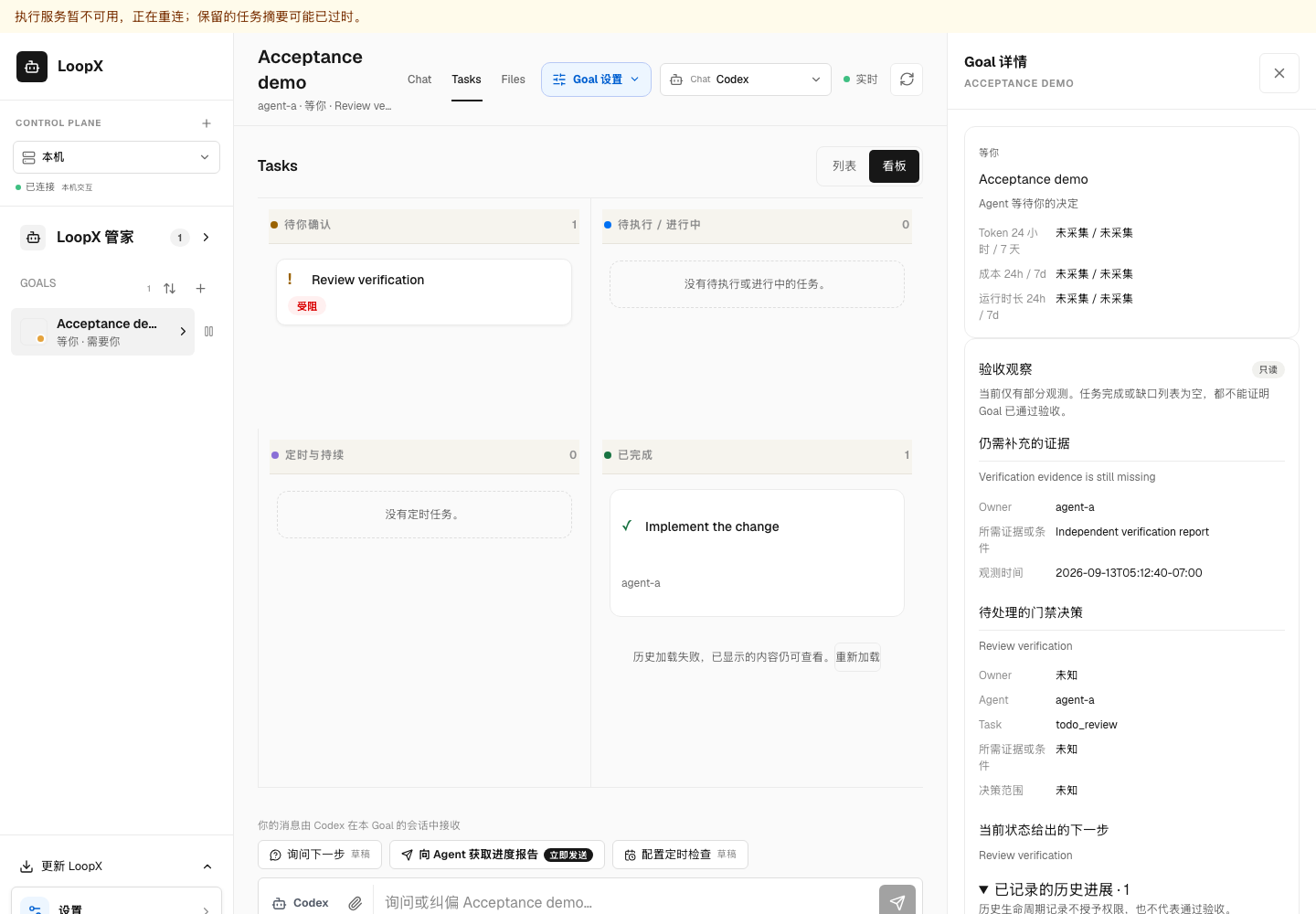
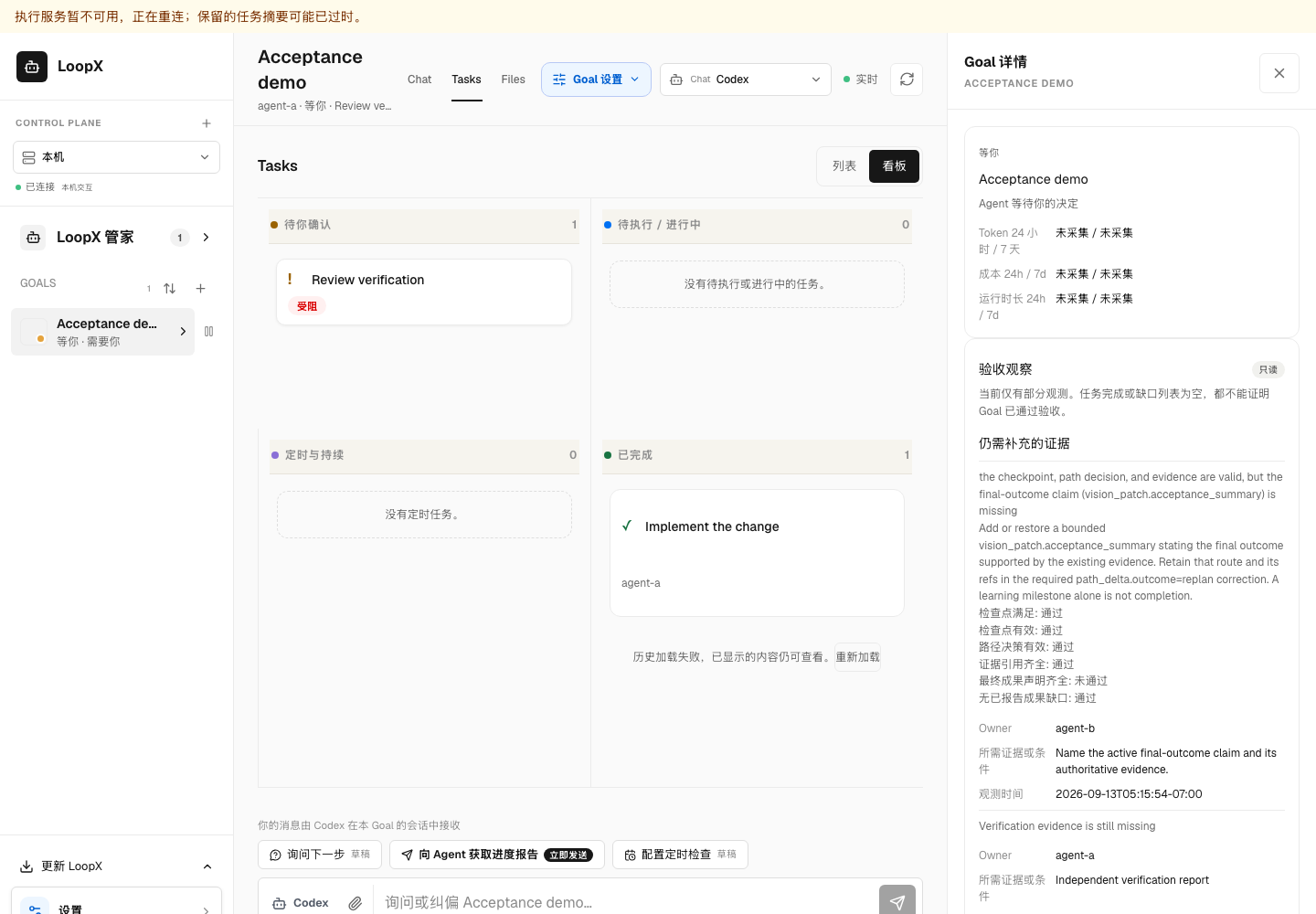
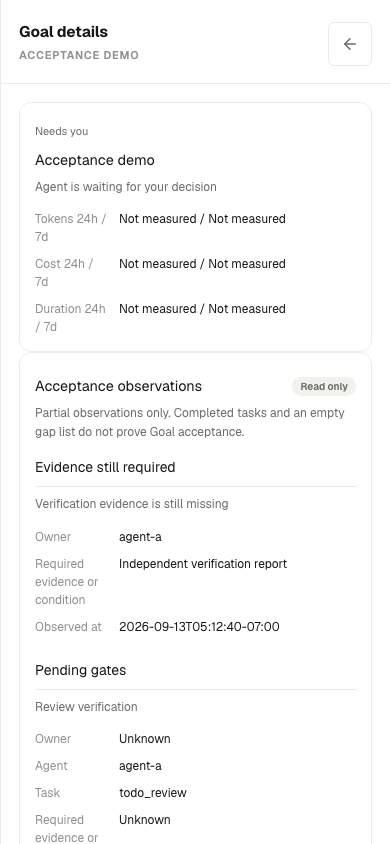
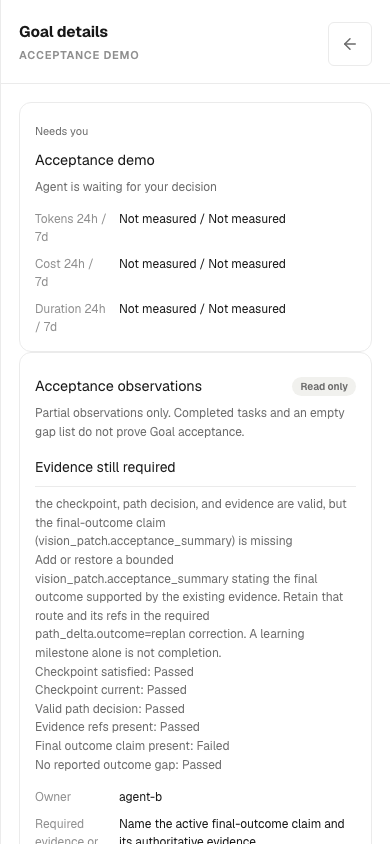
Vision correction is a normal state-machine transition, not only a self-repair fallback. Agents should write a bounded vision patch when:
- a normal progress turn changes the role's acceptance target;
- a user correction narrows or redirects the goal;
- a replan discovers that the current frontier no longer satisfies the acceptance summary;
- a monitor-only lane should remain a watch lane but needs an explicit continuation or expiry condition, including explicit monitor successors and a watch ACK; or
- a product bottleneck is real but no current todo/frontier projection exposes it.
The inline flags keep the common path small. A role can update only the fields
it knows: inline writes merge those fields into that agent's latest active
vision, preserving omitted durable mainline fields and the current state. A
todo, PR, capability, or monitor wait should normally update its own todo plus
replan_trigger_summary or last_patch_summary; it must not replace the
role's broader vision_summary merely because that dependency is current.
JSON packets are complete generated updates. When satisfying a current
vision-derived replan obligation, changing an existing vision_summary,
role_scope, acceptance_summary, or advancement_policy requires a
goal_path_delta_v0 with outcome=replan, regardless of whether the update
arrived through JSON or inline flags. This keeps a real mainline change
possible while making the prior assumption, observed reality, and
retained/changed/stopped route machine-auditable. Unchanged full packets,
non-replan inline edits, and initial baselines do not need a path delta.
When no patch is needed, the agent should still close a required checkpoint with
--vision-unchanged-reason. That reason is per-agent and must explain why the
existing acceptance and route still cover the material closeout.
Acceptance
A change satisfies this contract only when:
- per-agent vision fields are rejected or compacted at the CLI/write boundary;
- inline vision writes require a concrete
--agent-id; - material
refresh-statecloseouts emit a per-agentvision_checkpoint_v0; - missing per-agent checkpoints can become agent-scoped replan gaps instead of global goal-level noise;
- quota/status and
interaction_contractexpose avision_continuation_audit_v0before todo closeout, no-follow-up,--vision-unchanged-reason, or typed replan writeback; - ordinary
refresh-statecalls can write bounded vision corrections without a separate self-repair-only path; - replan state is decided from goal-level projection before local quiet/wait classifications;
- replan can clear an obligation only by writing a typed semantic delta accepted against the current goal-frontier obligation;
- durable replan ACKs survive neutral scheduler/accounting runs until material frontier state changes;
quota.pyconsumes the resulting projection instead of storing vision logic;- auto-research remains a thin preset over the reusable kernel; and
- public docs and smokes cover the budget, state machine, and
quota.pyboundary without private material.