App conversations and reusable asynchronous work delivery
- Status: Accepted; design and work are claimable. Conversation-entry repair delivered; broader continuity and async-inbox acceptance remain open. No new provider, scheduler or authority.
- Supersedes / closes: none
- Baseline:
27f0fc93b, inspected 2026-09-25. Implementation and live acceptance are separate. - Owners: overall roadmap R1–R3/G0–G2; semantic handoff M1–M3; conversation surface; TS migration T0–T4.
- Evaluation: steward golden queries.
- Language: Chinese semantic mirror.
Ordinary workspace conversations: bounded implementation checkpoint
The Core Chat entry can now open an ordinary workspace Session independently of a Goal or the steward's portfolio. In the App, a workspace is a scope of the steward conversation: its Scope picker lists the host's granted workspaces, and choosing one continues that workspace's own Session through the same composer, history, streaming, stop and image path as every other conversation. The scope never appears on the steward overview or the Goal list, and returning to the steward scope restores the steward Session. The shared typed context owner checks the exact workspace reference and current grant; missing roots, retargeted symlinks and changed grants fail closed. No Goal is synthesized, no portfolio context is injected, and the workspace grant cannot authorize peer delegation.
This extends the existing conversation-scope owner with project_workspace and
an exact host-observation contract, rather than introducing provider-local Session
authority. Python owns filesystem observations and the existing durable Chat store;
the TypeScript owner decides context identity and scope. Native Codex resume retains
the original upstream thread and workspace. HTTP/protocol fixtures qualify that
continuity and denial behavior; they do not establish real model adoption.
The local App grant covers the selected owner workspace under its current host permissions. Scope selection alone does not qualify Lark private-message admission, installed or mobile journeys. A revoked grant keeps history readable and blocks new messages until the host grants it again. The independent Lark checkpoint below qualifies its source implementation separately.
The source implementation also has an explicit owner-only Lark private-message binding. Settings → Lark selects an independently verified non-default App, a current host workspace and executor. Core owns the App-scoped owner/source identity, Session context and revocation; the provider stores no separate conversation authority. One machine/App lease covers both profile aliases and existing group listeners. Replies recheck the original source under that App; they do not require group-member scopes for private messages.
An existing group listener can also admit owner-private Chat through the same verified App. Settings → Lark → owner private Chat resolves a verified profile alias to the unique existing listener selector, including a legacy App ID, instead of starting a competing listener. Inventory discovery supports both profile names and App IDs; removal, retargeting and identity changes still reject. One consumer dispatches explicit group events to the existing group admission and private events to Core owner admission. Rejection never falls through to the other audience. Group grants and review callbacks remain separate, and disconnecting either route preserves the other. HTTP/Core fixtures cover setup, missing owner login, App mismatch and route removal; this does not qualify remote Agent delivery or an installed provider roundtrip. Legacy group entries without a stored App id use the freshly verified private profile identity while holding both the original profile-scoped lease and the App-scoped lease, fencing old processes and new aliases together. Setup checks the effective shared configuration before publishing the Core binding; an App identity change before publication is rejected without changing that binding. Real HTTP/Core/runtime-refresh fixtures cover this path and cold listener discovery, with no provider messages or model work.
Text admission persists the canonical Core Turn without waiting for its terminal
answer. The existing bounded Session queue keeps follow-ups in FIFO order; another
App can continue independently. Explicit /status, /stop and /new use the
shared request owner, and a replay retains the original Session/Turn target.
A lost admission correlation cannot move a request to a newer Session. Admission
feedback and final delivery use separate durable provider intents; an ambiguous
write is read back without blind resend. Unsupported media receives an explicit
notice. The workspace grant conveys no Goal, portfolio or peer execution authority.
Lark queued notices describe the observed queue state without claiming that an
earlier request is running: the first Turn can also await its native claim.
Recovery retains an already persisted notice's exact text and provider intent.
The existing four-slot reply pool wakes after private admission returns and after a local Turn worker exits, including preparation failure. These in-process Event hints carry no content or delivery authority and perform no provider IO; the scanner still reads the canonical journals and rechecks the source and Core. It clears the hint before discovery so arrivals during a scan remain visible to the following wait. Shutdown wakes that wait and unregisters the runtime hint. The one-second recovery poll, bounded pool, request fairness and thirty-second owner-notification cadence remain; custom controllers without the hook still poll. An occupied worker may still defer a request until a later scan. No completed- Future callback repeatedly reschedules unfinished work. File/Core and native protocol fixtures qualify this scheduling path separately from installed service, provider latency, complete stop acknowledgement and first-visible Web results.
Native Lark sends and receipt recovery use one operation-bound source verifier for the current App, exact profile/chat/message and Core grant, as existing reply edits already do. The observed Bot name must match the Inbox metadata; a rename still holds the first send while metadata refreshes. The verifier joins source reads and rechecks the exact binding before returning. A lost readback retains the same attempt and re-verifies without resending. No identity or grant is cached across operations, and legacy membership-only callbacks retain separate sender authentication. File/Core fixtures qualify this transport transaction, including late revocation; they do not qualify installed provider latency, the complete stop SLA or first-visible Web results.
The packaged settings journey, source revocation/recovery, duplicate events, native queue/stop and two-App isolation have synthetic-provider regression and browser coverage. A native Codex source canary separately qualifies distinct upstream threads with independently observed real App identities. Neither is a live Lark/model/mobile result. Installed service qualification, phone journeys, registered Agent selection, real incremental/media/permission interactions and broader long-running coordination remain open acceptance. Runtime and permission-boundary changes require maintainer review before promotion.
The private setup UI composes within Settings → Lark; the App workspace scope remains the sole ordinary local conversation entry. Legacy group profiles without a stored App identity retain their original profile-hash consumer lease. Requests without private bindings do not add provider authentication; configured aliases reuse one request-scoped verified identity observation. Lark HTTP composition resides in the extension, while the typed binding owner remains provider-neutral.
Binding resolution rereads the exact grant after provider identity observation. Revoking or replacing that binding during the observation rejects the request; an unrelated binding edit does not invalidate it. The typed owner still checks the current context, with no identity cache shared across verification calls.
The same Settings read model includes Core bindings for locally installed
conversation transports. Listener status comes from the exact host-composed
provider's optional health_snapshot() returning a content-free status, or
from the existing Lark listener observation for default profiles. This local
hook must return cached observations without network calls. Only existing
listener labels (starting, listening, retrying, stopped, standby,
inactive) are projected; missing, malformed or failed observations become
unknown, rendered as connection unconfirmed. Raw provider fields and exception
messages are excluded. Listening is neither a delivery receipt nor task
acceptance. Native binding/composition/HTTP regressions qualify the source read
model, while each provider's installed liveness and result return remain separate.
Model choices in the current ordinary conversation
The ordinary Codex composer saves an offered model and supported reasoning effort on its exact existing Session. Choosing performs no Turn, thread creation, history replay or interruption. The active Turn retains its actual configuration; the saved subsequent choice and native runtime readback stay distinct in the menu. Between Turns, the existing resume owner must confirm that choice on the same native thread before dispatch. Rejection before a new message's admission keeps its draft; a queued request keeps the existing queue's failure/recovery owner. Reloading retains the Session and its saved choice; other Sessions and machine defaults are unaffected. Save failure offers retry without claiming success.
Host-owned, steward, registered-Agent, bound-audience, native Goal and legacy migration Sessions retain their existing settings owner. Unsupported providers cannot silently start a replacement conversation. Availability and admission use one shared read model. Production HTTP/store and synthetic native-protocol tests qualify settings, history, busy/queued adoption and refusal. They do not certify live model quality, installed native input or cross-channel synchronization.
Continue an original private conversation on the local App
Settings → Lark offers Continue original conversation on an existing owner-private connection. Discovery uses Core's verified binding selector and requires its echoed identity; the URL then freezes that binding and exact existing Session. Missing, malformed, revoked, closed or unsupported targets remain unavailable. There is no fallback to ordinary steward/project history, Session creation, executor change or model reconfiguration on this entry. Group audiences retain their existing boundary.
An owner-private steward connection also offers Use for App steward. Core stores this explicit entry preference alongside the binding set, without changing any audience, managed identity or execution grant. Multiple stewards never compete by list order or recent activity. The local App steward Chat entry resolves only that source's existing current Session, then freezes its exact binding and Session in the URL. Discovery blocks the ordinary composer until it completes and performs no model work or Session creation. Existing unselected installations retain their ordinary entry. Once selected, a missing, revoked or replaced source stays unavailable until recovery or explicit clear; it cannot silently fall back to a peer or ordinary conversation. Goal-scoped, project, explicit original, managed-Agent and remote/read-only views retain their own navigation. A newly selected preference does not retarget an already frozen original conversation. Overview quick prompts and its composer use the same explicit choice and the existing exact Session send, active-Turn queue, stream recovery and readback. Resolving the entry does not open Chat or block Goal navigation. Sending stays disabled during discovery; failure offers retry and conversation settings beside the composer instead of switching to the ordinary manager. Unselected entries retain ordinary overview behavior. Quick prompts stay discoverable after source selection; opening the full conversation freezes its verified binding and Session in the URL. This journey adds no queue or message consumer. Settings retain an explicit clear action even after the selected binding is removed or its workspace becomes unavailable; clearing changes only the entry preference and retains all conversation history and execution grants.
Open desktop delivery checkpoint. The normal App, browser and external messaging entries must share one machine service owner and its original Chat store, Session identities and delegation audience. A window must not silently start another service/runtime with a different history. App close/reopen and upgrade must preserve the original consumer and its running work; a missing or unqualified service must show recovery rather than switch stores. Retain any previous independent App history for explicit recovery instead of merging or discarding it. Developer isolation remains explicit. Browser acceptance against one Bot service does not qualify the native App's actual service route. This checkpoint remains open until that native path is implemented and read back.
Chat storage overrides do not select another registered-work authority. The workspace Status and delivery task map read the coordinator's existing registered runtime root, while private Chat history and its settings keep their own store. The bound Session index returns its limited display source from the same fresh Core verification and binding fence. Opening that original conversation no longer waits for the full connection-settings inventory, unrelated Agent candidates or listener/recovery diagnostics. The client requires the exact binding echo, owner audience, available workspace and matching executor; missing or stale descriptors fail closed without a catalog fallback or replacement Session. The existing five-second read bound and fresh input admission remain unchanged. Unsent input for an original conversation belongs to its fixed binding/Session, not the executor's loading or unavailable display state. Source denial and recovery retain the editable text and in-memory images without enabling Send. Ordinary multi-executor conversations keep separate drafts. A unique retained executor-keyed draft is recovered into the same original conversation; conflicting drafts remain separately recoverable without overwriting current input. Retained uncertain sends keep their original request/Turn identity and require normal source admission before an explicit retry. Text retains the existing tab-session storage lifetime; this does not add image persistence across reloads. This qualifies a source-read boundary, not complete history/media synchronization or an installed provider roundtrip. The original-conversation request inventory pins one qualified code revision per HTTP read through the existing Effect request scope. Within that read, provider scope is verified once per distinct original Session, including older Sessions behind a reopened conversation, then every observed source is freshly verified again before any content is returned. Each row still checks its current source basis, host, Turn, target grant, Goal lifetime and receipt state. A revoked binding or provider identity at the closing check refuses the whole response. No proof survives the HTTP read; the next page independently qualifies source scope and code revision. This bounds provider IO by sources instead of historical rows, without caching receipt decisions or reducing scan coverage. Unreadable sources remain incomplete coverage rather than an empty successful inventory.
Within each HTTP read, the Chat source observer locates original client Turns once per verified source Session, then rereads the exact Turn file for every request. This Python IO locator retains only store paths: it caches no content, grants or receipt decisions and is discarded before the next page. A missing Turn or changed client identity remains unreadable source coverage. This removes repeated full-history scans without changing the typed collaboration owner or its checks; provider latency and full installed cross-channel acceptance remain separate.
Cold Goal links wait for the current status directory before invalidating a missing selection; the bundled placeholder is not proof that a valid Goal was removed. This keeps an initial Goal route out of default-steward discovery.
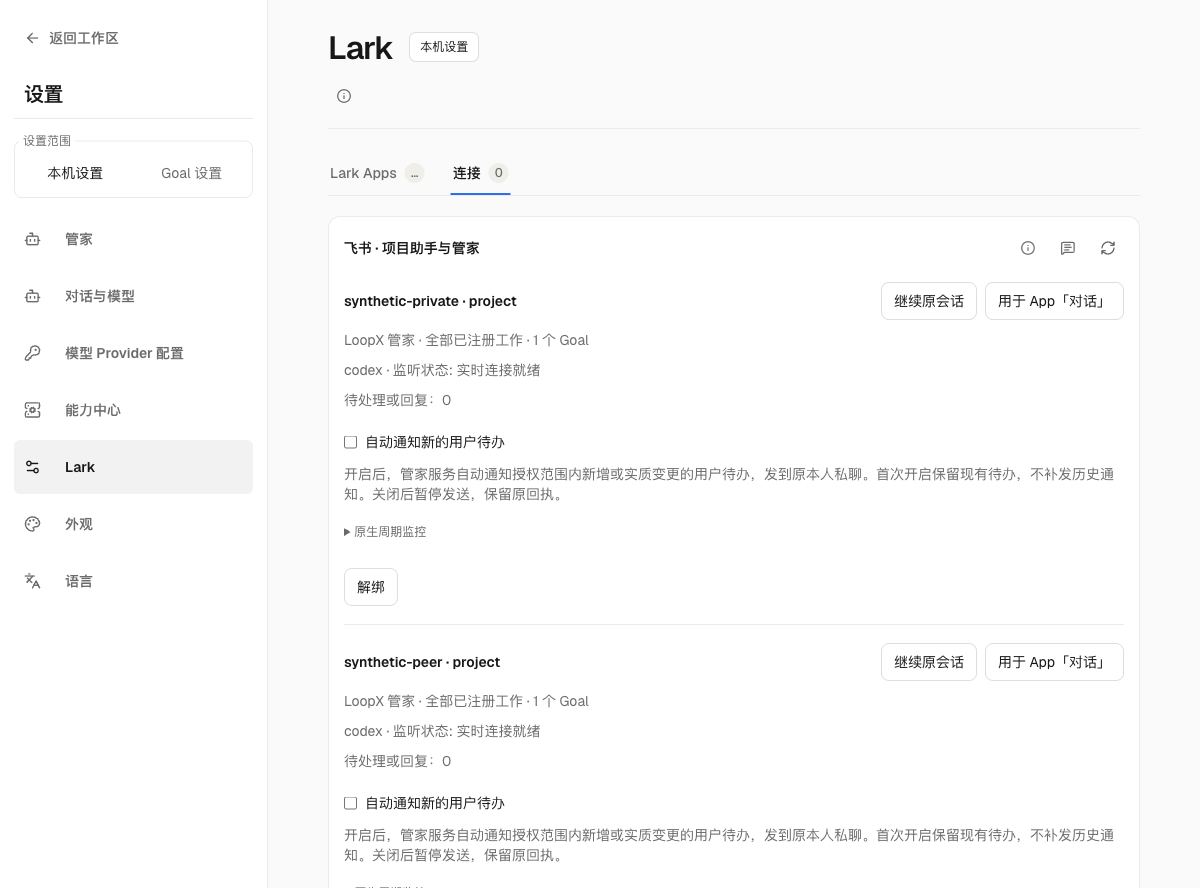
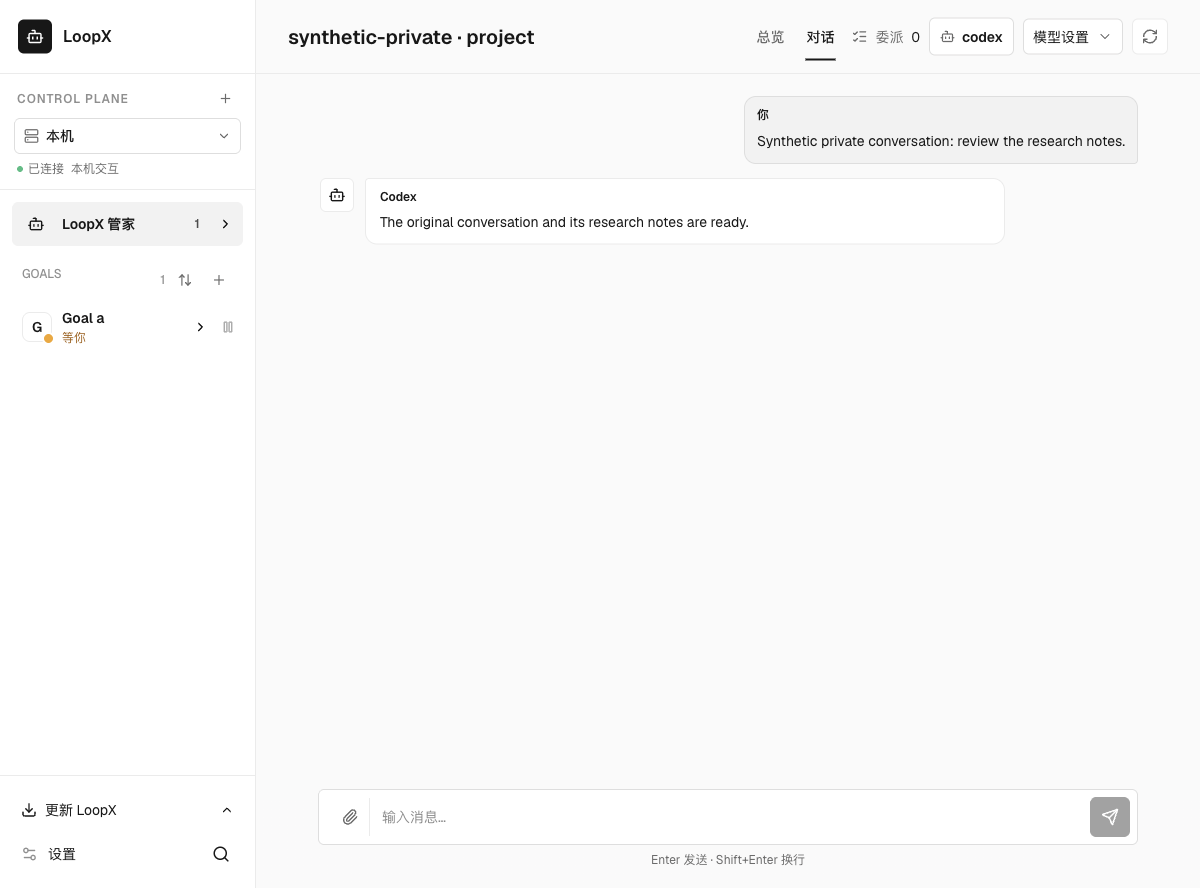
Public-safe packaged evidence also includes the narrow selection, unavailable entry, and complete narrow report. These use disposable Core/HTTP state and synthetic provider/model data; they do not certify installed external delivery or the complete synchronization goal.
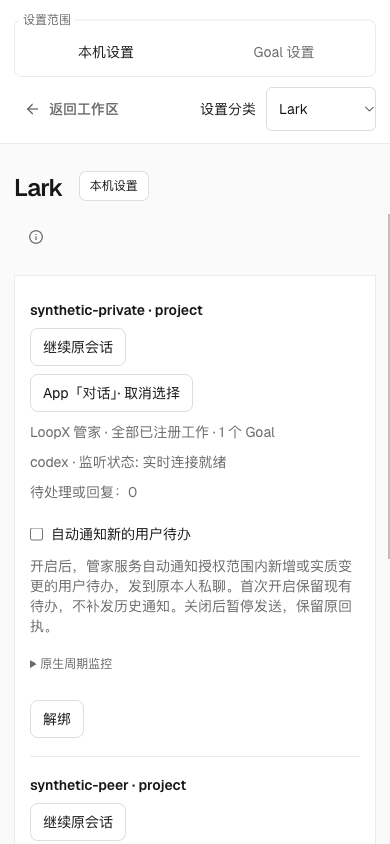

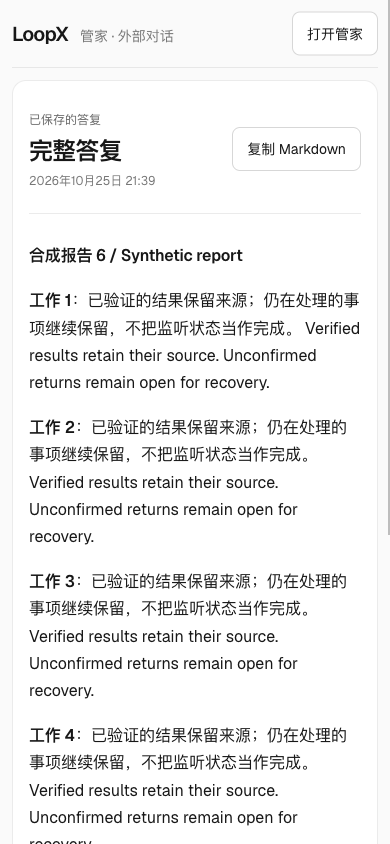
The App reuses its conversation history, single composer, stream recovery and queued-input owners. Quiet source refresh reads the verified compact index; only changed snapshots are read. Messages arriving from the original source become visible without navigation, and Web sends retain Web origin through the existing Core queue and fresh source admission. The connection list loads independently of App/credential catalogs, so a failed catalog does not hide an existing conversation or label it disconnected.
Real Chat HTTP/SQLite/Core with a synthetic provider and model qualifies source selection, both input origins, denial/recovery and no replacement Session. Packaged browser evidence qualifies the local UI path separately. Live Lark return delivery, installed service adoption, split-root composition and Goal-less project peer handoff remain open; this checkpoint does not close them.
The existing Lark reply workers now also project committed App-origin user and answer messages from that exact owner-private Session. Each provider outbox retains the canonical message identity, frozen text and delivery attempt. The original Lark input supplies address provenance only: projection never readmits it or starts model work. Before every write and receipt recovery, Core rechecks the Session, current binding and audience, and the provider verifies the original source. Posts identify the App speaker, stay in canonical append order within that outbox and retain complete long text through the existing rich-post parts. Distinct canonical messages and parts get distinct provider idempotency keys, including when their text is identical; callers without that identity retain their existing receipt digest. Known attempts are read back before continuation; a started write without a provider locator stays unconfirmed after restart. Revocation or changed identity prevents further delivery. Disable the existing connection to revoke it; rollback must preserve its private delivery journals.
Newly verified App user mirrors also reuse the existing reaction journals:
Get acknowledges receipt; only an observed starting/running Core Turn adds
OnIt. Terminal completion, failure or interruption removes processing feedback
while retaining receipt feedback. A queued input never claims to be processing,
and assistant mirrors receive neither reaction. Long inputs use their last
verified concrete post, not the composite parts locator. Turn-only changes are
discovered within the existing five-second scan even without a transcript append.
Before each effect, the worker rechecks the canonical input/Turn, current source
and grants, and frozen provider message. Feedback failures retain recoverable
receipts without blocking message delivery or starting work. Unknown provider
writes are not retried. Optional App feedback runs on at most one slot of the
existing reply pool, outside the body outbox lock. Its final write merges only
feedback fields, preserving concurrently delivered current and later answers.
No synthetic incoming event or original-request
settlement is used. Existing finished mirrors are not backfilled; current active
mirrors can adopt the feedback path. loopx chat --no-private-reactions keeps
feedback disabled without changing the message path. The isolated HTTP/Core and
synthetic-provider checks qualify source behavior; installed Lark reactions and
actual provider presentation remain separate acceptance work.
Use Continue original conversation or the explicitly selected App steward entry above to reach this path. Old ordinary history is retained separately. This checkpoint covers text and bounded App image projection, not reply/thread relation mirroring, retroactive insertion into Lark chronology or all-channel broadcast. Canonical App images reuse the existing resource uploader and post sender, retaining caption and ordered inline images in the original private chat. Long captions keep images on the final concrete post only. Every upload and send rechecks the original source and current Core message/grant. Sends and edits check again after provider preview, before recording the write intent; each continued or resumed rich part uses that same boundary. Completion also requires independent image-byte readback. Failed verification recovers the same message receipt without another upload or send. An upload whose provider acknowledgement is unknown, or a started send without a message locator, stays unconfirmed after restart. Earlier delivered attachment placeholders retain their frozen receipts and partial status; upgrades do not silently replay them. Synthetic real-HTTP/Core journeys cover repeated inputs, complete images and long captions, restart, missing/unknown receipts, byte mismatch, revocation and provider replacement. Installed provider readback remains a separate gate.
The implementation decision follows primary-source comparisons, not a claim that shared context already guarantees two-way delivery:
- OpenClaw history delta resets incomplete/scoped projections; its send retry owner reconciles already-started execution. These inform recovery, not a Lark bridge.
- nanobot unified session keys and last-destination routing share context; a last destination does not replicate a transcript to every surface.
- mautrix message mappings and portal echo handling motivate stable transaction/part identities and echo suppression. A Matrix homeserver/bridge would add separate infrastructure and identity ownership. LoopX borrows the design, not MPL-2.0 code; the other two snapshots are MIT.
Synthetic product previews: desktop, narrow, revoked workspace.
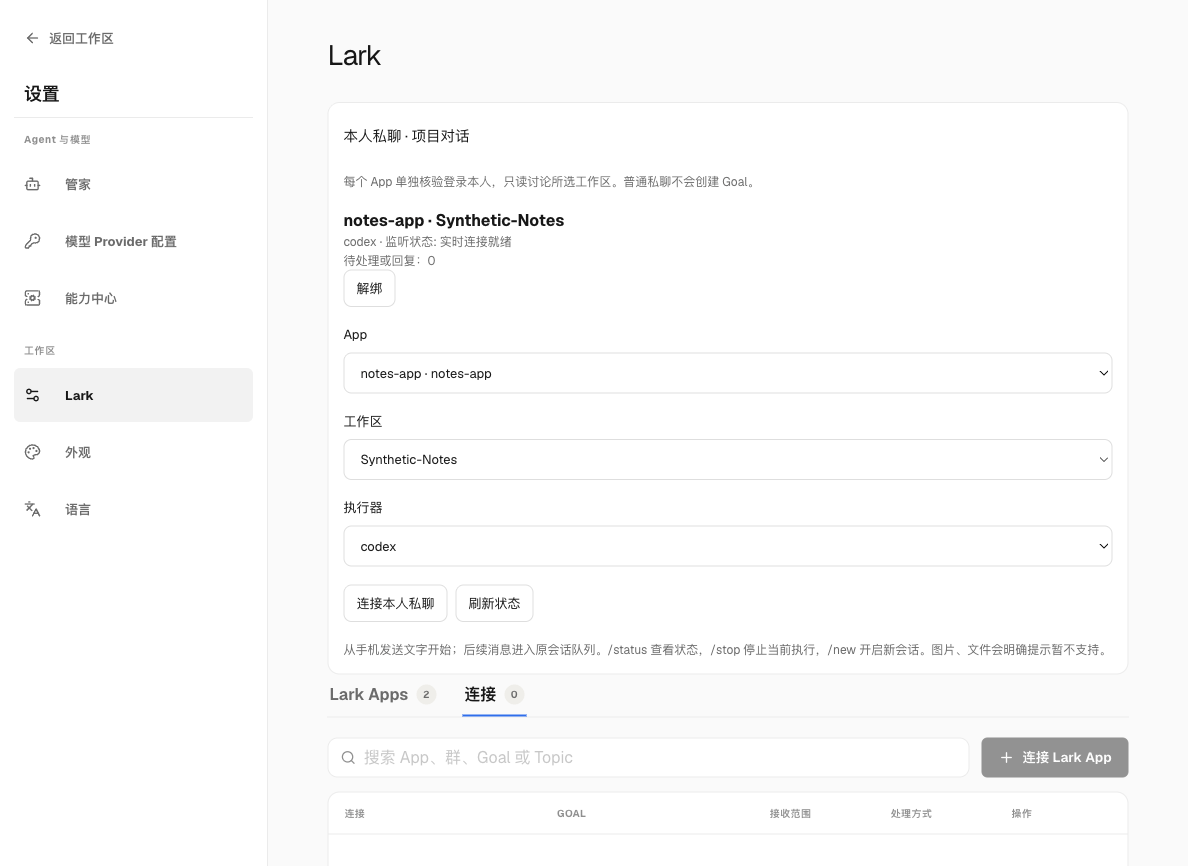
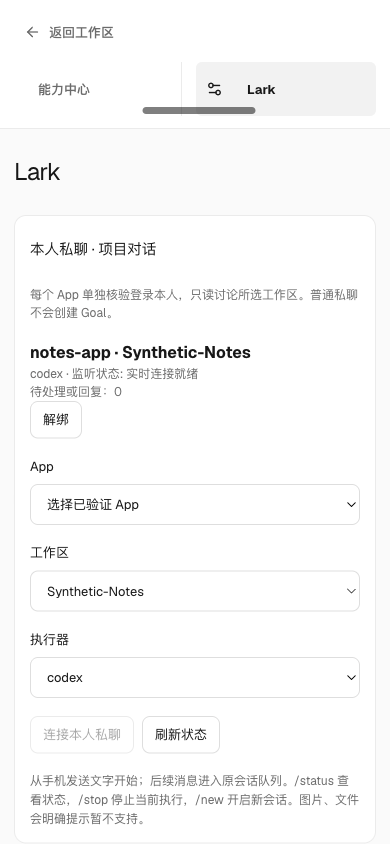
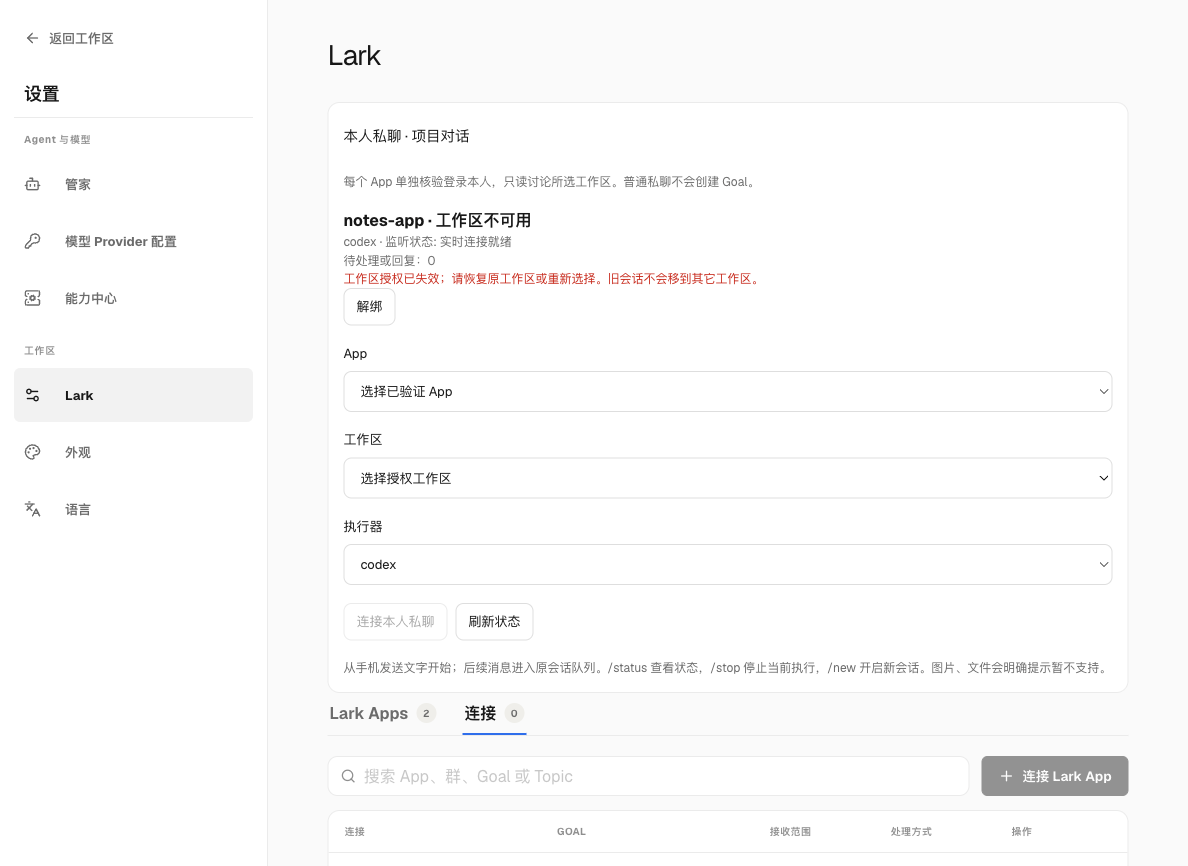
Selected group topics: isolated ordinary project Chat
Settings → Lark also connects a project App to explicitly selected groups. The list comes from that App's provider-observed group membership; Core validates the allowlist at configuration time. This is an audience option on the existing binding, not a new Goal Channel, listener, queue or model runner. One App retains one binding owner. Existing private bindings keep their audience and host grants.
New group bindings verify the selected Bot's App identity; they do not require a personal user login in that App profile. The group principal is App-scoped and never supplies private-owner authority. Private project/steward connections still require both the verified App and its independently verified user. Existing group bindings that used a user principal retain that exact identity and native home; an explicit disconnect/reconnect selects the new App principal and requires a new isolated home/login. Polling or a user's login/logout never migrates a binding.
A human starts a topic by mentioning the Bot. Admission reads the exact provider
message and, for a continuation, its original root; event text cannot substitute
the root or mention. Members in that topic share its Session and FIFO; different
topics, groups and Apps have independent Session identities. Status, stop and new
target that topic. Admission feedback, streamed posts, terminal edits and receipt
recovery use the existing delivery path with source_thread placement. A revoked
binding or unreadable source prevents later result delivery.
For /status, /help, /new and /stop in a locally admitted topic, the
transport batches the canonical incoming message and root in one raw provider
read. The accepted root journal only selects those two read IDs; it grants no
authority. After that IO, Core freshly resolves the exact binding and App inside
both existing request/source fences. An in-process source verifier checks the
envelopes against that selection, including sender, ancestry, root mention and
the still-current binding, before journal creation or exact replay. A changed
App or grant, incomplete pair or source mismatch rejects the command. An event
control hint whose canonical body is ordinary text returns to ordinary rendering
before any Core write. Unknown topics and legacy rendered journals retain their
original route. No identity survives the transaction; outbound verification,
typed admission decisions and stop recovery retain their existing owners.
File/Core tests qualify the transaction and its rejection/replay boundaries;
real provider read timings alone do not qualify the full stop reply or Web SLA.
A control prefixed by a structured Bot mention uses the same bounded read path. The event's rendered name or mention key only suggests which source to read; the raw leading mention must resolve to the freshly observed App and produce the same exact command. Prose, another Bot's mention or a mismatched hint cannot supply control authority. The original rendered message stays unchanged for exact replay and legacy journals.
A completed, target-frozen stop on a locally enabled group binding reads its two original provider messages while Core freshly resolves the binding and App identity. Both readonly observations must finish successfully before source, ancestry and root-mention validation can authorize delivery. Only that invocation reuses the verified identity; no observation is persisted or reused by a later verification. Changed bindings discard the buffered message observation; ordinary input, private conversations and unknown stop scope keep their existing paths.
When an ordinary Codex topic has no active Turn, /stop also covers background
commands left by completed Turns in that same canonical Session, even after a
later answer. Core freezes the original Session and canonical candidate Turn
identities in the existing request journal before native inventory or
transport resume can fail. Native observation may only narrow that frozen set;
a retry cannot add later completed/active Turns or switch to a newer Session.
Completed-command discovery reads the exact native thread's complete paginated
item inventory once, retaining only command ownership for the frozen candidates.
This avoids a separate inventory round trip for each historical Turn. Missing or
conflicting item ownership and incomplete pagination remain unconfirmed; the
existing exact-Turn cancellation and independent terminal readback still run.
The existing Lark listener returns after this durable freeze; its existing reply
workers recover the prepared request to observe and cancel native background
commands. Prepared recovery uses admission's fresh authority check inside both
the request and source-route fences, without a duplicate provider probe before
waiting for those fences. Revocation while waiting prevents control and delivery.
Slow or unavailable native control therefore does not hold inbound
admission. This is scheduling only: it introduces no queue or completion state,
does not defer an active Turn's exact interrupt, and sends no successful stop
reply until native control and the original delivery checks have succeeded.
A recovered legacy request without a recorded target has unknown original scope;
Core rejects retargeting and preserves it unconfirmed. A fresh stop is a separate
user request, never an automatic replacement for the unknown one.
An active Turn keeps its existing exact stop path; unavailable historical item
inventory cannot prevent that interruption or widen its target to earlier work.
Native command-item and terminal readback scopes the effects; unknown terminals,
other Topics and completed answer receipts remain intact. Replaying the stop
does not select newer work. If /new has deliberately closed the original
Session, its pending stop stays unconfirmed; recovery does not reopen it or
borrow control of the replacement Session. Unavailable control or incomplete
readback keeps the original stop unconfirmed rather than reporting an idle topic. This extends the
existing Lark command; active-Turn HTTP/frontend control and attached or native
Goal hosts retain their separate contracts. Synthetic provider/Core and real
child-process regressions qualify this source slice; installed host adoption,
live stop timing and the full community release pack remain separate exits.
Disconnecting an external binding, or replacing its identity/context/grant, publishes the typed revocation before applying native exact Turn interruption. Its queued work is stopped before its active Turn, across the binding's topics and resumed Sessions; currently authorized peers keep running. Grant history remains readable. Reapplying an identical binding does not stop its work. The IO bridge waits outside the grant publication fence and reuses Core Turn control; it creates no queue, scheduler or provider authority. A stop failure leaves the grant revoked and reports that execution stop is unconfirmed. Retry disconnect for the old binding identity with the current revision to confirm that stop, including after a failed replacement. Settings projects these revoked targets from canonical queued/active Turns: a failed mutation still reads back the current revision, and refresh/reload retains an exact stop retry without restoring the grant. Successful retry removes the recovery only after Core settles the Turn; a newly authorized binding and unrelated work remain intact. No separate stop ledger is introduced. A claimed attached-host Turn still lacks push stop control: revocation reports that limitation, cancels its pending external work and preserves unrelated local Turns. Controlled synthetic Codex/provider regressions qualify these source semantics; installed/live host stopping, physical command cancellation and community release remain separate acceptance requirements.
Group contexts always use workspace_only filesystem isolation, even when the
owner's private project uses host_default. Only the selected read/write workspace
grant is available. Personal portfolio, attached Agent selection, global skills,
MCP, shell profiles and inherited account environment are unavailable. The native
host must verify the exact permissions profile and workspace root. Its independent
store is never seeded from personal credentials/history; model authentication may
be supplied by the trusted host through the native external-token protocol below.
/status exposes the project title, not the host's absolute workspace path.
Core, HTTP, provider-readback and native-protocol fixtures exercise these boundaries. They are synthetic transport/model evidence, not a live community rollout. The community golden queries still require an isolated public workspace, qualified model authentication and actual pilot group journeys before either developer group is enabled. Public-source reading needs its separately qualified scoped tool; this change does not enable unrestricted network or personal browser access.
Ordinary workspace writes: default and revocation checkpoint
Ordinary project Chat defaults to workspace_write for host-declared roots. The
Core context owner derives the actual Codex workspace-write sandbox on start
and exact-thread resume; this is conversational work, without Task/Goal mode or
manager permissions. The project prompt follows workspace AGENTS.md and skills,
permits requested bounded edits, and keeps durable operations with their existing
owners. A write grant does not activate Material Lifecycle or certify a project
adapter's intake/ranking workflow.
loopx chat --project-workspace-grant workspace_read restricts the host to
read-only, including Lark bindings. Settings → Lark defaults a Codex project App
to workspace writes within that host grant and exposes an explicit read-only
choice. Other executors remain read-only until their host policy is qualified.
The readback, /status and /help show the effective grant. Selecting an existing
App restores its persisted setting. Changing a binding's grant requires a new
identity and Session, invalidates the old Session for new work, and requires new
Agent target grants; it cannot silently elevate an attached host or another App.
Host grant removal or downgrade is rechecked before admission and resume. Ordinary
local Scope reuses only the same typed project context; a host grant change opens
a new Session while retaining old history and rejecting new work on the old
Session.
loopx chat --project-filesystem-scope workspace_only additionally narrows ordinary
Codex project Sessions to workspace file tools: root access is denied, minimal
system executable reads remain available, and only the selected workspace has the
existing read or write grant. Temporary directories, shell environment inheritance,
login shells, web search and tool network access are disabled. The typed context
persists this selection; changing it invalidates reuse of the old context. Default
project access remains writable with host_default filesystem scope.
The shell environment keeps only PATH, disables shell profile snapshots, and
uses a fixed minimal system search path for POSIX workspaces. This preserves native
file commands while filtering account-configured environment overrides as well as
inherited variables. On macOS, the trusted host may prepend the Git binary directory
of the standard Command Line Tools or Xcode toolchain selected by the fixed system
xcode-select command and grant that toolchain read access. Every path from the
binary through / must be canonical, root-owned, of the expected type and neither
group/other-writable nor writable by the caller, including through an ACL. An unsafe
container (including a writable /Applications), missing toolchain or unsupported
selection leaves the original profile and search path intact. This adaptation does
not enable toolchain writes, root reads, account environment or tool network access.
Windows execution remains unqualified by the live probes.
The narrowed profile also disables automatic skill catalog injection and project
instruction discovery. The agent can read workspace-owned AGENTS.md and skills
through its bounded file tools. Ordinary project Sessions keep native instruction
and skill discovery. Workspace-only native Sessions now also launch with a private
HOME/CODEX_HOME, a minimal process environment and file-based native credential
storage. Effective MCP servers, including managed and project configuration layers,
and native Apps connectors are disabled on thread start and resume. The operator's
LOOPX_CHAT_PUBLIC_SOURCE_READ=on opt-in admits only the anonymous
read_public_url and read_public_image tools with explicit native tool approval;
other MCP tools remain unavailable. Turning it off removes that reader, while
Apps stay disabled for workspace-only Sessions. Core derives the store identity from the
authorized workspace and App/owner binding; topics retain independent threads
without requiring a new login for every message. Default host_default Sessions
keep the account's existing native configuration and authentication.
No authentication or conversation history is copied into the new store. An
existing project-native login retains its chosen account. Otherwise, when the
trusted host has native file-based ChatGPT authentication, the adapter supplies
only its access token and account identifier over private app-server stdio using
chatgptAuthTokens.
This experimental native mode holds tokens in process memory; it does not place
credentials in the project store, model prompt, tool environment or command line.
An unauthorized-token callback asks the native host account store to refresh;
concurrent callbacks reuse an already rotated token. An unavailable host account,
invalid credential store or account change fails closed with a redacted error.
Restoring the host account permits a retry without rebinding the conversation.
Keyring-only and API-key host authentication are not bridged by this adapter.
Independent login remains available through the native Codex flow with
CODEX_HOME set to the Session's recorded home.
Existing workspace-only Sessions created with a shared home cannot silently
resume or migrate: choose a new Session explicitly with its isolated native home.
Ordinary legacy Sessions keep their existing home and exact-thread resume behavior.
The adapter sends the Core-owned named permissions profile, never a simultaneous legacy sandbox override, on start and exact-thread resume. It verifies the returned profile and sole workspace root, and pins that profile on subsequent Turns. Hosts that do not support the profile fail closed rather than falling back to wider permissions. Other executors are rejected for this scope. The native helper uses the canonical Codex executable so a home-directory symlink needs no read grant.
This is a filesystem-tool boundary, not complete community Bot isolation. It does not authorize group audiences, erase historical context, isolate arbitrary host dynamic tools or make a checkout containing private files safe to publish. Group admission, a clean public workspace, qualified model authentication and live privacy/interaction qualification remain required before public enablement; native context isolation and a successful file probe are prerequisites, not public Bot acceptance.
Typed Core/HTTP/native-host regressions qualify default writes, explicit read-only, workspace identity, independent App grants, old-Session rejection and exact-thread resume. Earlier source evidence records a Codex canary editing and reading back a synthetic note while preserving prior text and creating no Goal. This historical host/filesystem evidence is separate from current synthetic-protocol regression checks and does not qualify live Lark, material intake or a release. Disconnecting a binding or replacing its identity, context or grant first publishes typed revocation, then reuses Core's exact-Turn interruption. Cancel that binding's queued work before stopping its active Turns, including topic and resumed Sessions; unrelated authorized work continues. History remains readable and unchanged-configuration retries do not interrupt execution. Never hold the authorization-publication lock while waiting for the host to stop or create another queue, scheduler or provider authority. An unconfirmed stop retains revocation and reports failure. Retrying disconnect with the old binding identity and current revision continues stop confirmation, including after a failed replacement. Settings projects pending/running targets from Core's persisted state, retains exact stop recovery across refresh and reload, and removes recovery only after Core confirms termination. It does not restore the grant or change the new binding and unrelated work. A claimed attached host still lacks push-stop support: report that limit, cancel its unclaimed external requests and preserve unrelated local Turns. Synthetic Codex/provider tests qualify source semantics; installed/live-host stop, physical command cancellation and community enablement remain separate acceptance.
Committed same-claim replay is separate from new admission: after a lost response and target revocation, the original host can recover its committed receipt; new claims and external result publication remain denied. Current validation uses real Core HTTP, file storage and the claim broker with synthetic Codex/provider transport; it does not rerun a live-model edit or phone journey. Installed/Lark journeys and broader IM interactions remain open.
Bound steward private Chat: explicit new commissions
Settings → Lark can now select a steward role independently of ordinary project
Chat. The existing typed conversation binding owns its App, verified owner,
source and workspace. New verified owner stewards default to all_registered:
the current configured registry supplies every registered Goal and Agent, including
future registrations. Stopped work remains inspectable through explicit history,
but cannot receive new work. A verified empty registry is distinct from unavailable
authorization; no historical registry or identity is imported. Ordinary Chat still
has no Goal or manager identity.
Older bindings retain their selected scope. Settings → Lark → Authorize all
registered work upgrades the existing binding and its known sender-bound delivery
policies without replacing its Session or audience. Individual recipient revocations
remain effective; discovery does not prove execution readiness or grant protected
operations. Trusted-local manager-inbox configure-delivery-scope uses the same
source-policy owner, and a verified new private source initializes that policy once.
An explicitly narrowed existing source policy is not widened by ordinary admission.
An upgrade verifies every known delivery policy before publishing the broader
binding. If an I/O write fails, the UI retains the old binding scope and offers
an explicit retry. Earlier source-policy writes authorized by that upgrade may
remain applied; retry converges them without resetting recipient revocations.
This ordering does not claim an atomic transaction across separate files.
When the configured registry declares common_runtime_root, coordination context,
inboxes and return processing use that declared root even if Chat has a separate
storage override. App bindings, conversations and provider credentials stay in
their existing private storage. Without a declared common root, existing local
Chat behavior is retained. This scope/path slice does not complete worker activation,
receiver adoption or original-route return; native private ingress remains a separate
integration boundary from the existing group ingress.
Only an explicit /delegate --tokens N objective prepares a goal.create
preview. Confirmation must arrive from that exact owner/App/source within fifteen
minutes. The immutable preview shows the read-only boundary, total native token
allowance and absence of automatic scheduling. Existing canonical Chat actions
create the Goal and return their receipt; Core adopts only that exact new creation
in the configured workspace. Existing Goal and single-workspace fallbacks cannot
redirect it. Neither normal conversation nor model prose creates a commission.
The existing service worker advances the durable Core request without blocking
inbound admission. Codex native Goal continuation performs the read-only work;
its result returns through the original private-source delivery journal.
/stop-commission freezes the execution target at admission, while an explicit
/resume-commission ... --tokens N retains the original Session, native thread,
objective and cumulative usage. Native completion is host execution evidence,
not canonical Goal/Todo acceptance. An allowance includes previous usage and
context; an in-flight request can exceed it. No default heartbeat is enabled.
Portfolio extension refreshes scoped evidence/tools in the same steward thread. After creation commits, the existing request journal saves its exact resource receipt before attempting portfolio adoption. An adoption or readback failure keeps that operation queued for recovery. Recovery rechecks the original binding and canonical receipt, adopts the same resources, and returns their result without creating another Goal or model thread. Notification cannot settle an operation whose adoption is pending. Fault journeys cover adoption failure, lost adoption readback, an interrupted creation-owner call and revoked binding; they qualify provider/Core IO recovery, not a full host restart. App, owner, source and workspace identity remain frozen and rechecked. A silent native event reader cannot block the control RPC receipt needed to pause work. The provider-specific setup companion belongs to the Lark extension; the conversation, request, scope and creation semantics remain in their typed owners.
Regression journeys cover independently verified empty versus missing scope, wrong App/source confirmation, expiry, creation/adoption, native result return, stop, duplicate events and same-thread recovery. A local actual Codex source canary separately exercised a budget-limited synthetic commission and resumed it in the same native thread to return verified fixture findings. It did not prove real Lark inbound or phone acceptance. Multi-Agent coordination, actual media / permission interactions, installed login recovery and mobile journeys remain open; runtime/authority promotion still requires maintainer review.
Synthetic product previews: empty steward and project assistant, narrow.
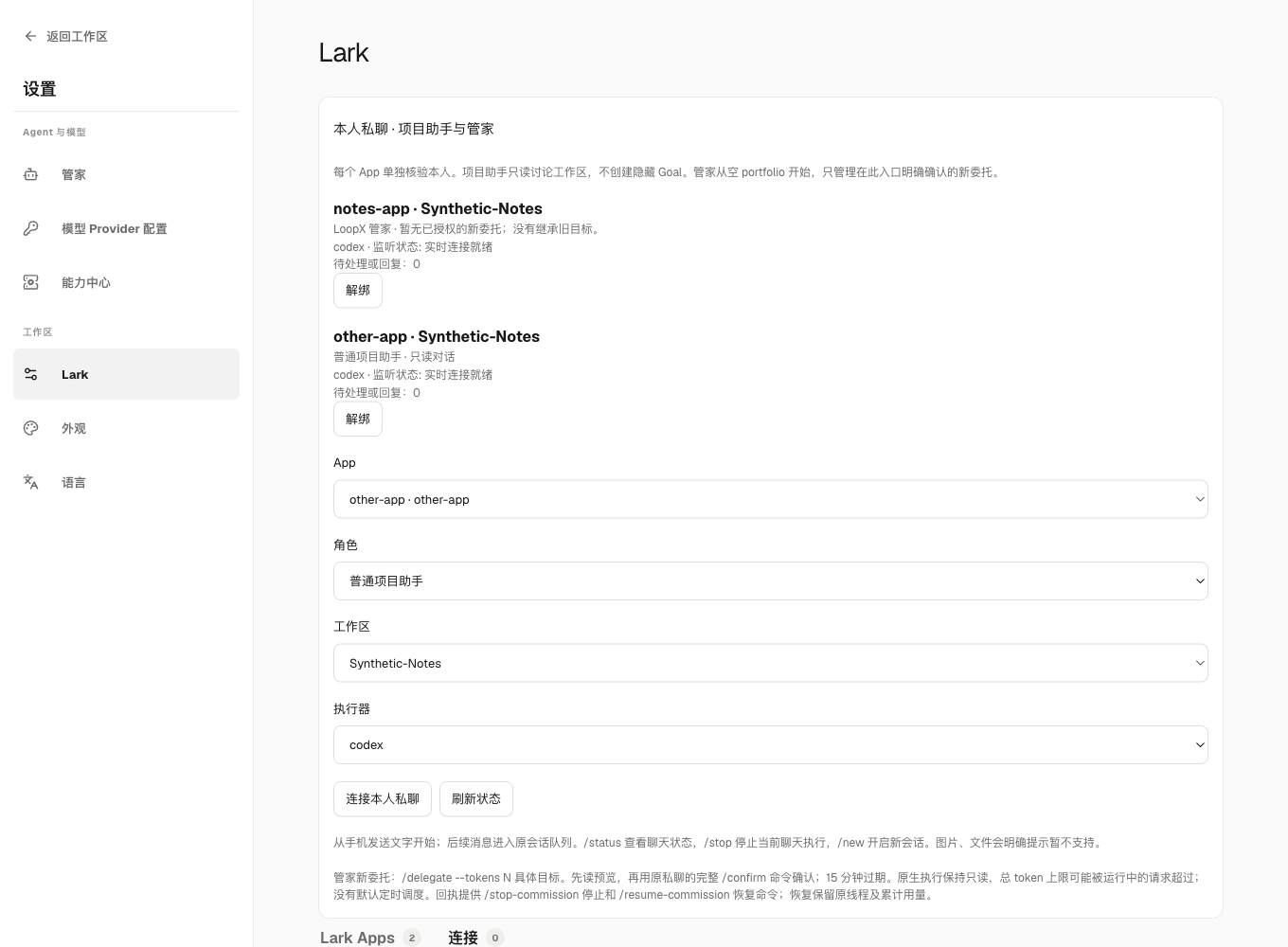
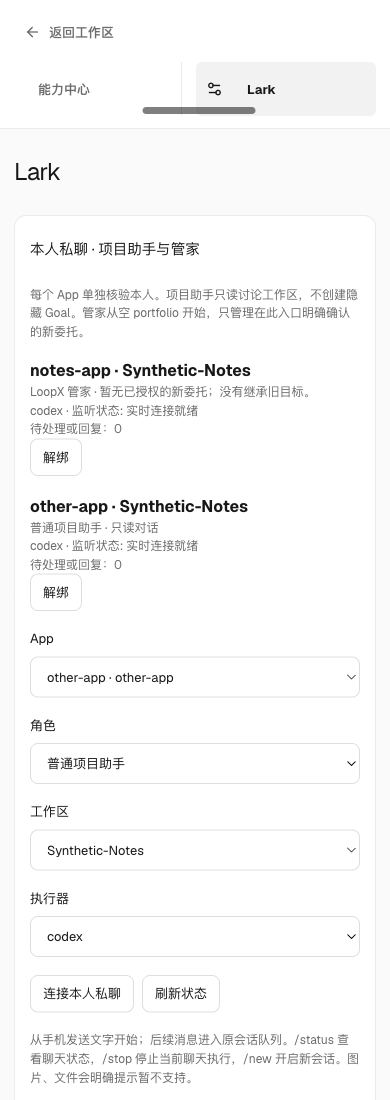
Private Chat status and help: scoped observations
/status and /help use the existing typed bound-request owner to report the
authorized role, workspace, executor endpoint, native Session/active Turn and
durable queued-Turn count. Steward status counts only that binding's freshly
authorized commissions. An executor endpoint is not a selected registered Agent;
native execution ending is not Goal acceptance or proof of result delivery.
The Core request persists a timestamped observation before provider delivery.
Duplicate events retain that snapshot instead of switching to a newer Session.
A selected Agent target keeps its exact bound Session: observation reads that
Session even when it is failed or closed, and never falls back to a newer
conversation.
Missing execution evidence and unknown states stay explicitly unavailable.
These commands open no Session, invoke no model and create no Goal. /help
shows role-specific commands and the existing Settings → Lark entry for workspace,
executor and revocation, including supported images and unavailable media/attached-host boundaries.
Regression coverage uses the production native filesystem store, durable queue, bound request and provider admission/reconciliation paths with a synthetic provider and protocol executor. It qualifies queue/stop/readback and duplicate delivery, not live provider, mobile or installed-service acceptance of this delta. The explicit attached-target selection checkpoint below is source-qualified; broader coordination and live acceptance remain open.
Explicit registered Agent selection: original attached host
Settings → Lark can grant a project App access to an exact existing registered Agent's attached Session in that authorized workspace. The typed binding owner checks Goal, Agent, Session, executor, Goal lifetime and exact host identity, with an independently verified App/owner and revision-fenced publication. Up to sixteen explicit target grants fit in one App binding. Executor names alone do not select a registered Agent. This creates no Agent or Goal and imports no host history, prior bindings or portfolio.
In private Chat, /agents lists only currently usable grants. Copy its complete
/agent <target-ref> command to select one; subsequent text enters the original
canonical Session queue for that existing host to claim and complete.
/project returns to the original ordinary project Session. Accepted messages
and their replies retain their original target and App/source even after that
switch or a crash. No model adapter is started or resumed for an attached target.
The host must already consume its native attached broker.
The queue stores its frozen audience and exact target. Host claim revalidates the local grant, current registration, workspace, lifetime and host under the grant/queue fences. Revocation prevents pending claims and private result return; a previously claimed execution still belongs to its host. Session and host audience stamps prohibit assigning the same ongoing host conversation to another App, including after grant revocation. Inbound and outbound provider checks independently verify that App's owner/source. Granting message delivery preserves the original host's permissions and claim/completion authority.
/status names the actual registered recipient and durable queue. The current
attached broker has no push interrupt or new-session capability: /stop and
/new return an explicit unavailable response and preserve the original host.
Handle those actions at that host, or use /project for ordinary Chat. Settings
can revoke a target or disconnect the App; stale roots/grants remain unavailable.
An empty candidate list does not bootstrap roles or fabricate a Goal.
Synthetic provider/native-store journeys qualify selection, follow-up, original result return, replay/recovery, revoked pending claims, exact registration and cross-App/host refusal. Source type checks and packaged Settings build qualify the companion. Live attached-host automation, mobile acceptance, incremental media/permission interactions and broader steward coordination remain open. This source delta requires maintainer review before installed promotion.
Decision: make the App the place where work conversations continue
Users should be able to say “接着做,结果给我” / “Keep going and bring me the result” in LoopX, without finding another terminal, copying context, or ferrying answers between Agents. Prioritize the installed App journey over Lark. Share semantics and evidence; qualify each transport independently. Lark remains a supported adapter with regression coverage, not the prerequisite for an App improvement.
This is more than displaying a remote transcript. LoopX must accept the request, associate it with the existing responsible work and executor, deliver corrections, observe real progress, and return a readable result to the same conversation. The runtime still owns execution. Goal/Todo, lease, quota, acceptance and effect owners keep their authority. Conversation membership creates no permission.
Five questions organize the experience: is my request still here; who is actually working; did my correction or stop take effect; where is the checked result; and how do I come back after failure without starting the work again?
Realtime Bot entry and recipient purpose
A native Bot replacement is another entry to this conversation lifecycle. Its realtime connection is independent of periodic Goal work. Entry and recipient purpose are separate: ordinary project chat, direct conversation with an existing Agent, and the persistent steward share mechanics but have different objectives and grants. The steward operational contract orders transport isolation, ordinary DM/role choice, progress/media/permissions and installed replacement qualification under S5.
Ordinary project chat needs a shared Core conversation context whose workspace, executor and audience are explicitly authorized, without a user-created Goal or an automatic global-steward objective. This is a remaining entry requirement, not a new shipped Session schema. Lark must not implement it by creating hidden Goals, copying another host's sessions, or introducing an independent executor. Explicit recipient selection uses permitted stable references; labels do not confer grants. Switching the selected recipient affects future input, while accepted work and returns retain their original Session, source and audience. Stop targets the exact current request rather than every Agent behind a Bot.
Managed and attached are different execution relationships
| Relationship | App promise | Required evidence and limit |
|---|---|---|
| Managed | Start or continue an authorized LoopX worker from the conversation; observe and control its actual Turn | Stable request→work→session/Turn relation, effective model/effort, admission, supported interruption, result and restart readback. One execution driver per binding |
| Attached | Connect the existing registered work and session; move subsequent interaction into LoopX while retaining its context and native entry | Verify host/session binding and adapter capabilities. Deliver through a supported live control or inbox/next-Turn path; queued is not adopted. Do not silently create a second session or start a competing driver |
| Unbound or unavailable | Preserve the request and explain the missing connection, authentication, permission or capacity | Offer the existing supported connect/create/repair path; catalog presence is not readiness. Ask only for an actual ambiguity or missing authority |
“Move the conversation” means continuity of future requests, results and stable links. It does not authorize copying raw host rollout databases, rebinding another identity, or importing hidden/private history. Use authorized summaries and artifact references. A native runtime can remain open; it must not become a second unsynchronized source of work truth. App closure stops observation, not execution. Stopping a conversation does not silently stop delegated work.
Product expression: what to borrow and what remains unproven
The Lorca release post was inspected on 2026-09-25. It contains a static screenshot, not a verified interactive or recovery demonstration. The screenshot shows a named conversation list, one dominant conversation, compact delegation/return lines and readable answer blocks. The creator's product page describes single/group chats, local execution, named agents and cross-device continuation. Those are creator claims; this research did not install Lorca or qualify its runtime, privacy, correctness or long-horizon guarantees.
The creator's conversation documentation claims streaming replies, direction updates after the current model/tool step, and desktop interruption. Mentions are passed to the Agent to interpret. It also describes cross-Agent recipients answering in their own conversations: LoopX must additionally verify synthesis returned to the originating request. These are documented claims, not observed execution. Do not import a fixed forwarding limit or conceal tool activity merely to match the reference.
Transfer the hierarchy, not the artwork or untested claims:
- Stable human-readable roles and conversation identity should be easier to scan than runtime ids. Keep actual model, host and connection details one step away.
- Give the active conversation and its result the largest useful reading area. A concise delegation line says who owns what and links the actual work; a return line points to the current result. Do not send users hunting in another conversation for a requested answer.
- Put one useful next action beside the relevant failure or decision. Fold routine activity; preserve missing authority, stale information and failures. Decision notices use the request body, object and evidence rather than a short scheduling label. Keep distinct request identities and label bounded previews; users inspect the current request before deciding. Steward and Goal details share one readable request brief: full body, reason/recommendation and linked evidence first; identifiers and declared scope remain in a keyboard-accessible disclosure. The compact list label is not repeated as another detail card. A summary-only source is labelled as such rather than presented as a complete request. Existing fresh-preview, read-only and lifecycle fences still govern actions; Markdown presentation cannot infer authority. Provider notices use the same content distinction: missing request bodies are explicitly unavailable, never reconstructed from legacy action labels or free-form gate prompts. Retire obsolete presentation branches rather than preserving old data shapes without an active caller or a documented migration requirement.
- Use typography, spacing and restrained state accents from the existing design system. Motion explains verified transitions, never invents busy workers.
- Recent-completion previews sort all loaded Goals by recorded completion time before limiting rows. Sidebar order, subsequent edits and refresh times are not completion evidence. Undated work stays in cumulative totals; deferred work and monitor cycles do not masquerade as delivered results.
- Keep creation/connect, direct owner chat and team work discoverable. A simpler screen must not conceal unresolved work or reduce permitted owner discovery.
Use public/synthetic data for preview. Review populated, quiet, blocked and unavailable desktop/narrow views. Retain keyboard access, reading position and return context. First-screen changes still require the repository's preview gate. No external screenshot, private incident transcript or proprietary asset is redistributed by this proposal.
The decision-detail slice qualifies the packaged renderer with synthetic desktop Chinese, narrow English and read-only sources: readable Markdown, retained full text, evidence links, disclosure/return focus, one correctly scoped preview, failed/missing/replaced source fences and inert source HTML. This is a proposed App presentation improvement, not installed readback or full GQ10 prioritization. Cross-project selection, at most two recommended priorities and actual scoped adoption remain in the existing P1 attention work.
The shared conversation evidence lens must preserve declared resume conditions,
successor relationships and decision scopes as structured facts. Overview text
is bounded and carries content_truncated; an exact view=todos, goal_id,
todo_id read recovers permitted text through the existing manager/Goal context
tool. CLI/SSH export uses goal-portfolio --manager-view todos --goal-id GOAL
--todo-id TODO and retains its external audience boundary. Neither a condition
nor a completed referent grants execution or proves readiness. Large local
catalogs use the existing private snapshot transport; conversation row limits
remain unchanged. Real File/SQLite readback, source loss, revocation, oversized
rows and the executor tool bridge qualify this evidence slice. They do not
qualify model prioritization, packaged App adoption or the complete GQ09/GQ10
journey; release evaluation must still prove those outcomes.
Waiting is part of the conversation
One shared TypeScript activity surface serves manager and Goal conversations, including the compact overview receipt. It appears when the user sends, before executor session preparation can block. The shortest journey is send → visible receipt → observed work or actionable failure → readable answer in the same place.
- Show the latest reported activity and request elapsed time on one quiet line. Time measures waiting, not percent complete or proof of active computation. View changes retain the request timestamp; recovery uses the recorded turn timestamp when available, and omits duration when it is unknown.
- Keep tool/phase events in an expandable recent-activity list. Render only upstream observations; never simulate phases, expose hidden reasoning, or infer progress from elapsed time. A period without new events has an explicit waiting caption, not an invented failure or continually changing animation.
- The original private Lark owner sees the same bounded recent reasoning-summary
model as Codex (up to four summaries, rendered within the 1,200-character
projection) alongside the existing answer stream. Tool and command titles are
not repeated in the Lark tree view. Group and unqualified projections retain
coarse labels. Antigravity maps its redacted
plannerResponse.thinkingsummary through the shared activity contract;rawThinking, planner completion and tool completion remain separate, and final answers still replace the draft on the original source-bound post. - Generate the visible answer once, then append a complete hidden review envelope
with
message: "". The production parser reuses the preceding Markdown and applies the same redaction and typed metadata normalization. Legacy nonempty envelope messages remain authoritative; missing/null messages do not select this convention. Codex uses the completed final answer item, excluding earlier commentary. Incomplete or malformed envelopes still drop action metadata. Removing duplicate generation does not qualify end-to-end response latency. - Before dispatch, cancel only session preparation and state that the request was not submitted. After acceptance, existing exact-turn steering/interrupt controls own effects; stopping observation is not stopping the worker.
- During a managed Codex Turn, the ordinary composer sends text instructions to
that exact Turn, without a second adjustment form or another Turn submission.
Attached-host messages keep their next-Turn queue semantics; unsupported
managed adapters keep the draft without advertising native steering. The
idle composer and initial presentation are unchanged. This changes the former
managed-running Send lockout; LoopX mode retains its explicit delivery choice.
A lost or mismatched receipt preserves draft and ingress identity, including
retry after completion or page reload in the same browser tab. The shared
composer persists the original Session/Turn/text/ingress before dispatch and
reuses it only for the matching Session and text; restoring the cache never
sends automatically. Only a confirmed non-delivery permits a new ingress.
Replaying a delivered receipt reads the current stored transcript rather than
reusing an earlier snapshot or inserting another local copy of the instruction.
History keeps the initial user request and later instructions as distinct messages
even while the initial request is still being reconciled with its stored identity.
The Codex provider sends the correction itself through native
turn/steer, retaining multiline text and the exact active Turn identity. Replaying the initial task/policy envelope incorrectly declares the correction to be a new standalone task and can displace the original deliverable. Initial Turn admission, policy and response framing stay in their existing owners; queued messages and resume context keep their caller-supplied scope. This transport repair serves steward and Goal Chat alike in the existing Python provider adapter under the TS migration boundary. HTTP/store/protocol regressions prove the payload and replay behavior, not model adoption or a first result. Unavailable browser storage keeps current-page retry behavior but cannot promise reload recovery. This tab-local cache is not delivery authority. Acceptance means the executor received the instructions, not that it adopted them or that delegated/team work stopped. Live adoption stays a release gate. - The shared App composer owns pending submission, instruction receipts, feedback and unsent images by its existing Goal/Agent conversation key. Waiting in one conversation cannot lock Send in another. Returning retains that conversation's actual wait or receipt; a late completion cannot clear a peer's pending request, replace a newer draft or open an old proposal over the current conversation. Failed delivery restores the submitted text and images together only while that composer's draft is still empty; later text or pasted images take precedence. Navigation now retains unsent images in their original composer, rather than discarding them; nothing is automatically resent. Packaged browser regressions inject delayed receipts and a rejected independent request. This qualifies App state ownership, not live model adoption, host steering or a new effect grant.
- The compact receipt and full conversation offer the same controls. Failure ends the live indicator, preserves the request/partial answer and names the next supported action. A completed delegation still shows receiver adoption separately; finishing the manager turn does not complete the delegated work.
Primary-source research (2026-09-29), not hands-on certification of other apps: Perplexity Pro Search documents research decomposition and source links; Cursor Agent distinguishes queued follow-ups from steering an active run; Gemini Deep Research documents a reviewable plan and completion notification. Borrow observability, control and clear completion boundaries, not provider-specific activity names. Notifications and durable cross-restart timing remain separate acceptance; a browser timer does not implement either.
Decisive regression: delay executor connection, cancel before dispatch, retry through startup failure, then observe a streamed turn while switching between overview and conversation. Verify stable elapsed time, quiet waiting, exact-turn controls, preserved partial output and no duplicate submission. Exercise the packaged UI with synthetic fixtures and qualify the chosen real query separately.
Current owners and gaps
| Boundary inspected | Existing implementation | Gap to address through that owner |
|---|---|---|
| App free text | personal-workspace-page.tsx, workspace-action-form.tsx |
Retire browser intent classification for Goal creation, Todo changes, assignment and scheduling. All free text reaches Chat intact; explicit controls open typed forms and reviewed previews |
| Chat request and observation | chat_ingress.py, chat_store.py, dashboard data/chat.ts |
Existing client ingress/Turn identity and event cursors are assets. Prove response-loss, same-key/different-payload and reload recovery before claiming durable end-to-end entry |
| Collaboration | control_plane/collaboration/inbox.py, typed collaboration rules and return-delivery owner |
Already Agent-neutral despite legacy storage names. Preserve decision/read/return distinctions; do not build another manager-only inbox |
| Operator inbox | control_plane/work_items/operator_inbox.py |
A source contract and shared urgency projection already exist; inspect and migrate the real pending/read/ack lifecycle rather than adding another generic wrapper |
| Lark transport | extensions/lark/event_inbox.py, routed_inbox.py, inbox_reply.py and reaction adapter |
Provider normalization, idempotent capture, read/processed records and reply recovery coexist with Lark ids/policy. Extract only demonstrated reusable semantics; keep authentication, addressing, provider ids, reactions and message limits in the adapter |
| Execution and control | Existing managed Turn, attached-session/host binding, Chat steering/interrupt | Qualify the exact supported profile. Neither registered nor inbox-acknowledged means running; native steering, next-Turn queue and unsupported must stay distinct |
| Result | Answer-report, artifact/revision, review/adoption and return owners | Read the stored version; preserve source and independent review. A failed report read retries reading, not a new model run |
The local-input repair uses the existing
POST /api/chat/sessions/{session_id}/turns with message and a stable
client_turn_id; delivery: "queue" remains optional. For an existing private
bound-owner Session, a normal send now enters the same queue after fresh
provider/operator, saved-binding and workspace checks. It retains origin=web,
the original Session/thread and the binding's narrow project or steward audience.
It does not become a provider event or an unrestricted local portfolio. Group
input and direct steering retain their source guards. The body cannot supply
origin, owner or provider claims. The TS binding/source owners decide admission
and provenance; Python observes identity and commits under the binding fence.
Steward ingress uses the registered coordination root and existing source policy,
separately from execution grants. File/SQLite HTTP regressions cover full text,
replay, FIFO and revocation races. The existing session-list endpoint also accepts
GET /api/chat/sessions?conversation_binding_id=<binding_id> to discover existing
private Sessions through that same fresh binding owner. It returns the existing
public Session summaries, retaining a project's null Goal and the original
Session/channel; it does not create or resume a thread, enqueue work or grant
execution. Group, unavailable and changed sources refuse; closed Sessions are
not offered as current targets and their history remains stored. An empty,
duplicate or mixed selector cannot fall back to the ordinary unfiltered list.
The filtered response includes the matching conversation_binding_id; callers
must require that match before adopting its targets. Older services may ignore
the query and return an ordinary list without it, which does not qualify this
discovery operation.
Provider observation stays outside the publication fence, and ordinary session
listing adds no provider IO. The product selector must use this verified original
identity rather than equating an ordinary workspace channel with a bound Chat.
This is a Core/API prerequisite: packaged
frontend discovery, live shared-Lark adoption, project-recipient collaboration
and original-conversation result return still require their existing acceptance.
Next implementation boundary: a project conversation as peer recipient
The remaining project-recipient path is a collaboration change, not another
local-input repair. semantic_request.ts currently requires a Goal/Agent pair;
peers.py validates both peers in one Goal, and source_grants.ts resolves
registered Goal recipients. Conversely, conversation_bindings.py can discover
an original project Session, but queued_admission.py admits bound input only
through its existing human/provider provenance. Discovery does not bridge these
contracts. Neither a fabricated Goal nor origin=web is a legitimate adapter.
The following remains the acceptance contract. The source proposal now connects
the exact source_session_v1 requester profile to an existing private Codex
project conversation through these owners. It preserves the original Session,
native thread and null Goal, and uses a per-Turn response schema on resumed
threads instead of requiring new dynamic tools. File/SQLite integration uses
the production source, request, FIFO, revision and return owners with a scripted
model transport. Packaged browser evidence qualifies the local management
journey only; legacy requester profiles, other executors, installed provider
delivery and natural receiver adoption remain unqualified. See the
operator and recovery contract.
This is proposed behavior, not a claim of shipped acceptance.
Accepted corrections use revision/digest-bound continuations in the same FIFO, including after the original conclusion has been read. Queue-write recovery and saved-answer recovery reuse that revision without another model call; the first Turn and its result remain historical. The panel selects the current revision's state rather than presenting an older conclusion as its pending result.
The requester's automatic Goal Turn agenda and explicit Inbox return read share the same typed outgoing-address reader. Original project requests retain their versioned conversation recipient, not a synthetic Goal/Agent. The agenda follows the current revision from waiting for a result to explicit requester consumption; reading a conclusion alone does not remove it. Changed requester identity or a missing/conflicting original return route leaves incomplete coverage, not an empty queue. This read-only source checkpoint neither acknowledges work nor dispatches another Turn; full briefs, live adoption and installed-provider qualification retain their separate acceptance.
Keep one typed recipient identity across discovery, grants, request publication, receiver read/assessment and return. Extend the existing collaboration owner with an explicit original-conversation recipient alongside registered Goal/Agent recipients. Resolve the former from a fresh binding and canonical Session, retaining provider, operator, audience, project and executor identity. Keep the Session's null Goal and existing native thread. A Session ID or workspace path alone is a selector, not authority. Preserve existing Goal recipient addresses, request hashes and historical receipts; a versioned new recipient must not silently reinterpret their fields. The requester's Goal lifetime, when present, and the recipient's conversation identity have separate meanings.
An existing workspace grant, verified discovery or all_registered Goal delivery
scope does not authorize the new recipient kind. Reuse source policy for an
explicit source-to-recipient grant, checked against original parent lineage and
current binding state. Receiver execution retains its own workspace/tool/cost
permissions; receiving context creates none. Configuration, discovery and refusal
readback belong in the existing collaboration/connection journey, with the CLI
exposing the same owner. Do not add a confirmation round to already authorized
work; an actually missing grant holds only the dependent delivery.
Deliver one vertical path through these owners:
- The requester selects the verified original recipient and submits its brief, inherited source reference and stable operation identity through the existing collaboration entrypoint. Host observations supply source/store identity; model-authored routes never supply grants.
- The typed publication owner binds that operation to immutable requester, recipient and source identities. Replaying the same operation recovers its request; changed recipient, source or content rejects. Persist the original return route before exposing executable work. Keep the existing request store and receipt model rather than introducing a project-only inbox database.
- The owning Chat host admits that request to its existing Session FIFO with explicit peer provenance. Extend both queued admission and worker-time source validation; changing only the enqueue check is incomplete. Recheck revocation, closure and identity before dispatch. Recover publication/enqueue response loss by the same request and Turn identity; never start a second queue, Session or executor. Claim/lease and busy-host behavior remain with the current owner.
- The receiver reads the current request and records its own adopt/defer/reject decision through the shared request/result owners. A project receiver must not invent a Goal/Todo merely to record that decision. Retain request revisions and cancellation: the current exact-Goal control profile cannot simply accept a null Goal. Context receipt, adoption and successful execution stay distinct.
- Return the evidence-backed conclusion through the saved requester route. Running in a bound project conversation does not authorize sending its peer result to that conversation's external audience. Retry a lost result receipt without rerunning the model, and retain requester read/adoption separately. The existing conversation UI must expose queued, unavailable, decision and returned states; a successful CLI call alone does not qualify the journey.
The decisive isolated test starts with one registered requester and one existing bound project Session with no Goal, using separate Chat and coordination roots. Through the production entrypoints, deliver the authorized request, interleave ordinary human input, restart between publication and enqueue, consume the brief, record an independent decision and return the exact result to the requester. Assert one Turn per operation and unchanged Session/thread/Goal identity. Cover revoked source/recipient grants, changed App/operator/audience/project, closure, concurrent replay, same-key/different-content, stale revision/cancellation and lost return receipts. Preserve the registered-recipient and ordinary bound-human paths as compatibility controls. Exercise the affected supported authority backends according to the repository's real-path policy; synthetic provider/model results qualify the protocol only. Packaged discovery and actual receiver use remain separately observable acceptance, not implied by documentation or merge.
Lark's readable-answer exit also checks rendered emphasis, not only a matching
Markdown source receipt. Following the CommonMark delimiter rules,
the shared inbox reply adapter normalizes a paired
strong span whose trailing punctuation is immediately followed by a word:
**Done.**Next becomes **Done**.Next. Visible text remains identical; the
punctuation moves outside the emphasis. Inline/fenced code, escaped markers and
link destinations stay opaque. Qualify this with a real post's rendered bold
styles and preserved inline-code syntax, alongside source/thread placement and
idempotent readback. This provider formatting stays in the Python Lark adapter
under the TS migration RFC; it adds no conversation state or decision owner.
App formatting and other Lark Markdown constructs remain separate acceptance.
No new capability is needed for the first repair: this is the existing App conversation/action boundary, with built-in Chat/runtime providers unchanged. The shared inbox work belongs under existing coordination/collaboration owners; Lark remains an extension-delivered provider. Reconsider a public capability only if a real provider-neutral caller outcome cannot fit those owners.
Phased delivery and decisive queries
The ordering is evidence-based, not a promise that all phases ship in one PR. A phase closes a useful user path, including negative cases and readback.
| Priority / phase | Natural query | Useful exit, existing owner and next dependency |
|---|---|---|
| P0 / conversation entry | “解释一下 monitor 的工作原理。” / “Explain how a monitor works.” | The selected conversation receives the complete question and returns an answer; no unrelated monitor/heartbeat preview or scheduling write. Explicit scheduling controls remain usable. First bounded App repair under R1 |
| P0 / connect and continue | “用已经在跑的那个,接着做。” / “Continue with the one already running.” | GQ02 managed and attached variants: one verified owner/binding, retained context, actual dispatch or honest queued state, original-conversation result. Follow GQ01 for genuinely new work; don't force every question into a Goal |
| P0 / durable interaction | “先只看微软。” / “Focus on Microsoft.” | GQ07–09 on the same work: steering adoption or explicit next-Turn queue, scoped stop, reconnect/reload/restart recovery, no duplicate execution or lost result |
| P0 / small team | “组个小队,把分歧查清楚。” / “Get a small team to resolve the disagreement.” | GQ05/GQ11–13: 2–3 real workers, two cycles, dependency consumption, independent review, revision adoption and original-route synthesis; no manual copying |
| P1 / attention and transfer | “这周先做什么?” / “What comes first this week?” | GQ06/GQ10/GQ14–15: evidence-based priorities, materials and scoped replanning, model/cost constraints retained; routine progress quiet, requested results returned |
| P2 / breadth | “本机安排,云上跑。” / “Plan here and run in the cloud.” | GQ16/GQ17 retain separate cross-host and scale qualifications. Start only after the bounded local journey passes |
The first fix is not full GQ01/GQ02 or autonomous team acceptance. Continue the existing creation/connect, conversation reliability, affinity handoff and small-team Todos; do not create duplicate planning queues. Packaging/first-use checks run with each usable phase, not at the end of an architectural rewrite.
Nearest user-visible exit: one request, controllable work, returned result
Qualify one concrete G0/R3 journey before expanding the feature inventory. The user says “Prepare a community survey for LoopX; bring me a draft.” The App finds the qualified existing owner, retains the request, shows its actual disposition, and returns a readable Markdown draft with sources. The correction “Chinese first; do not publish.” must reach and be adopted by the actual receiver. Publication is outside this draft-only pilot.
Freeze GQ02/GQ04/GQ08/GQ09 with these observable exits:
- No manual Agent-id lookup, old-session link, repeated context, reminder or result relay. Recipient identity and task purpose are visible.
- Accepted, deferred, rejected, executing and returned facts remain distinct. A delivered deferral is not task completion. Explain delay beside the request; private receiver reasoning never enters an external audience automatically.
- One authorized driver performs the work. Correction and scoped-stop variants require receiver/runtime readback, not only a transport ACK.
- The draft opens in the original App conversation after reload or session replacement. Record source, packaged UI and real native execution separately as passed, failed, blocked or not run.
The existing conversation reader now proposes a bounded GQ02 companion:
view=agent_route observes one exact discovered Goal/Agent through the shared
TypeScript selector and read-only host adapter. It can locate a unique readable
binding after archived history without asking the user to copy a session link.
Unknown or multiple readable bindings remain unresolved, and remote-source
observation stays unavailable rather than inspecting the local host. The
manager and ordinary Goal reader share this path; no manager-only lifecycle or
new execution driver is introduced. Qualification uses a real isolated host
store and leaves it unchanged. This removes a read-tool gap, not the remaining
native dispatch, correction adoption, scoped Stop or original-route result exit.
Installed behavior must be qualified after maintainer merge and promotion.
Then qualify existing G1 with “Get a small team to check the cash-flow numbers and resolve the disagreement.” Two or three real workers consume versioned inputs, independently challenge a period/unit error, adopt the revision and return a checked synthesis. A second cycle changes the consumed input basis. This is GQ05/GQ11–13, not a new milestone or queue.
The deterministic integration in tests/test_chat_delegation_journey.py connects
the production Chat controller, scoped handoff, receiver inbox and result return
through a disposable file store for both steward and Goal Chat. It checks ingress
replay, a separately adopted correction, and Markdown return to the original
conversation after session replacement and store reload. Model responses and
receiver work are scripted: this does not qualify owner selection, native
execution, live steering/stop, the packaged App or G1. Release qualification must
exercise those remaining boundaries with the selected real executor; ordinary
test runs require no model credentials or paid calls.
App snapshot readback resolves a delegated request using the Goal instance in its original receipt and the existing typed history-inspection decision. This keeps receiver disposition visible after alias recreation, so the existing App return watcher can retain the original session. A mismatched route/receipt never substitutes another instance; unavailable readback preserves the saved message. Production HTTP tests cover steward and Goal Chat with real disposable stores. This is readback qualification, not native executor or model-routing acceptance.
Saved-answer readback retains the same distinction outside the timeline: the existing return phase labels a progress update or conclusion, and delivery verification remains visible beside it. Delivery alone never means completion. Navigation reuses the typed conversation-scope owner rather than a storage Goal: Goal answers return to that Goal, portfolio answers to Steward, and external answers offer Open Steward, without claiming to open the external audience. Packaged read-only validation uses the production HTTP/store and return projection with synthetic receiver results. This closes a saved-answer presentation gap; external-conversation selection, native adoption/correction and the two real collaboration cycles remain separate acceptance work.
Returned web destinations must be usable in the conversation and its saved answer, even when the receiver supplies a plain HTTP(S) URL rather than a named Markdown link. Reuse the shared safe prose renderer for Steward, Goal Chat and artifacts. Preserve query strings and balanced path punctuation; separate CJK prose punctuation from bare destinations. Code stays literal, HTML stays inert, and email or unqualified domains are not inferred as destinations. Opening a link preserves the original conversation and does not rerun work. The native shell must handle these new-window requests too: open HTTP(S) destinations in the system browser while retaining the App's origin fence. Do not create a privileged child WebView or launch file/custom-protocol handlers. Browser-only anchor checks cannot qualify that native interaction. macOS navigation policy can precede the new-window delegate: denied external web navigation must still reach the browser, while the App keeps its original origin. Asynchronous provider setup opens its actual verification URL in the native host; only a browser retains a synchronous placeholder for its popup blocker. This is a presentation boundary, not evidence that an external artifact is adopted.
Keep WIP on the first journey and demonstrated blockers. Reuse acceptance recovery, GoalRef and late-return changes. Shared TS refactors accompany the affected transaction; full migration, Lark visual parity, scale and promotional film do not block this pilot. Component PR merges do not certify the journey.
TS and generic async inbox: migrate with the user path
Semantic boundary
Reuse existing persisted identities and contracts. The conceptual relation is source request → addressed recipient/work → admitted execution → result → original-route return. These are links across existing owners, not instructions to merge every message, Todo and artifact into one database table.
| Fact | Meaning | Must never imply |
|---|---|---|
| Accepted/queued | Durable owner accepted a scoped request or queued it | Worker started or message was adopted |
| Supplied/read | Request was exposed/read through a supported receiver path | Agreement, responsibility transfer or permission |
| Adopted/declined/deferred | Receiver recorded its actual disposition with basis | Independent acceptance of an artifact or task completion |
| Executing | Current owner supplies live execution evidence and observation time | Eligible quota, open Todo, online registration or ACK |
| Result ready | Versioned result exists; validation status remains separate | Original requester received it |
| Returned | Original route has the applicable delivery/readback fact | User read it, approved it, or downstream consumed it |
Work, execution, transport, freshness and acceptance are orthogonal facts.
Display their useful combination; do not invent one all-purpose isActive or
force every simple answer through an adoption workflow.
Replacement cadence
- App caller first (R1/T0). Reproduce input, message identity and scope races in the existing Chat path. Fix the selected complete conversation before any store migration. Delete browser effect heuristics when the existing semantic executor or explicit control owns the operation; do not replace them with a larger keyword blacklist or add a paid classifier before every message.
- Whole async lifecycle (R3/T1–T2). Inventory producer, persisted record, consumer, retry, return and cleanup for Chat, collaboration inbox and Lark. Characterize current valid/invalid transitions first. Move one cohesive accept→pending→consume/disposition→return-recovery lifecycle into the nearest typed owner, with source IO/provider adapters around it. Admit App and one Lark adapter through this owner; prove adapter-off isolation. Do not introduce per-field RPCs, dual writes or a second durable queue.
- Recovery and retirement (T3–T4). Migrate existing pending records with explicit schema/read compatibility and original ids. Inject failure between acceptance and dispatch, between provider acceptance and reply recording, and during restart. Only retire old transition logic/writers after real-path parity and schema-aware rollback evidence. Preserve legitimate historical facts; rollback cannot reactivate an old executor or resend committed effects.
- Expansion. After App and Lark are independently qualified, apply the shared contract to another authorized ingress when a real caller needs it. Do not add a broker, scheduling engine, provider marketplace or third task ledger merely to name the abstraction. Broader persistence cutover retains D1–D3.
Keep provider authentication/signatures, external event decoding, addressing,
chat membership, rate limits, attachments and rendering in Lark. Generic pending
selection, stable request identity, replay/disposition and recovery rules should
not depend on oc_/om_ identifiers or a bot reaction. Notification/attention,
Todo/lease, model admission and artifact acceptance keep their existing owners.
Dispatch events wake the existing driver within admission; polling repairs gaps.
An inbox is not permission to start another automation.
Returning a blocker or reviewable draft must not prevent later completion from reaching the same conversation. Preserve the initial immutable conclusion and append explicitly identified result updates through the shared TS publication owner. Retries retain one result identity; conflicting replacements fail closed. Chat/Lark sends wait for the preceding result's verified delivery, and peer consumption acknowledges only the result that was read. Qualify restart, duplicate retry, uncertain prior delivery and exact Goal-instance isolation in the packaged conversation. This is result continuity within R3/T1–T2, not a new work request, permission grant, task-completion claim or separate manager queue.
The return-verification slice uses the existing TS classification owner for
both adapter results and typed resolution failures. Exception text is diagnostic,
not route/authority evidence: a transient read failure retains its locator and
backoff, then reconciles the original result without another send. Explicit
revocation, lost routing and missing required provider acknowledgements remain terminal. This
also holds after a source_session_v1 Goal is recreated: a crash-persisted
attempt recovers on the original GoalRef and conversation, transient verification
backs off without resending, and typed terminal blockers stay stopped. This
qualifies the persisted recovery boundary, not live provider availability or
the complete GQ09 journey.
Committed handoff recovery uses the existing typed collaboration lifecycle. A failed, timed-out or interrupted originating Turn does not cancel work already committed to a receiver's Inbox. Once that Turn settles, its receiver's saved result may return through the same trusted route even when the caller lost its handoff response. Recheck the current source grant, committed request identity, route and exact Goal instance; a conflicting saved handoff receipt blocks recovery rather than being ignored. Preserve the original failed Turn and append one idempotent return. Active originating Turns still wait; source revocation, missing entries and changed routes cannot authorize a send. Provider-specific initial-reply acknowledgement and post-send verification remain separate gates.
The GQ07/GQ09 regression variant is “Keep going and bring me the result.” Inject failure after Inbox/route commit but before the caller's response is saved, reopen the real store, then publish the receiver's conclusion. Steward and Goal conversations must show that conclusion once without rerunning the model or rewriting the failed Turn. Synthetic production File/HTTP and typed counterexamples qualify this recovery boundary; they do not establish live owner selection, receiver adoption, native steering or two real team cycles.
The same commitment now supplies owner-private App readback while the caller is active or its answer is missing. Prefer the saved answer; otherwise attach the existing delegation card to the original user message, without appending a fake answer or rewriting the failed Turn. The shared typed lifecycle admits observation independently of result-return admission: pending/supplied/adopted/returned remain separate facts. Match the exact saved conversation, client Turn, request and Goal instance; ambiguous routes or conflicting receipts do not produce a card. External sessions do not receive private brief or receiver rationale. Route discovery retains the existing bounded historical scan; full backlog indexing and installed/live journey qualification remain separate acceptance work.
App history recovery is a shared TS read boundary for steward and Goal channels. One unavailable older Session must not hide readable messages, lose their original result locators or restart the current stream. Show incomplete history, retry missing snapshots with backoff, and preserve live text and drafts. An unreadable current Session blocks ordinary send until its exact record recovers; never infer an empty conversation or create a replacement driver from a read failure. A recovered read does not prove receiver adoption or native GQ02/GQ09.
Equal-timestamp messages retain the original Session's append order: opaque message IDs are identity, not chronology. The shared history merge preserves complete bodies and repeated text, deduplicates only the same Session/message identity, and uses a deterministic Session tie across independent snapshots. Browser recovery waits for asynchronous hydration and for the held stale reader to settle, including an aborted request; it does not require a response from an already timed-out fetch. Synthetic source-order captures qualify this read/display boundary, not full history pagination, reply threading or installed App/Lark bidirectional delivery.
The same Session snapshot endpoint now supports opt-in message_limit (1–200)
and message_cursor. Its additive loopx_chat_message_page_v1 read metadata
binds an offset to the original Session, frozen row count and raw-prefix digest.
Appending during a read cannot move that boundary; rewriting/truncating it or
an unreadable journal refuses the page. Complete bodies and attachments are not
trimmed. Collaboration projections choose the carrier from the whole frozen
context, then project the selected page and its related return labels; crossing
a page does not create another carrier or reload every off-page Turn. The TS
history owner drains and validates every page before publishing a complete
snapshot, then rechecks an exact connection/Goal source. Interrupted, repeated,
mis-scoped or inconsistent cursors remain unreadable and retry through the
existing recovery path, without model replay. Unpaged v1 callers remain
compatible. This is a stateless read hint, not a new store, consumer, execution
state or grant. Response row count is bounded; server-side journal reads and
prefix hashing still scale with full history and no latency improvement is
claimed. HTTP/store and source/packaged browser checks qualify this bounded
history path; installed native input, reply threading and live App/Lark media
remain separate acceptance. Earlier baseline and --pagination-only runs did
not qualify the default return scenario's background wait. That historical
timeout is retained; the default return journey now reads background revisions
across steward/Goal navigation. The App entry keeps one workspace and its
readers mounted, sharing its source readback. Pending or failed discovery still
gates the ordinary queue. Disposable HTTP/store checks qualify this continuation
path, not installed native or live-provider acceptance.
Following the newest reply also survives a resized viewport or timeline, including image layout and expanded replies, without waiting for another message. Scrolling up keeps the reader in history across layout changes; the existing latest-message button resumes following. This stays in the shared conversation view, without a new session or execution owner. The synthetic desktop and narrow captures qualify this layout boundary; they do not establish installed native input, complete history pagination, provider delivery or bidirectional Lark media.
App 历史恢复由管家与 Goal 对话共用的 TS 读取边界负责。旧 Session 读取失败不应 隐藏可用消息、丢失原结果位置或重启当前流;应明确展示历史不完整,退避重读缺失 快照,并保留实时文本与草稿。当前 Session 无法读取时,普通发送等待原记录恢复, 不能据此推断空会话或新建执行驱动。读取恢复仍不代表接收方采用或原生 GQ02/GQ09 已经验收。
The pending-receipt checkpoint moves file-existence classification into the
shared collaboration/inbox_receipts.ts read model. Missing, unreadable and
identity-conflicting decisions/results are explicit; a damaged conclusion cannot
silently clear the receiver's request or remove the original App collaboration
card. Original-byte recovery returns once without rerunning work or changing
audience. Native private-file/CLI and production HTTP tests cover this boundary;
packaged browser checks cover its existing unverified-delivery presentation.
The adapter batches by count and encoded bytes rather than raising the bridge
limit. No new store or persisted schema is introduced. This does not complete
the accept/consume/cancel lifecycle migration or qualify native owner selection,
steering, team adoption or live Lark transport.
Before each extraction report base/head real-call latency, boundary crossings, bytes, owners deleted/retained and compatibility callers. Product delivery must not wait for full Python retirement. Python may retain IO; TS owns migrated transitions and effects exactly once. Existing TS receipt and CAS machinery must be reused where applicable, without pretending a Chat record is a Todo command.
Acceptance and failure matrix
Freeze source/package/runtime/profile, public inputs, budget, timeout and independent expected results before running. Keep passed, failed and untested separate; a browser fixture cannot qualify a real attached host.
| Boundary | Required counterexample and observable result |
|---|---|
| Meaning | Explanation, quote, negation, mixed language and future conditional mention of scheduling stay conversational. Explicit UI schedule still reaches its reviewed typed path |
| Acceptance | Response lost after durable accept: recover by the same scoped identity; one logical Turn/provider call. Same id with different text conflicts; deliberately repeated new request remains possible |
| Dispatch | Fail after accept before start; existing recovery resumes the request. ACK without execution is queued with next trigger, never running |
| Scope | Navigate A→B→A, late response, old subscription terminal event: update the original source/session/Turn only. Full snapshots and delta streams have different merge rules |
| Stream | Duplicate/late events and hydrate overlap preserve one logical answer. A new event does not force scrolling while the user reads history |
| Correction/stop | During tool execution and at completion: actual receiver adopts the latest scope or reports queued/unsupported. Stop targets the original Turn, never its successor or all peers implicitly |
| Result | Replacing the active session or navigating away must not hide later results or revisions. One delivered reply does not close observation. Quiet transcripts use the compact session index; changed transcripts and outstanding metadata refresh only their own context and preserve streamed text. Missing file retries read only; v1 review cannot certify v2; opening a report is not adoption. Lost return ACK reconciles before another send |
| Attached | Native host offline, stale binding, unsupported steering, next-Turn-only adapter and restart: request remains visible; no guessed success or competing driver |
| Managed | Runtime start failure, quota denial, missing login and stop/restart: effective profile and actual condition readable; no silent model/account substitution |
| Authority | Revoked access or source change rejects stale effects; unrelated permitted branches continue. No private history enters a shared audience |
| Packaging | Supported local installed bundle completes first request and return; narrow layout, keyboard, reload, unavailable and quiet cases remain usable |
Measure time to first useful result, recovery, locating the answer, unnecessary human relays, status misreads and cost per accepted outcome. Keep setup, first result and recovery timings separate. Retain the golden pack's frozen attention comparison; no measured improvement is claimed by this proposal.
Delivery boundary
The delivered conversation-entry repair removes browser free-text action classification. Shared queue preparation now settles accepted start failures instead of leaving requests indefinitely queued. Neither change proves a whole managed or attached journey.
The shared TypeScript read model retains visited conversations after a first
delivered reply and across navigation. The existing session index now includes
an opaque transcript_revision, since appending a receiver result does not
change execution updated_at. Python observes the stored transcript file;
TypeScript selects changed reads and reconciles each result into its original
context. Outstanding collaboration/delivery metadata still needs readback even
without a new message. Quiet transcripts do not download their full histories
repeatedly; failed reads retain their prior revision for retry. This additive
read hint creates no persisted schema, lifecycle authority, model replay or
inbox owner. Packaged acceptance uses the production HTTP/store with synthetic
result writes: first result, later revision while another context is visible,
one lost read, deduplication and current-conversation preservation. Installed
native execution, receiver adoption and multi-result publication retain their
separate acceptance requirements.
Keep work in this order: qualify the installed App's existing-owner-to-original- conversation journey (GQ02–04, with entry/recovery companions); then G1's two real small-team cycles (GQ05/GQ11–13, with correction and interruption). Shared report polish, materials and attention summaries follow; promotional film and scale follow product evidence. Reuse pending acceptance-recovery and GoalRef work rather than implement a competing session or inbox lifecycle. Generic TS inbox extraction remains incremental within those journeys, not their prerequisite.
The direct-group companion retains typed non-admission causes through the provider and App. Feedback describes the last observed event and current trigger separately: enabling direct messages does not prove an old message ran, and does not scan and dispatch captured history. Consecutive concise requests and a correction must retain their own object, constraints and return lineage. Transport fixtures do not qualify receiver adoption or actual repair and merge.
Owner-private Lark connections also compare bounded provider history with native capture receipts in the existing background delivery scanner. This default observation starts within one minute and repeats one minute after completion; it uses the same verified App and an already-admitted owner destination. The initial live lookback is bounded to a day; later complete windows overlap by a minute. Each pass reads live sources first, up to 20 pages, then at most five older pages from the provider's beginning to a fixed boundary before the live window. A private pagination cursor resumes that historical read across restarts, including upgrades of receipts that only contain the live cursor. Incomplete historical pagination cannot report verified coverage. Each history-page request retains its five-second budget; identity verification retains its existing timeout. Failed, stale or changed-binding reads cannot advance coverage. A bounded, successful historical page batch may save its cursor without claiming completion. The private receipt retains every previously observed gap; absence from a later window does not close it. Group topics and other providers retain their own coverage contracts.
Capture evidence is matched to the same verified App/profile, provider source, private destination and owner, including a receipt from a prior context binding. That receipt proves capture only; it neither grants the current binding work authority nor establishes a final result. Foreign sources remain separate.
After an outage, bounded one-day windows continue from the last complete cursor; catch-up cannot certify an unscanned interval. A per-binding receipt lock covers the read, provider query and write. Regression coverage uses a real native binding, Core and connection HTTP endpoint with synthetic provider history and host execution: a two-day outage still exposes its missed source, and admitting only the later source after interleaved observations cannot erase an earlier gap.
The existing connection API and Lark settings show source coverage separately
from live-listener readiness and pending execution. Its ingress observation
uses unobserved, verified, gap and unavailable, with timestamps and counts,
without source identifiers or bodies. An observed Bot reply does not establish
native capture, a final answer or requester adoption. A newly observed unanswered
live-window gap may stop only this service's existing consumer once; older-history
discoveries do not trigger that reconnect. The existing App lease
and refresh lifecycle own its replacement. History never enters Core admission,
replies, retries or failed-Turn recovery. Reconnection is a live-path mitigation,
not proof that a missing historical request ran or that provider loss was fixed.
The shared conversation intake resolves intent and verifies decision-relevant facts before delegation. A currently satisfied outcome returns its evidence without duplicate work or another protected-action proposal; a historical record or unavailable read is not current proof. Direct analysis, existing-work reuse and bounded peer verification are valid outcomes. This is general reasoning guidance for every domain, not another classifier or authority owner. Core's typed grants/effects remain authoritative; normal authorized host tools resolve external facts, and restricted audiences retain explicit gaps. GQ03/GQ07 include both already-satisfied and genuinely unfinished requests, alongside the equivalent report cases. Actual lookup and model quality remain release qualification.
Entry behavior compatibility
All ordinary input now uses the selected conversation, including requests to create or change work. Runtime tool support, authorization and existing action review still determine what actually executes; removing the browser classifier does not certify a model's ability to complete GQ01–GQ17. Explicit creation and scheduling controls open field-based forms and create only a reviewed preview. Goal permissions are explicitly selected in the form (the existing workspace-write-on-confirmation default is retained); permissions are no longer inferred from boundary prose. The permission selector and the written execution boundary must both be respected downstream. The explicit status-only profile returns a labelled snapshot, not a keyword-built answer. Converting a reply into a task opens the complete editable text rather than guessing its next-action sentence. Structured ID/date/resume-condition validation remains. Lark admission retains its existing conversation owner.
Todo proposals may carry an explicit goal_id resolved from the permitted
directory. A manager answer with that target reaches the existing typed Todo
confirmation card; an unscoped manager proposal and a proposal naming a different
Goal from the selected Goal never silently inherit a UI target. Legacy unscoped
Goal replies keep their current Goal behavior. This adds no automatic write.
In a bound steward private conversation, the same scoped proposal is prepared
by the canonical todo.create action owner and returned with the existing
/confirm and /cancel commands. The request journal retains its expiry and
idempotency before preview IO. Confirmation requires the same current App,
owner, private source and granted Goal, within fifteen minutes; read scope or a
model proposal alone authorizes no Todo mutation. The existing canonical writer
supplies the verified receipt, and the result returns to that original private
conversation. It neither creates a Goal nor starts or assigns an execution.
Stale, revoked or expired previews fail closed. Lost preview replies recover
the same preview; an already committed Todo recovers its existing receipt.
No callback consumer, executor or independent work queue is introduced. These
source/fixture contracts do not certify an installed Bot or model recognition.
Conversational goal preparation: integrating the team-workspace proposal
PR #4376, contributed by KashiwaByte, contributes a useful interaction idea: help the owner clarify a goal through one consequential question at a time, with contextual reply suggestions. Integrate that idea into the existing App conversation and Goal action path. Its independent workspace, JSON store, subprocess runner and scheduler are not adopted; the unshipped prototype is removed from this PR's final product delta. Preserve its contribution in history.
| Idea | Existing owner and acceptance |
|---|---|
| Conversational goal draft and contextual options | R1 / GQ01: shared typed goal_draft in Chat; reusable App card and editable Goal form. Suggestions fill the composer and require explicit send. Unknown requirements remain empty; no regex intent classifier or automatic creation |
| Ask a person to supply information, perform work or judge a result | Existing operator inbox, user gates and review/adoption contracts. Keep those different decisions visible; a reply does not imply delegated authority. End-to-end acceptance remains open |
| Remember corrections and collaborator strengths | Existing scoped brief/context and capability-memory owners. Corrections may inform subsequent work; they cannot mint permissions, prove capability or silently change an execution binding |
| Rolling plans and independent checks | R2/R3 work graph, managed/attached Turn and independent acceptance owners. Require real dependency adoption, correction, stop and result return; a conversational draft does not qualify a team |
| Optional remote executor | Existing extension and execution-profile contracts. No additional provider is admitted without a real caller, explicit binding and lifecycle qualification |
The bounded implementation adds a provider-response suggestion, not another planner or source of Goal truth. TypeScript admits its structure in the existing collaboration owner; Python performs transport redaction and persists it alongside the completed message. App history and reconnect use that message. Both managed and attached completion storage retain the same optional field. Ordinary answers and malformed drafts preserve the old response contract. A provider must actually emit the structured suggestion; storage/UI acceptance is not proof of model intent quality or a live attached-host loop.
Before drafting, resolve the current conversation and inspect permitted existing work. A continuation or correction uses the existing qualified owner and scoped handoff; an owner already answering in Goal Chat keeps the conversation. Compare all plausible candidates; ambiguous identity asks one useful question. Missing grants or stopped work are explicit gaps, never reasons to create a replacement. An explicitly separate goal may overlap an existing topic. This is semantic model selection against host evidence, not keyword routing or a new discovery service. TypeScript prevents a response with a handoff, protected action, proposal or gate from also advertising a new Goal. The host still verifies recipient authority.
A complete draft opens the existing typed goal.create preview directly, with
one explicit apply. Optional editing reuses the existing form and the same request
builder. Incomplete drafts remain editable. Retry/reopen of the same source
message and draft preserves operation identity; a separate message is a separate
request. Draft-derived previews remain read-only with heartbeat disabled. The old
explicit form keeps its current default. Workspace, owner and permission checks
remain authoritative; creation is not proof of worker execution or delivery.
Lark receives the shared semantic answer/handoff behavior, while draft cards and
direct preview are App-only. No new capability, provider or scheduler is added.
The public model evaluation runs only during release-candidate qualification, with explicit paid-call opt-in and at least two repeats per default or newly advertised model profile. Routine PR work and heartbeats use offline regressions and affected browser scenarios; they do not launch paid evaluation. Record candidate identity and retain failures or skips rather than presenting an unqualified profile as passing. The suite uses the production prompt/parser and fixed public contexts. Its frozen outcomes cover new work, existing owners, ambiguity, stopped/ungranted recipients, scope correction, current-Goal follow-ups, quotes, negation and ordinary questions in Chinese/English. An empty answer fails for either provider. The API lane also checks raw envelope conflicts, omitted tags and truncated generations; the Codex lane consumes adapter protocol warnings, including missing tags, rather than certifying its readable fallback. Codex raw envelope integrity beyond the adapter's warnings remains unqualified. Both receive the same fixture context and normalized request. Report model, template and per-case effective prompt hashes, case hash, request settings, available token usage and repeat count. Offline provider fixtures exercise the CLI and report without paid calls. This layer qualifies model interpretation of supplied evidence, not live discovery, actual dispatch, stop enforcement or full GQ01/GQ02 completion. Packaged browser and real collaboration transport tests qualify those separate boundaries.
The same conversation surface preserves reading position during streaming: output follows only while the reader stays near the bottom, and a latest-message action restores following. Multiline drafts expand within a bounded composer; suggestions remain on overview/empty entry states rather than displacing an active conversation.
Image admission and current-conversation position
An ordinary request such as “Look at this screenshot and draft a community thank-you” must reach the existing conversation with its image intact. The turn HTTP budget includes the base64 representation of the existing attachment allowance: at most four images, 5 MiB each and 12 MiB total. Text and metadata retain their separate 64,000-byte budget; other JSON endpoints retain their existing ceiling. Only a confirmed rejection before turn admission restores the draft and images for manual resend. An uncertain or accepted submission must not be presented as safe to replay.
Operation cards belong at their creation point among messages. Updating or restoring an old operation must not append it after a new answer; undated history must not masquerade as fresh activity. The shared TypeScript conversation read model owns ordering, while the Python HTTP/attachment adapter owns wire admission. Existing confirmation and effect authority remain unchanged.
Source qualification covers HTTP admission, durable session readback and a synthetic Codex protocol process, plus packaged desktop/narrow-screen image send, historical cards and rejected-draft recovery. These fixtures establish transport and interface behavior, not live model quality, public posting or installed-host acceptance. GQ06's material entry and GQ07–09's continuity remain subject to their full delivery and recovery acceptance.
Local text document attachments
Local managed Codex conversations also accept UTF-8 .md and .txt source
attachments. The existing four-attachment limit and 64,000-byte serialized
message/metadata budget apply; text data does not use the image allowance.
The original bytes remain in the accepted Session request and queue, reach the
native input as labelled source text, and can be previewed/downloaded from the
original conversation. Busy-session FIFO, replay identity and restart recovery
remain owned by the existing queue. Invalid encoding, mismatched type/name,
binary NUL data and excess size reject the entire request without truncation.
Attached hosts, other executors and linked/Lark conversations reject this new
input before admission; this is not a file-sync or arbitrary-path grant. Images
retain their existing routes. Source delivery does not prove comprehension,
automatic material adoption, full GQ06 qualification or lower model cost.
Default Lark private images reuse native Turn attachments
Ordinary project and steward private conversations accept images and image/text posts by default. The provider verifies the canonical message under its receiving App, downloads only that message's resources as that App, and passes bounded PNG/JPEG/GIF/WebP data into the existing Core request and durable Session queue. Limits remain four images, 5 MiB each and 12 MiB total. Captions survive; resource keys and private image bytes do not enter typed routing observations. Duplicate events reuse downloaded input and the original Turn; restart drains that same Turn and upstream thread. Grants are checked again after download and on return.
Failed downloads, unsupported files/audio/video, and images sent with control commands or to an attached host receive an explicit non-execution notice. The provider does not execute only the text of a partially supported post. Attached host media and file delivery remain separate gaps. Regression covers model-wire image input, unchanged Session, replay, durable restart and download-time revocation; live provider/model acceptance is reported separately. No new Session authority, queue, worker or feature toggle is introduced.
Native history migration and unfinished-request continuation
A delivered failure notice is not a completed business request. The existing private reply scanner now discovers eligible unfinished ordinary Codex steward requests after the legacy manager-context migration. Context version 21 restores the complete visible user/assistant history once in native persisted history; the old upstream identity remains recorded, and native Goal/attached executions are not replaced by this migration.
Discovery uses the local enabled binding and the same typed candidate planner, without provider identity IO for every historical failure. This is a queue hint; admission still re-resolves current App/owner/grant and exact source/native proof under the existing fences before reserving or enqueueing any continuation.
A steward request that fails locally with manager_authorization_unavailable
can also qualify on Codex or Antigravity. Core must record exactly the queued,
manager-context phase, context snapshot and failed events, with distinct IDs,
no upstream Turn, response, deltas, steering or attachments. Missing events alone
do not prove safety. Current source and binding verification remain mandatory.
The original worker reserves at most three deterministic continuations, after
one, two and four minutes from each failure, through the existing Session queue.
A stop, pending newer input, an equivalent later human resubmission, another
recovery kind or contradictory native evidence blocks new work. Repairing the
correlation of an already admitted continuation does not dispatch it again.
The original failure and its delivery remain recorded; a qualified private
steward notice describes conditional recovery rather than promising a replay.
Unknown failures after native dispatch remain holds.
Source verification accepts both ordinary text and text-only rich posts. A post must retain its original provider rendering, an explicit empty attachment inventory and the same admitted text after intake whitespace normalization. The current provider message type and complete rendering must still match. Missing or edited evidence, images and attachment failures remain holds; recovery does not download resources or submit only a media caption.
Core may admit one correlated continuation per request and context version after current App/owner/grant and unchanged source verification, an exact failed native Turn readback, and a complete inventory containing only its original user item. Policy/usage denials, corrections, tools, unknown effects, closed Sessions, group/attached routes and unreadable evidence remain holds. The original failed Turn and its verified failure notice remain unchanged; the existing same-Session queue owns continuation, and a distinct frozen delivery phase owns the eventual original-source result. A restart resumes the deterministic reservation rather than dispatching it twice. Existing provider replies accompany recovery as data so completed work can be retained without repeating its effects.
The same bounded admission also covers a current-format host_gate failure
whose native error is other, only when the stable native inventory proves
there was exactly the original user input and no execution item. It resumes the
existing thread, without a history migration or error-message text matching.
This proves absence of execution, not provider health or eventual success. A
terminal Core failure on this unclassified-host/context-migration path is
returned and retained; it cannot enqueue another continuation on that path.
The existing in-flight transport retry also recognizes the exact native
other diagnostic workspace routing discovery timed out. This provider hint
alone grants no retry: a fresh, stable inventory must show the latest failed
native Turn contains only its original user item. Unknown or changed diagnostics,
additional items, stop/grant/configuration changes and exhausted budgets remain
holds. It reuses the original Core Turn, input, Session and three-retry/backoff
budget; it never reopens a terminal historical request or resets a reservation
after restart. Native error prose is not copied into the retry journal. Existing
App and Lark retry progress and final readback expose the same request's outcome.
After those in-flight retries end, the original private reply worker can also recover a proven routing outage for ordinary project assistants and stewards. The exact diagnostic above, or its native remote-compaction wrapper, must be independently read back from the latest failed native Turn. Its complete stable inventory may contain only one user input and native compaction bookkeeping; answers, tools, corrections, unknown items and active native work remain holds. Fresh source, App/owner and grant verification still precede each admission. Core reserves at most three new, correlated continuations per original request, with 60/120/240-second backoff from the preceding persisted failure. Restart neither resets this budget nor reopens the failed Turn. A lost acknowledgement after queue admission adopts the exact existing client identity, including an already completed Turn, instead of enqueueing it again. Recovery attempts retain their own presentation keys and earlier reservation/notice history. A delivered failure of a continuation remains unfinished work; a completed answer does not activate recovery. This does not establish provider availability or eventual business completion, and it creates no additional event consumer.
Recovery discovery backoff is only a temporary hint. The existing reply worker retains its per-request fairness count while that canonical request still exists; an omitted hint does not retire work or let earlier unresolved requests repeatedly take every available slot. The four-worker and no-extra-backlog limits stay intact.
Continuation admission, progress, cursor and final delivery use a version-scoped presentation journal. They never reopen the acknowledged original Inbox source or edit its failure notice as a new draft. The final replaces only the new draft. For already-returned legacy continuations that reused the old notice, the same worker may restore that notice and retire subsequent stale drafts using their exact confirmed edit proofs. This is edit-only presentation repair: current source/grant, canonical Turn and unchanged prior-or-desired provider body must verify. Changed bodies, uncertain effects and edit-limit rejections stay pending; repair neither enqueues work nor appends another result. Acceptance independently checks actual provider bodies, including rollover and lost acknowledgements.
Qualification covers the actual background scanner, source/grant counterexamples, native inventory reads and crashes before admission, after enqueue and before transport synchronization. Synthetic model/provider journeys and read-only native observations do not certify live model completion or the wider conversation SLA.
Explicit unfinished work after a completed Turn
A terminal model Turn is distinct from completed business work. A private
project worker can include unfinished_work={remaining,dependency,effects_settled:true}
in its response envelope after verifying its settled results. This bounded
report supplies no permission, task, scheduler or retry authority. Gates,
protected actions, handoffs, ambiguous effects and legacy prose cannot supply it.
This path covers source-bound ordinary private project Codex conversations;
steward, group, attached-host and attachment-bearing requests remain outside it.
The existing original-source reply worker may reserve one continuation after 60 seconds. Core revalidates the original owner/App/source, unchanged message, workspace grant and stop/correction state. Native readback must independently show that the exact latest Turn completed, its full item inventory is stable, every effect item completed, no background work remains, and the same final answer explicitly contains that report. A later native Turn, unknown item, failed/declined/live effect, edited source or revoked grant remains a hold.
The original Session queue and deterministic work-1 reservation own execution;
restart adopts an already committed Turn instead of dispatching it again. The
native inventory is checked again immediately before dispatch, and waiting new
input takes precedence. The worker reads prior history and artifacts and completes
only remaining authorized work. Its new result uses a separate original-source
delivery phase; the earlier
Turn and partial reply remain unchanged. A failed or still-incomplete continuation
cannot fall through to another business, routing or quota retry. There is no
second consumer. Old untyped partial replies are retained without inferring an
intent or rewriting their status; their remaining business is not certified by
this capability. Disposable native/provider journeys qualify the bounded path,
not completion of historical user requests or live model behavior.
Lark progress-edit budget and final-result recovery
Private conversations and steward commissions reuse persisted Turn events to edit one progress message; the Core terminal answer still owns the full result. Progress allows at most 12 edit attempts, persisted before the provider write. Unknown receipts consume the budget and restart does not reset it. This is a conservative transport limit, not Lark's maximum allowance. After exhaustion, retain Turn events and the allowance for a final edit and necessary close notice.
Older long tasks may already have exhausted the provider quota. Only an explicit
230072 response plus fresh readback proving the target body absent allows
retaining the rejected-edit proof and sending the complete result separately
through the existing source-session, audience and idempotent-send path. Never
mark an exhausted draft successfully closed, rerun the model or recreate the
Session. Unknown errors, lost receipts and unavailable readback retain recovery
without a blind resend. If the result is verified but reaction cleanup remains,
recover only its original result proof without sending again.
Regression covers budget persistence across restart, final-result retention, explicit quota refusal, unknown failure, lost post-write receipt, unavailable readback, recovery of older failed journals and two-App isolation. Live provider delivery remains separate. Model completion, material intake and an intermediate card cannot substitute for final-message readback.
Recovering a native result after Core failure
A quota-failure notice remains pending work. For Antigravity, the original worker
may reserve one new quota-continuation Turn only after two independent reads of
the same idle native trajectory prove its latest invocation contains exactly the
original input and a structured QUOTA_EXHAUSTED error, without model output or
tool steps. Admission binds the prompt hash, source, execution time, native index,
current authorization and fresh capacity. Later source input, steering, stop,
queued input, unknown or cleared steps veto continuation. An unconfirmed cancel
alone confers no replay eligibility. An enabled flexible endpoint pool may select
Codex through the existing quota owner; dispatch rechecks current configuration
and capacity. Keep the failed Turn and its original notice, and adopt the same
reservation after a crash. The original Bot still delivers and independently
reads back its normal result in the original audience.
Historical native-result discovery waits while the same Core Session is busy or has an active Turn, leaving shared reply workers available for current progress. Already verified result metadata keeps its existing correlation owner.
An Antigravity owner request can finish natively while Core retains a transport
failure. The original reply worker may adopt that existing answer, without
admitting another Turn, sending native input or cancelling an invocation. The
typed conversation owner requires the original private steward binding, source,
failed Turn and current grant, with no attachments, steering, stop/new command
or attached-host routing. The provider read must cover a stable, idle trajectory,
its latest input and one fully settled native execution ending in a normal final
response. Correlation requires the exact Core source context, original message
and input time inside the failed Turn. New inputs additionally persist the
pre-send prompt hash and native start index in the existing turn.started event.
Missing, conflicting or stream-error evidence keeps the request pending.
The existing request journal freezes the adopted result and rendered message before appending one deterministic canonical Chat message. The original failed Turn, events and delivered failure notice remain unchanged. Lark uses a distinct phase in the same Inbox intent/readback path; a crash resumes the same message and receipt. An unknown post-write acknowledgement remains owed and cannot cause a blind resend. Invalid action metadata preserves the answer with an explicit gate and submits none of its actions. Recovery itself does not execute even valid action metadata. Such work remains pending after the recovered prose is delivered; answer restoration does not certify the requested business or handoff complete. Cancellation failure retains the primary provider error and unconfirmed cleanup.
After the recovered answer is independently delivered, a malformed batch whose only actions are string-brief handoffs can reserve one format review through the original Session queue. Fresh original native input/answer hashes, current binding, source readback and an idle queue are required. The review sends no business request again: that invocation disables native tools and user hooks, requires exact normal text-only completion, and withholds model prose until validation. Each normalized brief must retain its original context text and the same ordered recipients. Other actions, changed targets, unknown completion, new input, steering, stop or revoked authority admit no handoff.
The existing ingress preserves the original source id, so ordinary publication uses the same recipient-specific request identity and fresh grants. The normal handoff owner supplies actual receipts; receiver conclusions remain separate. The original reply worker returns those receipts in a distinct presentation phase alongside the immutable failed Turn, failure notice and recovered answer. Reservation/enqueue crashes adopt the same queued Turn. A failed, partial or unknown review stays pending and cannot become another review or business retry. Other malformed actions and completed Turns without a recovered native result remain explicit holds; this path is not a generic action or execution replayer.